Quick answer
All-on-4 vs All-on-6: How Do Full-Arch Plans Differ?: the right answer depends on diagnosis, the actual treatment plan and individual risk factors. Use this article to prepare for consultation, then have the treating clinic confirm timing, medicines, suitability and travel planning for your case.
- Do not confirm treatment before adequate clinical assessment.
- Get scope, risks, aftercare and return-travel criteria in writing.
- For care in Turkey, verify the authorised facility and responsible clinician.
All-on-4 vs All-on-6 compares two full-arch implant strategies that use four or six implants to support a fixed prosthesis in selected patients. The current evidence does not show a universal winner. A 2026 systematic review and meta-analysis of 55 studies reported pooled implant survival of 99.20% for All-on-4 and 100% for All-on-6 at 1 year, 99.66% and 98.55% respectively at 1 to 5 years, and 98.14% and 97.50% respectively at 5 years or longer. A separate systematic review comparing four versus six implants in the upper jaw found no significant differences in implant or prosthesis survival or in technical and biological complications. Start with our All-on-6 page and ask why the proposed implant number fits your bone, bite and prosthetic design rather than assuming six is automatically better than four.
What All-on-4 Means
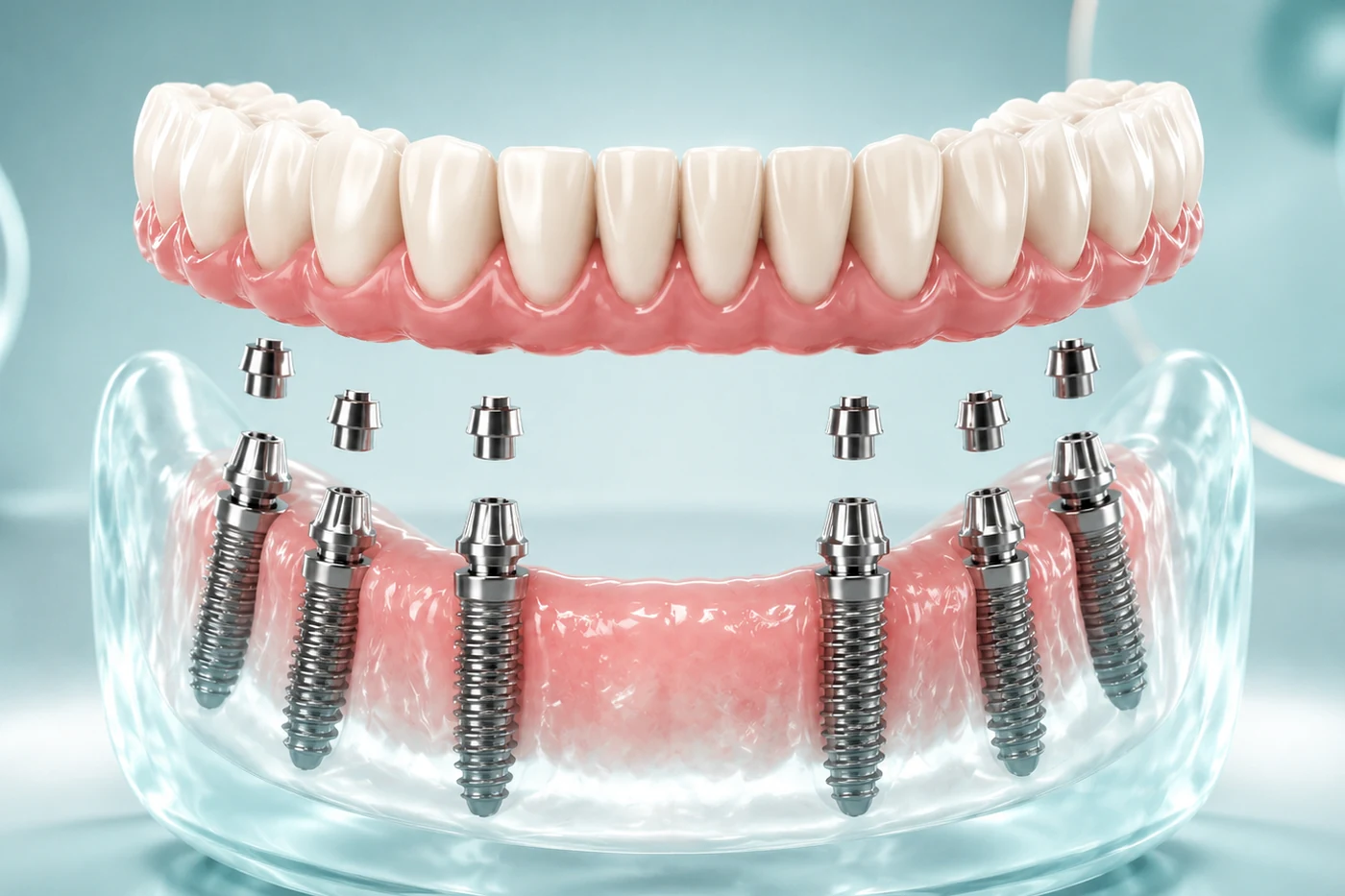
All-on-4 generally describes a fixed full-arch prosthesis supported by four implants. In many plans, the posterior implants are angled to use available bone and reduce the need for more extensive grafting.
The concept can be appropriate in selected jaws when the anatomy, implant positions and primary stability support the prosthetic plan.
What All-on-6 Means
All-on-6 uses six implants to support the full arch. Two additional implants create more support points and can change how biting forces are distributed, provided there is enough suitable bone for safe placement.
Two extra implants do not automatically guarantee a better result. If implant positions are poor or the prosthesis is badly designed, increasing the number alone does not solve the problem.
Which Is Better: All-on-4 Or All-on-6?
There is no universal answer. The latest pooled evidence shows high survival with both approaches and does not demonstrate a consistent survival advantage for six implants.
The clinically appropriate choice depends on bone distribution, jaw anatomy, bite forces, implant position, prosthesis material, hygiene access and how the plan would cope if one implant later failed.
What The 2026 Meta-Analysis Found
The 2026 review pooled data from 55 studies. At 1 year, implant survival was 99.20% with four implants and 100% with six. At 1 to 5 years, the pooled figures were 99.66% and 98.55%. At 5 years or longer, they were 98.14% and 97.50%.
These are pooled study results, not guarantees for an individual patient. The included studies differed in jaw, implant systems, prosthetic materials, follow-up and patient selection.
How Bone Changes The Choice
The location and quality of bone matter as much as the total amount. Nerves, sinuses, jaw shape and previous bone loss affect where implants can be placed.
Three-dimensional imaging is commonly used to plan implant positions. A clinic should not choose four or six implants only from a price list or photographs.
Does All-on-6 Spread The Load Better?
Six implants can provide more support points and may allow a different distribution of biting forces. That can be useful in selected cases, but the benefit depends on implant position, prosthesis stiffness, bite and bone quality.
More support points are not useful if they cannot be placed safely or if the additional implants force a compromised position.
What About Immediate Loading?
Some full-arch plans use a fixed temporary prosthesis soon after implant placement. Immediate loading depends on adequate primary implant stability, the surgical plan and the prosthetic protocol.
If stability is insufficient, the dentist may recommend a different healing and loading sequence. The name of the full-arch concept does not guarantee same-day fixed teeth.
How Long Does All-on-4 Last?
There is no fixed expiry date. Long-term reviews show high implant and prosthesis survival for full-arch treatment, but technical and biological complications still occur and maintenance is expected.
Longevity depends on implant health, prosthesis design and material, hygiene, smoking, grinding or clenching, bite forces and regular professional review.
Common All-on-4 Problems
- Inflammation around implants and bone loss.
- Failure of one or more implants.
- Loose or fractured screws.
- Chipping, wear or fracture of prosthetic teeth or framework.
- Food trapping and difficulty cleaning under the bridge.
- Bite problems or uneven loading.
- Need for repair, relining or replacement of prosthetic components over time.
Do Six Implants Prevent These Problems?
No. All-on-6 can still develop biological and technical complications. A 2026 umbrella review of complete-arch implant prostheses found that complication patterns were influenced by prosthetic design and material, while implant number alone did not determine survival.
Maintenance remains necessary whether the arch is supported by four implants or six.
What Happens If One Implant Fails?
The consequence depends on which implant fails, how the remaining implants are positioned, bone condition and the design of the prosthesis. A six-implant plan may leave more support points, but that does not guarantee that the bridge can simply continue unchanged.
The restorative dentist should explain the contingency plan before treatment begins.
Questions To Ask Before Choosing Four Or Six Implants
- Why are you recommending four or six implants for my jaw?
- What does my three-dimensional scan show about bone and anatomy?
- Will any implants be angled, and why?
- Is immediate loading planned, and what stability is required?
- What material will be used for the temporary and final prostheses?
- How will I clean underneath the full-arch bridge?
- What happens if one implant fails?
- What maintenance and professional reviews are required after I return home?
- What findings could change the plan from four implants to six, or from six to four?
How Turkelite Medcare Coordinates Full-Arch Treatment
Turkelite Medcare is a patient coordination service, not the treating implant clinic. We do not decide whether four or six implants are appropriate or whether immediate loading is safe.
Our role is to organise provider communication, scans and records, appointments, travel and follow-up around the treatment plan confirmed by the implant team. See patient services.
Frequently Asked Questions
Is All-on-6 Better Than All-on-4?
Not automatically. Six implants provide more support points, but current evidence does not show a universal survival advantage. The right choice depends on anatomy and prosthetic planning.
How Long Does All-on-4 Last?
There is no fixed lifespan. Long-term success depends on implant health, prosthesis design and material, hygiene, bite and ongoing maintenance.
What Are Common All-on-4 Problems?
Problems can include implant failure, inflammation around implants, screw issues, fracture or wear of the prosthesis, food trapping and cleaning difficulty.
Do Six Implants Eliminate Complications?
No. A six-implant full-arch restoration still needs maintenance and can develop biological or technical complications.
The Implant Number Should Follow The Scan And Prosthetic Plan
Four versus six is not a quality ranking. The better plan is the one that places implants safely, supports the prosthesis appropriately and leaves a realistic maintenance strategy for the years after treatment.
Sources and further reading
- Guy’s and St Thomas’ NHS: Dental implants
- NHS: Dental treatments
- Republic of Türkiye Ministry of Health: International health tourism regulation
These sources support general patient information. Individual medical recommendations must come from the treating clinician.
View the related treatment area
This content is for general information and does not replace individual medical advice, diagnosis or treatment. Discuss treatment suitability, risks and recovery with a qualified healthcare professional.