Quick answer
Back Surgery in Turkey: Decompression, Stenosis and Fusion: the right answer depends on diagnosis, the actual treatment plan and individual risk factors. Use this article to prepare for consultation, then have the treating clinic confirm timing, medicines, suitability and travel planning for your case.
- Do not confirm treatment before adequate clinical assessment.
- Get scope, risks, aftercare and return-travel criteria in writing.
- For care in Turkey, verify the authorised facility and responsible clinician.
Back surgery in Turkey is not one procedure. The correct operation depends on the diagnosis: spinal stenosis may need decompression, a disc herniation may need selected disc surgery, and instability or deformity may sometimes require fusion. The American Association of Neurological Surgeons notes that surgery for lumbar spinal stenosis is generally considered when symptoms significantly limit activity, neurological deficits progress, walking becomes difficult or non-surgical treatment is ineffective. Start with our Orthopedics page and make sure the diagnosis and surgical target are clear before travel is booked.
Back Pain Alone Does Not Define The Operation
Back pain can come from discs, joints, nerves, muscles, fractures, deformity, infection or other causes. A scan finding also does not automatically prove that the visible abnormality is the source of symptoms.
The surgeon should connect symptoms, neurological examination and imaging before recommending an operation.
What Is Spinal Stenosis?
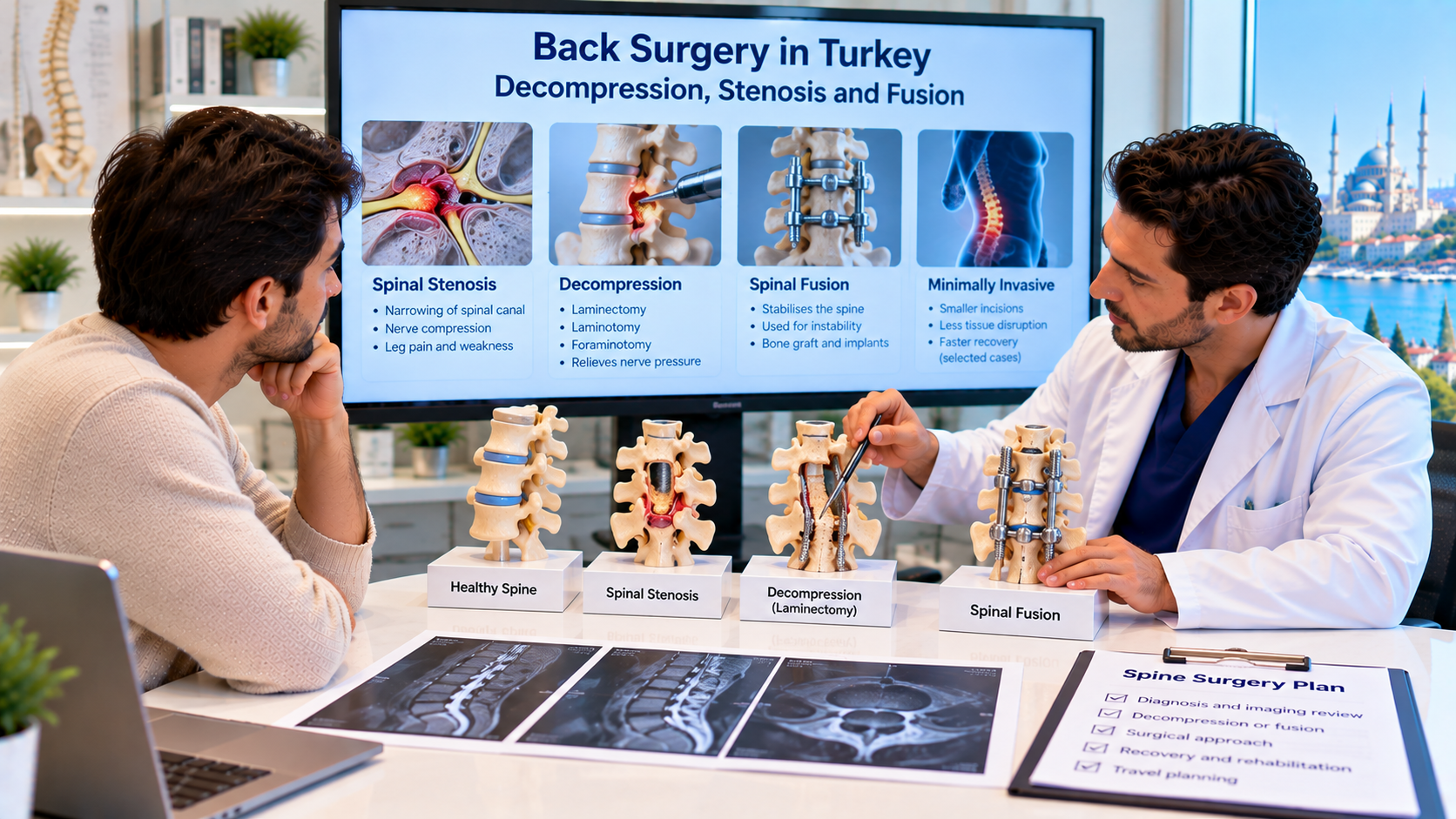
Spinal stenosis is narrowing around the spinal canal or nerve pathways. In the lower back it can cause leg pain, numbness, weakness or cramping with standing and walking, sometimes improving with sitting or bending forward.
Degenerative changes, thickened ligaments, disc changes and bone overgrowth can all contribute to the narrowing.
When Is Surgery Considered For Lumbar Spinal Stenosis?
Professional neurosurgical guidance describes surgery as a possible option when pain or neurological symptoms significantly impair daily activity, walking is difficult, weakness or other deficits progress, or medication and physical therapy have not provided enough relief.
Age, general health, bone quality, smoking, other medical conditions and the exact neurological findings also affect surgical risk and suitability.
What Is Spinal Decompression Surgery?
Spinal decompression surgery in Turkey aims to create more space for compressed nerves or the spinal cord by removing or reshaping structures that are causing pressure.
Common decompression procedures include laminectomy, laminotomy and foraminotomy. The exact technique depends on where the compression is located and how much bone or soft tissue has to be removed.
What Is A Laminectomy?
A laminectomy removes part or most of the bony lamina at the back of a vertebra to create more space for neural structures. It is a common decompression procedure for lumbar spinal stenosis.
It can be performed with or without additional procedures such as disc removal or spinal fusion, depending on the case.
When Is Spinal Fusion Added?
Fusion joins selected vertebral segments using bone graft and, commonly, instrumentation such as screws or rods. It is considered when instability, deformity or another structural problem makes decompression alone insufficient.
Fusion is not automatically required for every stenosis operation. The surgeon should explain what finding makes stabilization necessary in the individual case.
What About Minimally Invasive Spine Surgery?
Some decompression and fusion procedures can be performed through smaller incisions using tubular instruments, microscopes, endoscopes or navigation. Professional neurosurgical information notes potential benefits such as less tissue disruption and faster recovery in selected cases.
Not every condition can be treated through a minimally invasive approach, and a smaller incision does not remove the risks of nerve injury, bleeding, infection or the need for rehabilitation.
Which Tests Should Be Reviewed Before Travel?
Spine planning commonly uses a detailed history, neurological examination and imaging such as magnetic resonance imaging, computed tomography or X-rays depending on the suspected problem.
Ask whether the treating surgeon has personally reviewed the original images rather than only a written report, and what new imaging may be required after arrival.
When A Second Opinion Is Especially Useful
A second specialist opinion can be valuable when one surgeon recommends fusion and another recommends decompression alone, when the symptoms do not clearly match the scan, or when several spinal levels are being proposed for surgery.
The second opinion should address the diagnosis, surgical target, alternatives and what may happen without surgery rather than only comparing prices.
Red Flags Need Urgent Assessment
New loss of bladder or bowel control, rapidly worsening leg weakness, numbness around the saddle area, severe progressive neurological symptoms or signs of serious infection require urgent medical assessment.
Do not wait for an overseas elective-surgery consultation if emergency neurological symptoms develop.
How Travel Changes Spine-Surgery Planning
International spine surgery requires more than an operation date. The plan should cover hospital stay, pain control, mobility, wound review, thrombosis prevention when relevant, physiotherapy and the criteria for being fit to travel home.
Return-flight timing should be confirmed by the treating surgeon after the actual procedure and early recovery, not fixed only from a package itinerary.
Rehabilitation Should Be Planned Before Surgery
Recovery can depend on walking progression, restrictions on lifting or bending, wound care and physiotherapy. Fusion cases may have different restrictions from decompression-only cases.
Ask who will supervise rehabilitation after you return home and what operative notes, imaging and restrictions will be provided to the local team.
Questions To Ask A Spine Surgeon Before Booking
- What diagnosis explains my symptoms?
- Which level or levels are causing the problem?
- What non-surgical options have been tried or remain reasonable?
- Is the proposed operation decompression, disc surgery, fusion or a combination?
- If fusion is proposed, why is stabilization necessary?
- What neurological risks are specific to my case?
- How long is the expected hospital and local recovery period?
- What milestones must I reach before flying home?
- What rehabilitation will I need after returning?
- Who provides urgent review if weakness, wound problems or severe pain develops at home?
How Turkelite Medcare Coordinates Back-Surgery Travel
Turkelite Medcare is a patient coordination service, not the treating spine team. We do not diagnose spinal disease, choose the operation or decide whether decompression or fusion is appropriate.
Our role is to organise provider questions, imaging and records, appointments, travel and the return-home handover around the surgical plan confirmed by the treating surgeon. See patient services.
Frequently Asked Questions
What Is The Most Common Surgery For Lumbar Spinal Stenosis?
Decompressive laminectomy is a common operation for lumbar spinal stenosis. Some patients need decompression alone, while others need additional procedures depending on instability or other findings.
Does Spinal Stenosis Always Need Surgery?
No. Many patients are managed first with non-surgical treatment. Surgery is considered when symptoms, neurological findings and quality-of-life impact justify it.
Is Fusion Always Needed With Decompression?
No. Fusion is added when the surgeon believes instability, deformity or another structural issue requires stabilization.
Can I Fly Home Immediately After Back Surgery?
That should not be assumed. Travel timing depends on the operation, mobility, pain, wound condition, neurological status and the treating surgeon’s assessment of fitness to travel.
Choose The Operation By Diagnosis, Not By Destination
The useful question is not simply where to have back surgery, but what diagnosis is being treated, what structure is causing symptoms, why the proposed operation matches that problem and how rehabilitation and follow-up will continue after the journey home.
Sources and further reading
- AAOS OrthoInfo: Patient education
- Royal College of Surgeons: Patient information
- Republic of Türkiye Ministry of Health: International health tourism regulation
These sources support general patient information. Individual medical recommendations must come from the treating clinician.
View the related treatment area
This content is for general information and does not replace individual medical advice, diagnosis or treatment. Discuss treatment suitability, risks and recovery with a qualified healthcare professional.