Quick answer
Bone Graft for Dental Implants in Turkey: Timing & Sinus Lift: the right answer depends on diagnosis, the actual treatment plan and individual risk factors. Use this article to prepare for consultation, then have the treating clinic confirm timing, medicines, suitability and travel planning for your case.
- Do not confirm treatment before adequate clinical assessment.
- Get scope, risks, aftercare and return-travel criteria in writing.
- For care in Turkey, verify the authorised facility and responsible clinician.
Bone graft for dental implants in Turkey is considered when the jaw does not provide enough suitable bone to place an implant in the planned position. The graft is not the implant itself; it is a separate procedure intended to create, preserve or rebuild bone so an implant can later be placed or supported. The American Academy of Periodontology notes that ridge augmentation and sinus augmentation may require several months of bone development before implant placement, although implants can sometimes be placed at the same time when conditions allow. Start with our Bone Grafting & Sinus Lift page and ask whether your plan is simultaneous or staged before you book flights.
Why Bone Grafting May Be Needed Before Dental Implants
Dental implants need enough bone in the correct location to provide stability and support. Bone loss can follow tooth loss, periodontal disease, infection, trauma or long-term denture use, and the shape of the jaw can also limit implant placement.
The important question is not simply whether there is “enough bone,” but whether bone quantity, quality and position allow the planned implant to be placed safely and prosthetically correctly.
What A Dental Bone Graft Does
A dental bone graft places bone or a bone-substitute material into an area that needs additional volume. The graft acts as a scaffold while new bone develops and the site heals.
Depending on the defect, the clinician may also use a membrane or another technique to protect and shape the graft during healing.
What Materials Can Be Used?
Bone-graft material may come from the patient, from a donor source, from animal-derived material or from synthetic substitutes. The American Association of Oral and Maxillofacial Surgeons notes that the choice depends on the defect, the amount of bone needed and the surgeon’s plan.
Ask for the graft material and product to be written into your treatment record, especially if material origin matters to you for personal, religious or medical reasons.
What Is A Sinus Lift?
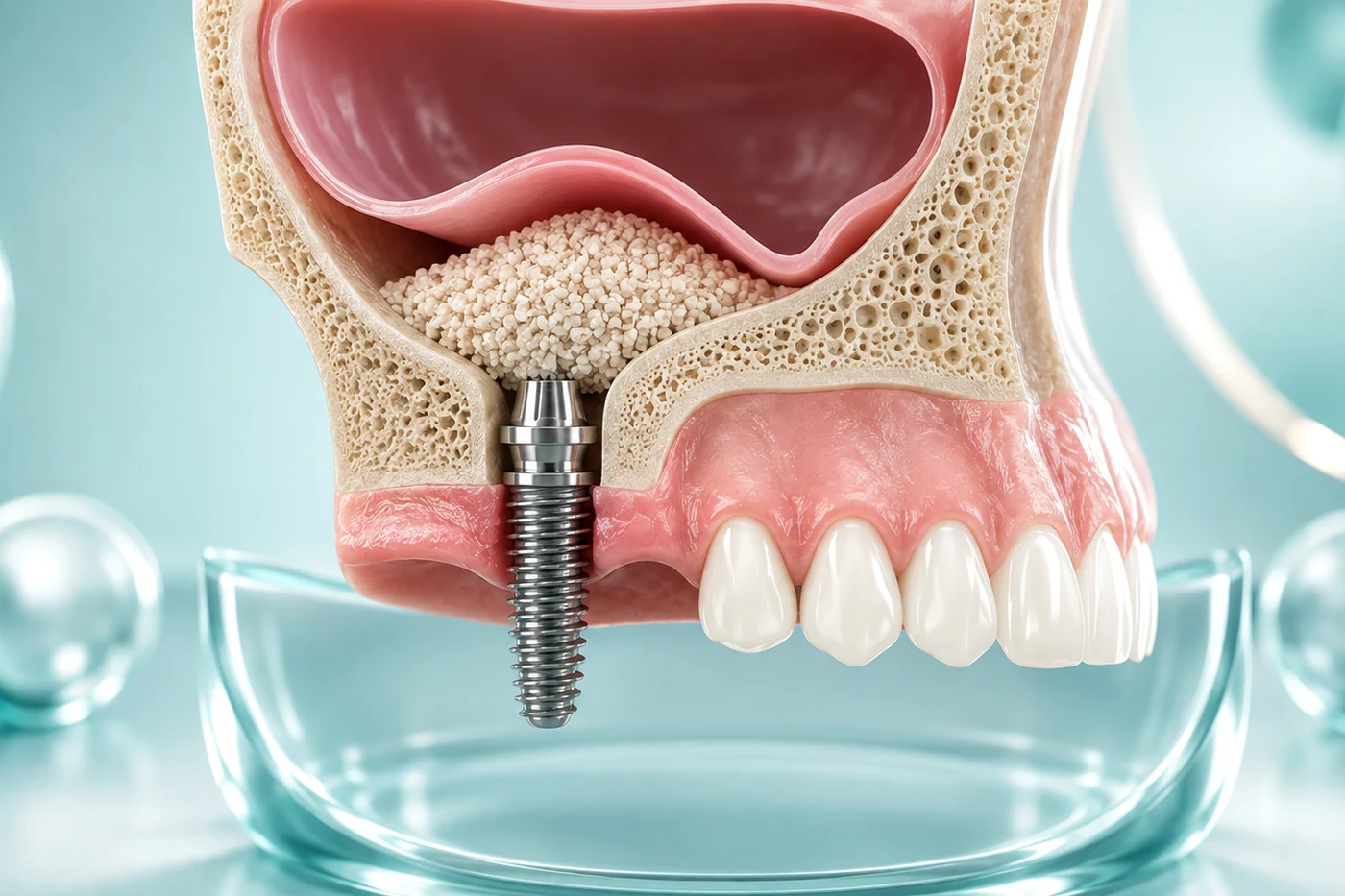
A sinus lift, also called sinus augmentation, is used in the back part of the upper jaw when the sinus is close to the ridge and there is not enough vertical bone for the planned implant. The sinus lining is elevated and graft material is placed beneath it to create additional bone height.
It is a specific type of bone-augmentation procedure and should not be used as a generic label for every upper-jaw graft.
Lateral Window And Crestal Sinus Lift Are Different
Two commonly described approaches are the lateral-window technique and a crestal or vertical approach. The lateral approach creates access through the side of the upper jaw, while a crestal approach reaches the sinus through the implant site or ridge.
The choice depends on residual bone height, anatomy, the amount of lift required, implant timing and the clinician’s judgement. One technique is not automatically better for every case.
Can The Bone Graft And Implant Be Done At The Same Time?
Sometimes. If there is enough existing bone to stabilise the implant, grafting and implant placement can be combined. If stability or bone volume is inadequate, the graft may need to heal first and the implant may be placed during a later stage.
This distinction directly affects how many treatment stages and international trips may be required.
How Long Does A Bone Graft Need To Heal?
There is no single healing period for every graft. The American Academy of Periodontology states that, depending on individual needs, ridge or sinus grafted bone may be allowed to develop for about 4 to 12 months before implant placement, while some cases permit simultaneous implant placement.
The exact interval depends on defect size, graft type, site, patient health, smoking, infection control and how much primary stability is available.
How Bone Grafting Changes The Number Of Trips
If grafting and implant placement can be combined, the surgical stages may fit into one treatment trip followed by a later restorative trip after implant integration. If the graft has to heal first, an additional surgical stage can be required before implant placement.
A patient who needs staged grafting should not assume the same two-trip timeline as someone who has adequate bone at the first visit.
What Is The Sinus Lift Success Rate?
There is no single universal “sinus lift success rate” because studies use different techniques, graft materials, implant systems, follow-up periods and definitions of success. A 2026 systematic review and meta-analysis included 22 studies and 6,860 implants placed in augmented maxillary sinuses. It reported a pooled implant failure rate of 3%, corresponding to a cumulative implant survival of 97%.
The same review rated the certainty of the evidence as low and found substantial variation between studies. The 97% figure describes implant survival after sinus augmentation in the pooled studies; it should not be presented as a guaranteed success rate for an individual sinus lift.
Does A Sinus Lift Guarantee Implant Success?
No. Sinus augmentation creates the conditions for implant placement, but later implant success still depends on healing, implant stability, infection control, smoking, systemic health, oral hygiene, prosthetic loading and maintenance.
The treating team should explain the separate risks of the graft, the sinus procedure, the implant and the final restoration.
What Can Delay The Plan?
- Active dental or sinus infection.
- Insufficient graft healing or bone formation.
- Sinus-membrane complications.
- Smoking or health factors that impair healing.
- Need for a larger graft than expected after imaging or surgery.
- Inadequate implant stability for simultaneous placement or loading.
- Wound-healing problems that require extra review.
What Imaging Is Usually Important?
Implant and sinus-graft planning commonly relies on three-dimensional imaging to assess bone height, width, sinus anatomy and neighbouring structures. The final surgical plan should be confirmed after clinical examination and appropriate imaging rather than from photographs alone.
Ask whether the imaging will be performed before travel, on arrival or both, and whether the result could change the number of stages.
Questions To Ask Before Booking A Dental Bone Graft In Turkey
- Why is grafting needed in my case?
- Is this ridge augmentation, socket grafting, sinus augmentation or another technique?
- What graft material will be used and why?
- Can the implant be placed at the same time as the graft?
- If not, how long is the planned graft-healing period?
- How many surgical stages and trips are currently expected?
- What imaging is needed before the final plan is confirmed?
- What findings could change the plan after examination?
- What warning signs require urgent review after I travel home?
- Who confirms that the graft is ready for implant placement?
How Turkelite Medcare Coordinates Grafting And Implant Stages
Turkelite Medcare is a patient coordination service, not the treating implant or grafting clinic. We do not decide whether a graft is necessary, choose the graft material or determine when an implant is ready to be placed.
Our role is to organise provider questions, imaging and record requirements, appointment sequencing, travel and return-home follow-up around the surgical plan confirmed by the treating team. See patient services.
Frequently Asked Questions
Do I Need A Bone Graft Before Dental Implants?
Only if the treating clinician finds that bone quantity, quality or position is insufficient for the planned implant. Some patients have enough bone and do not need grafting.
Can A Bone Graft And Dental Implant Be Done Together?
Sometimes. Simultaneous placement is possible in selected cases when enough native bone remains to stabilise the implant.
How Long After A Sinus Lift Can Implants Be Placed?
Timing is case-specific. Professional guidance describes graft-development periods of roughly 4 to 12 months in staged cases, while some patients can receive implants at the same time as the sinus procedure.
Is A 97% Sinus Lift Success Rate Guaranteed?
No. The 97% figure comes from pooled implant survival after sinus augmentation in a 2026 review. It is population-level evidence with low certainty and should not be treated as an individual guarantee.
Bone Grafting Changes The Timeline Before It Changes The Implant
The practical issue for an international patient is whether grafting can be combined with implant placement or has to heal first. That decision changes the number of stages, the gap between trips and when the final implant restoration can realistically be completed.
Sources and further reading
- Guy’s and St Thomas’ NHS: Dental implants
- NHS: Dental treatments
- Republic of Türkiye Ministry of Health: International health tourism regulation
These sources support general patient information. Individual medical recommendations must come from the treating clinician.
View the related treatment area
This content is for general information and does not replace individual medical advice, diagnosis or treatment. Discuss treatment suitability, risks and recovery with a qualified healthcare professional.