Quick answer
Cochlear Implant Surgery in Turkey: Candidacy to Follow-Up: the right answer depends on diagnosis, the actual treatment plan and individual risk factors. Use this article to prepare for consultation, then have the treating clinic confirm timing, medicines, suitability and travel planning for your case.
- Do not confirm treatment before adequate clinical assessment.
- Get scope, risks, aftercare and return-travel criteria in writing.
- For care in Turkey, verify the authorised facility and responsible clinician.
Cochlear implant surgery in Turkey is only one stage of a longer hearing-care pathway. A cochlear implant is an electronic hearing device for selected people with significant sensorineural hearing loss who receive limited benefit from appropriately fitted hearing aids. Professional audiology guidance emphasises that candidacy requires a full hearing assessment, speech testing, medical review, counselling and a plan for programming and rehabilitation after surgery. Start with our Cochlear Implant Surgery page and confirm the complete pathway, not only the operation date.
Who May Be Considered For A Cochlear Implant?
Candidacy is not based on a hearing test number alone. The implant team considers the type and degree of hearing loss, benefit from well-fitted hearing aids, speech understanding, hearing history, communication needs, medical findings and realistic expectations.
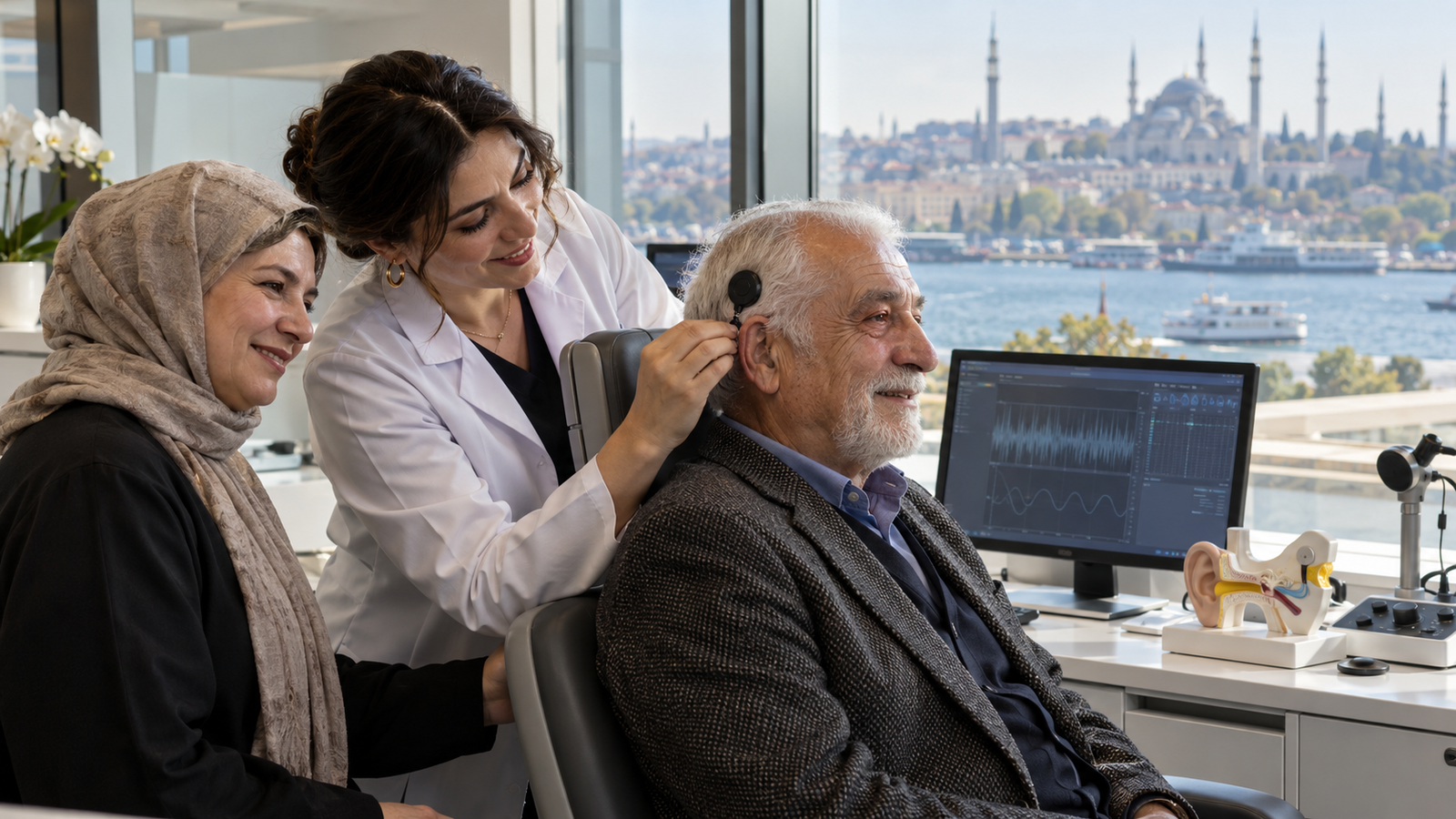
For adults, assessment commonly involves an audiologist together with an ear specialist. The goal is to determine whether a cochlear implant is likely to provide more useful hearing access than the person receives with appropriately fitted hearing aids.
Children Need A Team-Based Assessment Too
Children are assessed through a multidisciplinary pathway that considers hearing levels, hearing-aid benefit, speech and language development, communication goals, family participation and medical suitability.
Age alone does not decide the whole plan. The team should explain expected benefit, rehabilitation needs and how hearing and language progress will be monitored after activation.
What Tests Are Usually Needed Before Surgery?
The pre-implant assessment commonly includes detailed hearing tests and speech-recognition testing with and without appropriately fitted hearing aids. The medical team also reviews ear history, general health and factors that could affect surgery.
Imaging such as computed tomography or magnetic resonance imaging may be used to assess the inner ear, cochlear anatomy, auditory nerve and surrounding structures. Vestibular or balance testing may also be considered in selected patients.
How Does A Cochlear Implant Work?
A cochlear implant has an external sound processor and an internal implanted system. The external part captures sound and sends coded information to the internal device, which delivers electrical stimulation through an electrode array placed in the cochlea.
The system does not restore normal biological hearing. It provides a different form of auditory input that the brain has to learn to interpret, which is why programming and rehabilitation are essential parts of treatment.
What Happens During Cochlear Implant Surgery?
The operation is usually performed under general anaesthesia. The surgeon places the internal receiver beneath the skin and inserts the electrode array into the cochlea through the surgical approach selected for that patient.
The exact technique, incision and device position depend on anatomy, surgeon preference and the selected implant system. Surgical planning should be individual rather than based on a standard travel package.
What Happens Immediately After Surgery?
After surgery, the team monitors the wound, pain, balance and other early symptoms. Some programmes discharge suitable patients the same day, while others use overnight or longer observation depending on the clinical situation and local protocol.
The external processor is not always switched on immediately. Wound healing and the planned activation schedule should be explained before you leave the hospital.
Activation Usually Happens After The Operation, Not During It
The first activation is commonly scheduled after the surgical site has had time to heal. Major clinical guidance and patient information describe activation at roughly 1 to 4 weeks after surgery in many programmes, although timing can vary by centre, patient and device pathway.
Activation is the beginning of device use, not the end of treatment. The first settings are adjusted over repeated appointments as the person adapts to electrical hearing.
Programming And Rehabilitation Continue After Activation
The audiology team programs, or maps, the implant so electrical stimulation is comfortable and useful. Settings commonly need repeated adjustment as hearing responses change and the user gains experience with the device.
Auditory rehabilitation can include listening practice, communication support and speech or language therapy depending on age and individual needs. Long-term follow-up is part of cochlear-implant care.
What Are The Main Risks?
Potential complications include infection, bleeding, dizziness or balance problems, taste disturbance, tinnitus, facial-nerve injury, leakage of fluid around the brain and spinal cord, pain or numbness, loss of residual hearing, device problems and failure to achieve the expected hearing benefit.
Serious complications are uncommon, but they are important because an international patient needs a clear plan for urgent assessment after returning home.
Why Meningitis Vaccination Should Be Discussed Before Surgery
People with cochlear implants have an increased risk of certain forms of bacterial meningitis compared with the general population. Vaccination recommendations depend on age, vaccination history and national guidance.
Ask the implant team to review vaccination status before surgery and confirm what should be completed before travel or implantation. Vaccination reduces risk but does not remove every possibility of meningitis.
What Does International Travel Change?
Travelling for surgery means the plan must cover more than the operation. Activation, programming, wound review, rehabilitation, device support and replacement of external components may continue after you return home.
Before booking, identify which appointments must happen in Turkey, which can be transferred to a local audiology service and whether the local team can program and support the specific implant system selected abroad.
Device Support Matters Long After The Wound Heals
A cochlear implant is a long-term medical device. Users may need ongoing processor support, replacement parts, software or programming updates, troubleshooting and future assessment if the internal or external equipment develops a problem.
Ask who provides technical support in your home country, whether local programming is available and how warranty or replacement issues are handled across borders.
Records To Take Home
- Your hearing assessment and speech-testing results.
- The medical and surgical report.
- Imaging reports where available.
- Details of the implanted device and electrode system.
- The activation and programming schedule.
- Current device settings after activation.
- Vaccination information relevant to implantation.
- Contact details for the implant and audiology teams.
- The rehabilitation and long-term follow-up plan.
Questions To Ask Before Cochlear Implant Surgery In Turkey
- Why am I considered a candidate for a cochlear implant?
- What benefit am I currently receiving from properly fitted hearing aids?
- What hearing and speech tests are required before surgery?
- What imaging or medical assessments are still needed?
- Which implant system is planned and why?
- When is the first activation expected?
- How many programming appointments are planned after activation?
- What rehabilitation will I need after returning home?
- Who can program and support this implant system in my home country?
- What symptoms after surgery require urgent medical assessment?
How Turkelite Medcare Coordinates Cochlear-Implant Care
Turkelite Medcare is a patient coordination service, not the treating implant centre. We do not decide candidacy, choose the device, perform programming or determine the rehabilitation plan.
Our role is to organise provider questions, records, appointments, travel and the return-home handover around the hearing-care plan confirmed by the implant team. See patient services.
Frequently Asked Questions
Who Decides If I Am Suitable For A Cochlear Implant?
The implant team decides after audiology testing, assessment of hearing-aid benefit, medical review, counselling and any required imaging or other investigations.
Will I Hear Normally As Soon As The Implant Is Switched On?
No. Cochlear-implant sound is a new form of auditory input. Programming and rehabilitation are needed, and hearing performance develops over time rather than becoming normal immediately.
When Is A Cochlear Implant Usually Activated?
Many programmes activate the device roughly 1 to 4 weeks after surgery, but the exact timing depends on healing, the centre’s protocol and the individual treatment plan.
Can Children Have Cochlear Implants?
Yes, selected children can be candidates after a multidisciplinary assessment that considers hearing, hearing-aid benefit, development, communication goals, medical factors and family participation.
Is Surgery The End Of Cochlear-Implant Treatment?
No. Surgery is followed by activation, repeated programming, rehabilitation and long-term audiology and device follow-up.
Surgery Is The Start Of The Implant Pathway, Not The Finish
For an international patient, the strongest plan links candidacy, surgery, activation, programming, rehabilitation and long-term device support before travel. The operation matters, but the hearing outcome also depends on the care that continues after the surgical wound has healed.
Sources and further reading
- NHS: Hearing aids and implants
- CUH: Tonsillectomy
- Republic of Türkiye Ministry of Health: International health tourism regulation
These sources support general patient information. Individual medical recommendations must come from the treating clinician.
View the related treatment area
This content is for general information and does not replace individual medical advice, diagnosis or treatment. Discuss treatment suitability, risks and recovery with a qualified healthcare professional.