Quick answer
Dental Implants vs Bridge: Which Missing-Tooth Option Fits?: the right answer depends on diagnosis, the actual treatment plan and individual risk factors. Use this article to prepare for consultation, then have the treating clinic confirm timing, medicines, suitability and travel planning for your case.
- Do not confirm treatment before adequate clinical assessment.
- Get scope, risks, aftercare and return-travel criteria in writing.
- For care in Turkey, verify the authorised facility and responsible clinician.
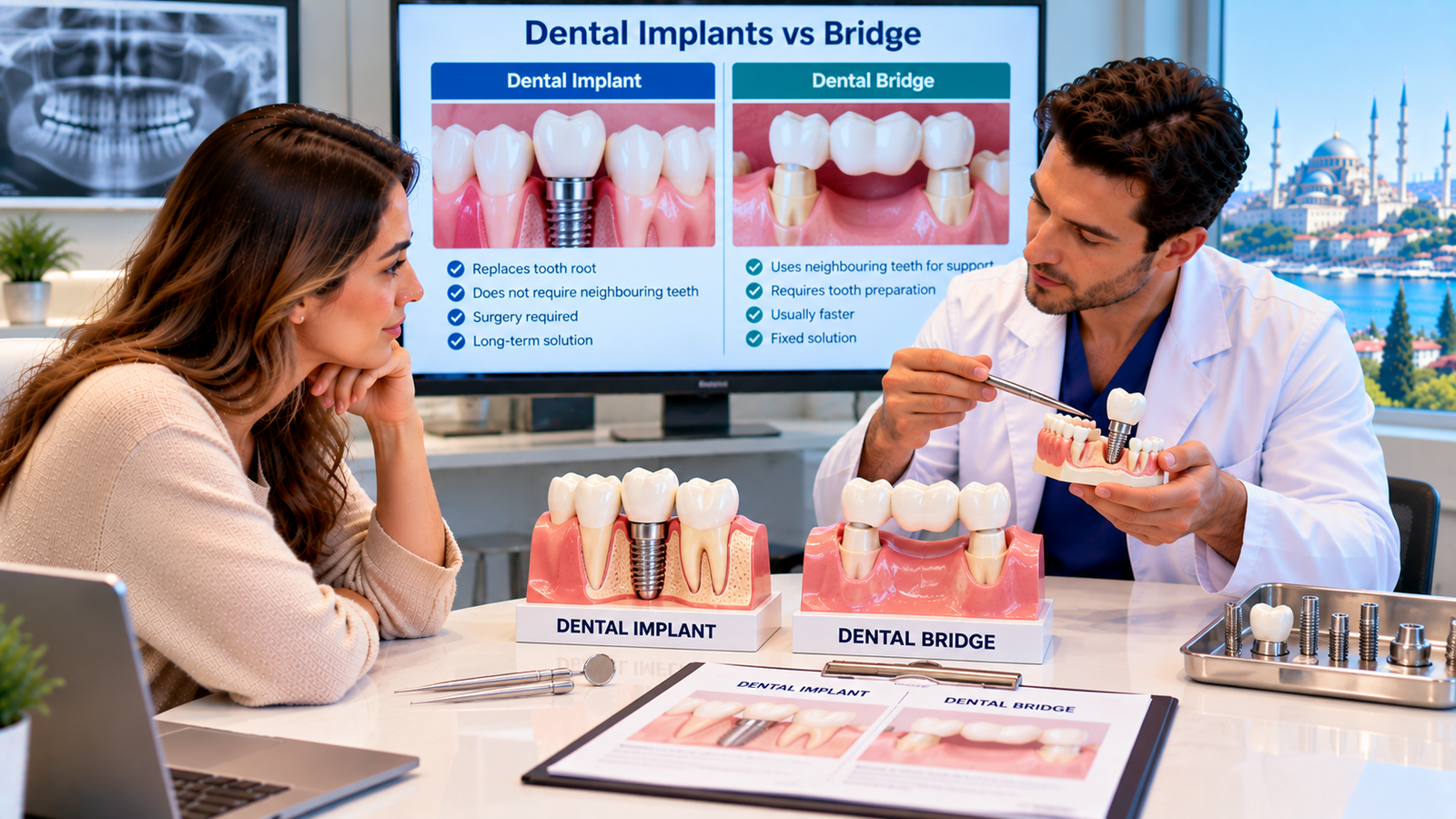
Dental implants vs bridge is not a simple question of which treatment is better. A dental implant replaces a missing tooth root with an implant fixture that supports a crown or larger restoration. A traditional dental bridge replaces the visible missing tooth by using neighbouring teeth as supports. Both can be appropriate, but they affect surgery, healthy tooth structure, treatment time, cleaning and future maintenance differently. Start with our Dental Bridges page and ask for a diagnosis-led comparison before choosing the replacement.
What A Dental Bridge Does
A conventional bridge uses teeth next to the gap as supports for a fixed replacement tooth. Those supporting teeth usually need preparation so the bridge can be fitted over them.
This can be a practical option when the neighbouring teeth already need substantial restorations, but the dentist should explain why preparing them is justified if they are otherwise healthy.
What A Dental Implant Does
A dental implant is placed in the jawbone and later supports a crown, bridge or larger prosthesis. It can replace a missing tooth without preparing the neighbouring teeth solely to support the restoration.
Implant treatment requires surgery and enough suitable bone, and some patients need grafting or a staged healing period before the final tooth is fitted.
Which Option Preserves More Natural Tooth Structure?
For a single missing tooth with healthy neighbours, an implant can avoid cutting those neighbouring teeth for bridge support. A conventional bridge, by contrast, normally depends on prepared abutment teeth.
That does not make an implant automatically preferable. Bone, gum health, medical history, surgical suitability, bite and the condition of the neighbouring teeth all change the decision.
Which Option Is Faster?
A tooth-supported bridge can often be completed without waiting for an implant to integrate with bone, so the restorative timeline may be shorter. The exact schedule still depends on diagnosis, tooth preparation, laboratory work and whether temporary teeth are required.
Implant treatment may involve extraction, healing, grafting, implant placement, integration and the final crown in separate stages. Some stages can be combined in selected cases, but that cannot be assumed before examination.
Cleaning Is Different
A bridge is joined across the missing-tooth space, so cleaning has to reach underneath the replacement tooth and around the supporting teeth. Special floss, interdental brushes or other cleaning aids may be recommended.
An implant crown is cleaned around the implant restoration and gum margin, but implants also require long-term plaque control and professional review because inflammation and bone loss can occur around implants.
What Happens If A Supporting Tooth Develops A Problem?
A conventional bridge depends on its supporting teeth. Decay, fracture, root-canal problems or periodontal disease in an abutment tooth can threaten the bridge and may require repair or replacement.
An implant avoids depending on adjacent teeth, but it has its own possible biological and technical complications, including inflammation around the implant, loss of supporting bone, screw or restoration problems and, in some cases, implant failure.
Dental Implants vs Dentures
A removable denture is another missing-tooth option. It can replace several teeth or a full arch without placing an implant at every missing tooth site, but it is removed for cleaning and may feel different from a fixed restoration.
Implants can also be used to support or retain removable dentures in selected cases. The useful comparison is therefore not only implant versus denture, but fixed versus removable design, support, maintenance and what the patient can realistically clean and manage.
What If Several Teeth Are Missing?
Several missing teeth do not always require one implant per tooth. Selected implants can sometimes support an implant bridge, while natural teeth can support a conventional bridge in other cases.
The number and position of supports should come from the bone, bite, span length, condition of remaining teeth and prosthetic design rather than from a package formula.
What Does The Evidence Say About Longevity?
Long-term systematic reviews show that both conventional tooth-supported bridges and implant-supported restorations can have high survival, but both also develop biological and technical complications over time. Older comparative reviews did not establish one universally superior replacement for every patient.
Survival figures from different studies should not be treated as a personal guarantee because bridge design, implant system, tooth condition, smoking, gum health, bite and maintenance vary between patients.
How Travel Can Change The Decision
A bridge may fit into a shorter restorative journey if the supporting teeth are ready and no additional treatment is needed. Implant treatment often has a longer biological timeline because healing or integration may separate surgical and restorative stages.
Before travelling, ask how many trips are planned, what temporary tooth will be used, what could add another stage and who will maintain the restoration after you return home.
Questions To Ask Before Choosing An Implant Or Bridge
- Why is this option being recommended for my specific gap?
- Are the neighbouring teeth healthy enough to avoid preparation?
- Is there enough bone for an implant without grafting?
- How many treatment stages and trips are expected?
- What temporary replacement will I have during treatment?
- How will I clean the final restoration?
- What happens if a supporting tooth or implant develops a problem?
- What maintenance and professional reviews will I need at home?
How Turkelite Medcare Coordinates Missing-Tooth Treatment
Turkelite Medcare is a patient coordination service, not the treating dental clinic. We do not decide whether an implant, bridge or denture is clinically appropriate.
Our role is to organise provider questions, records, appointment sequencing, travel and the return-home handover around the treatment plan confirmed by the treating dentist. See patient services.
Frequently Asked Questions
Is A Dental Implant Better Than A Bridge?
Not in every case. An implant can preserve neighbouring tooth structure, while a bridge can avoid implant surgery and may have a shorter treatment timeline. The better fit depends on the individual diagnosis.
Does A Bridge Damage The Teeth Next To The Gap?
A conventional bridge usually requires preparation of the supporting teeth. Whether that trade-off is reasonable depends on the condition of those teeth and the available alternatives.
Are Implants Better Than Dentures?
They solve different problems. Implants can support fixed or removable restorations, while dentures can replace several or all teeth without an implant at every missing site.
Do I Need One Implant For Every Missing Tooth?
No. Depending on the pattern of missing teeth and the prosthetic plan, several missing teeth can sometimes be replaced with an implant-supported bridge using fewer implants than teeth.
Choose The Support Strategy Before Choosing The Material
The key decision is how the missing tooth or teeth will be supported: neighbouring teeth, implants, a removable prosthesis or a combination. Once that is clear, the dentist can plan materials, timing, travel and long-term maintenance around the chosen support strategy.
Sources and further reading
- Guy’s and St Thomas’ NHS: Dental implants
- NHS: Dental treatments
- Republic of Türkiye Ministry of Health: International health tourism regulation
These sources support general patient information. Individual medical recommendations must come from the treating clinician.
View the related treatment area
This content is for general information and does not replace individual medical advice, diagnosis or treatment. Discuss treatment suitability, risks and recovery with a qualified healthcare professional.