Quick answer
Eyebrow Transplant Recovery: Healing and Regrowth Timeline: the right answer depends on diagnosis, the actual treatment plan and individual risk factors. Use this article to prepare for consultation, then have the treating clinic confirm timing, medicines, suitability and travel planning for your case.
- Do not confirm treatment before adequate clinical assessment.
- Get scope, risks, aftercare and return-travel criteria in writing.
- For care in Turkey, verify the authorised facility and responsible clinician.
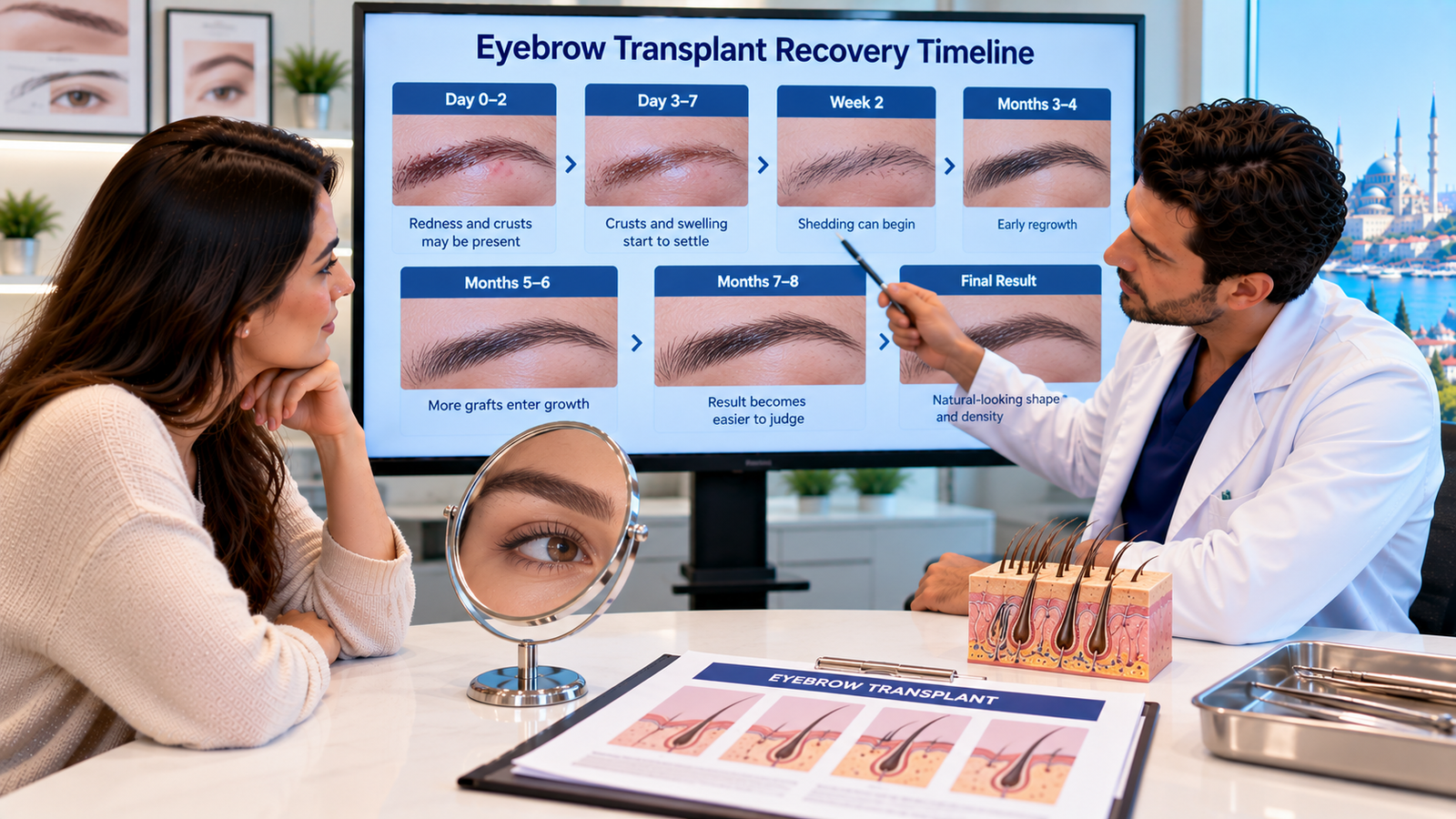
Eyebrow transplant recovery has two different timelines: the skin usually settles over days to weeks, while the transplanted hairs commonly shed and then regrow over several months. Published eyebrow-transplant reviews describe early crusting, temporary redness or swelling, shedding of transplanted hair shafts after the early healing phase and new growth beginning several months later. Start with our Eyebrow Transplant page and follow the operating clinician’s written care plan because washing and crust-removal instructions vary between published protocols.
Day 0 To Day 2: Protect The Grafts
The eyebrow area can look red, dotted or crusted immediately after transplantation. Mild swelling or bruising around the forehead and eyelids can occur.
The main goal is to avoid rubbing, scratching or pressure on the implanted hairs while the grafts begin to establish blood supply. Follow the clinic’s instructions for sprays, ointment, sleeping position and face washing.
Day 3 To Day 7: Crusts And Swelling Start To Settle
Published eyebrow-transplant protocols differ during this period. Some describe keeping grafts dry for several days, while others allow carefully directed washing earlier.
Because the angle of eyebrow hairs is important, do not copy another clinic’s washing routine. Use the timing and direction confirmed by the treating team.
Day 7 To Day 10: Early Review And Crust Management
Some published protocols review patients around 7 to 10 days after surgery. Crusts are usually becoming easier to remove or are starting to fall away.
Do not force crusts off before the clinic says it is safe. Friction during the early phase can disturb newly implanted hairs.
Around Week 2: Shedding Can Begin
Published reviews describe shedding of many transplanted eyebrow hair shafts around the early weeks after surgery. This can look alarming, but shedding of the visible shaft does not automatically mean the follicle has been lost.
The follicles can remain in the skin and enter a resting phase before producing new hair.
Months 3 To 4: Early Regrowth
Several published eyebrow-transplant techniques report that new growth begins around 3 to 4 months. Not every graft starts growing at the same time, so early density can look uneven.
New hairs may initially be fine or irregular in direction before later maturation and grooming.
Months 5 To 6: More Grafts Enter Growth
Published postoperative guidance reports that additional transplanted follicles commonly enter growth during months 5 to 6, increasing visible density.
This is still not necessarily the final result. Hair calibre, direction and the way the brow blends with native hairs continue to mature.
Months 7 To 8: The Result Becomes Easier To Judge
Some published eyebrow-transplant protocols describe more complete visible regrowth by around 6 to 8 months. A second procedure, if considered at all, is usually not planned until the first result has had enough time to mature.
The treating clinician should decide when the result is stable enough for a meaningful density or symmetry review.
Why Transplanted Eyebrow Hair May Need Trimming
Eyebrow transplants often use scalp donor follicles. Those follicles can keep growth characteristics from the donor area, which means the transplanted hairs may grow longer than native eyebrow hair.
Regular trimming and grooming can therefore be part of long-term maintenance. The clinic should explain expected growth direction and grooming before surgery.
Direction Matters As Much As Density
Eyebrow hairs grow at very flat angles and change direction across the brow. Poor angle or direction can make a transplant look unnatural even if many grafts survive.
A 2024 review of dissatisfied eyebrow-transplant patients found that sparse density, uneven density, disordered direction and mismatch in hair characteristics were among the reasons for poor cosmetic results.
The Cause Of Eyebrow Loss Still Matters
Eyebrow loss can result from trauma, burns, overplucking, stable scars or medical hair-loss conditions. The underlying cause should be assessed before surgery because active disease can affect long-term graft survival.
For inflammatory or scarring hair-loss disorders, the treating dermatologist or surgeon should confirm that transplantation is appropriate rather than assuming every empty eyebrow area is a cosmetic-only problem.
Warning Signs That Need Medical Review
Increasing pain, pus, fever, rapidly spreading redness, worsening swelling, persistent bleeding or a new eye problem should be assessed. Folliculitis can also occur after eyebrow transplantation.
Do not delay urgent local care because you are waiting for a response from an overseas clinic.
Questions To Ask Before Travelling Home
- When can I wash my face and the eyebrow grafts?
- When can crusts be gently removed?
- When can I use eyebrow makeup?
- When can I trim the transplanted hairs?
- What amount of redness or swelling is still expected?
- When should shedding begin and when should regrowth start?
- When should I send photographs for review?
- Which symptoms require urgent local assessment?
How Turkelite Medcare Coordinates Eyebrow-Transplant Follow-Up
Turkelite Medcare is a patient coordination service, not the treating hair-transplant clinic. We do not decide when crusts can be rubbed away, diagnose infection or judge whether graft direction is acceptable.
Our role is to organise provider communication, records, appointments, travel and the return-home handover around the written plan confirmed by the treating clinician. See patient services.
Frequently Asked Questions
How Long Does Eyebrow Transplant Recovery Take?
The visible skin healing is mainly measured in days to weeks, while shedding and regrowth continue for months. Published techniques commonly describe meaningful new growth from around 3 to 4 months and more complete regrowth by roughly 6 to 8 months.
Do Eyebrow Transplant Hairs Fall Out?
Yes. Many transplanted hair shafts can shed after the early healing phase while the follicles remain in place and later regrow.
When Can I Wash My Eyebrows?
Published protocols vary, so use the treating clinic’s written instructions. The important point is to avoid early rubbing or friction that could disturb the grafts.
Will Transplanted Eyebrow Hair Need Trimming?
Often yes when scalp hair is used as the donor source, because the transplanted follicles can keep longer scalp-hair growth characteristics.
Judge Healing Early And Cosmetic Results Later
The first days are about protecting grafts and controlling swelling or crusting. The cosmetic result takes months, and direction, density and grooming matter as much as simply seeing hairs grow.
Sources and further reading
- NHS: Hair transplant
- NHS: Choosing who will do your cosmetic procedure
- Republic of Türkiye Ministry of Health: International health tourism regulation
These sources support general patient information. Individual medical recommendations must come from the treating clinician.
View the related treatment area
This content is for general information and does not replace individual medical advice, diagnosis or treatment. Discuss treatment suitability, risks and recovery with a qualified healthcare professional.