Quick answer
Flying After a Facelift: How Soon Can You Fly?: the right answer depends on diagnosis, the actual treatment plan and individual risk factors. Use this article to prepare for consultation, then have the treating clinic confirm timing, medicines, suitability and travel planning for your case.
- Do not confirm treatment before adequate clinical assessment.
- Get scope, risks, aftercare and return-travel criteria in writing.
- For care in Turkey, verify the authorised facility and responsible clinician.
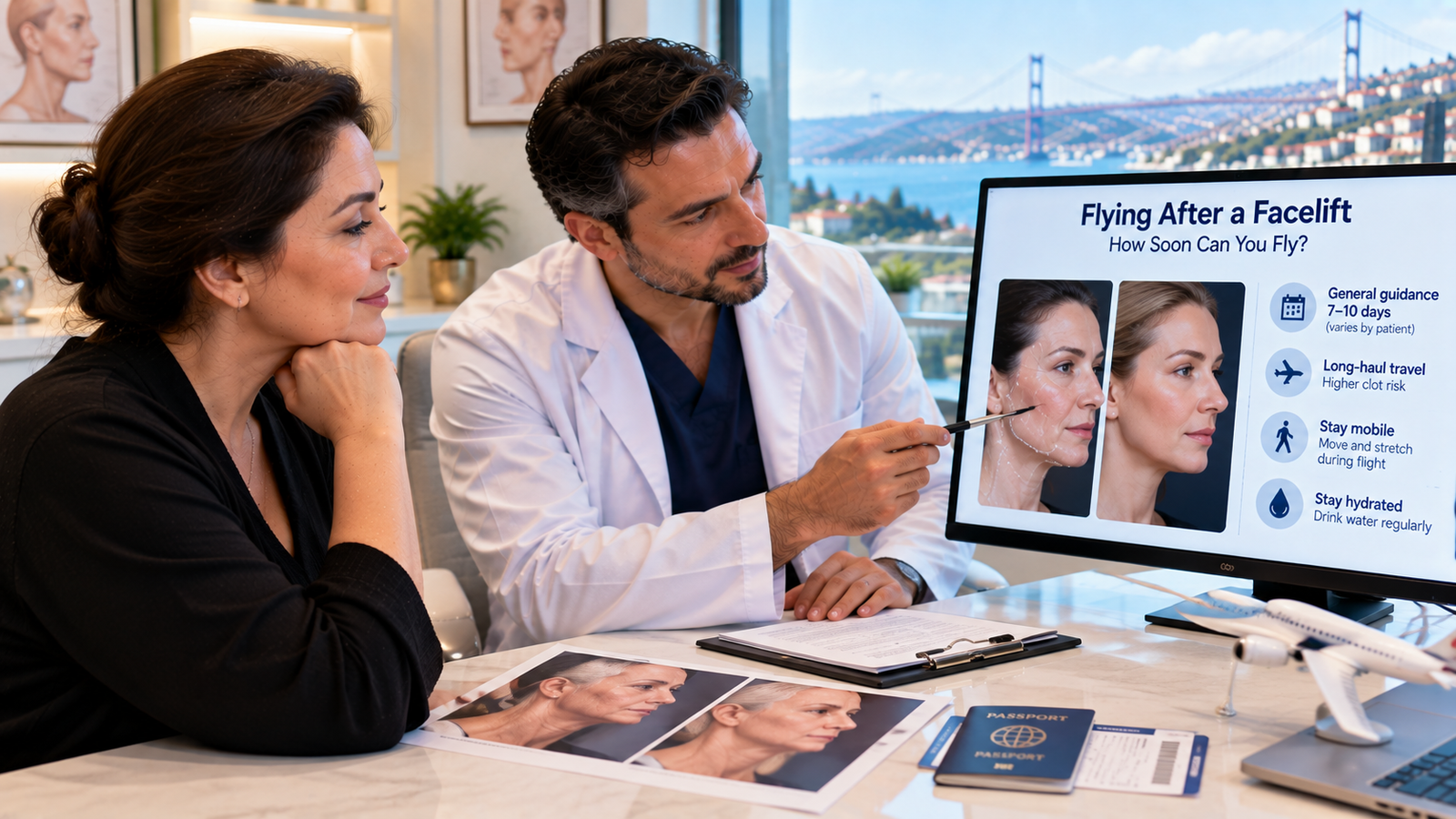
Flying after a facelift should be planned around early wound checks, swelling, mobility and blood-clot risk rather than around a fixed package date. The American Society of Plastic Surgeons has advised waiting about 7 to 10 days after facial cosmetic procedures such as facelifts before flying, while also stressing that surgery and long-distance travel together increase the risk of complications. A more recent American Society of Plastic Surgeons discussion of deep-plane facelift recovery reported that patients in one surgeon’s practice are often back on an aeroplane within about 10 days, but that is not a universal clearance rule. Start with our Facelift / Neck Lift page and let the treating surgeon confirm your individual fit-to-fly date.
Why Flying Too Soon After A Facelift Can Be A Problem
A facelift creates surgical wounds and tissue swelling. Early travel can make it harder to attend the first postoperative review, manage dressings or drains and obtain rapid assessment if bleeding, infection or another complication develops.
Long periods of immobility during air travel also add to the risk of venous blood clots after surgery. The combination of recent surgery and a long journey deserves more caution than either factor alone.
What Does The 7 To 10 Day Guidance Mean?
Professional plastic-surgery guidance has used about 7 to 10 days as a general waiting period after facial cosmetic procedures before flying. This is a broad safety guide, not a promise that every facelift patient will be ready on day 7 or day 10.
Your surgeon may advise a longer stay if swelling is significant, a drain is still present, wound healing is uncertain, another procedure was combined with the facelift or your clot risk is higher.
How Soon Can You Fly After A Facelift?
In an uncomplicated case, some patients may be considered fit to fly around the end of the first postoperative week or during the second week. The decision should follow an in-person review when possible and the surgeon should confirm that the wound, swelling, mobility and general condition are acceptable for travel.
Do not book a return flight on the assumption that a specific day is guaranteed before surgery has happened.
Flying After A Deep-Plane Facelift
A deep-plane facelift changes the surgical dissection plane, but it does not remove the need for postoperative review or travel-risk assessment. In an American Society of Plastic Surgeons interview, one experienced surgeon said recovery is broadly similar across facelift techniques and that out-of-town patients are typically back on an aeroplane within about 10 days in his practice.
That statement describes one surgeon’s experience. It should not be converted into a rule that every deep-plane facelift patient is safe to fly at exactly 10 days.
What Recovery Usually Looks Like Around The First Two Weeks
American Society of Plastic Surgeons recovery guidance describes swelling and bruising as common during days 7 to 14, with numbness, tingling or tightness also possible. Many patients feel substantially better by the end of the second week, but visible swelling can still remain.
Feeling better is not the same as being medically cleared for a long flight. The treating surgeon should assess both recovery and travel risk.
Why The First Postoperative Review Matters Before Travel
Early follow-up allows the surgeon to inspect the incisions, swelling, bruising and any drains, and to check whether healing is following the expected pattern. It also gives the team a chance to identify problems before you are several hours away by air.
Ask before surgery which review must occur before the clinic will consider return travel.
Long-Haul Flights Need Extra Planning
Longer flights mean more time sitting still. After surgery, prolonged immobility can increase concern about deep-vein thrombosis and pulmonary embolism, especially when other risk factors are present.
Your surgeon may give individual instructions on walking, hydration, compression stockings or medication. Do not start blood-thinning medication for a flight unless the treating clinician has specifically prescribed it.
What To Do During The Flight If You Are Cleared To Travel
- Follow the surgeon’s medication and wound-care instructions.
- Keep postoperative documents and the clinic contact details with you.
- Move your legs regularly and walk when it is safe and permitted.
- Drink fluids according to your medical instructions.
- Avoid lifting heavy cabin luggage if lifting is still restricted.
- Protect healing facial skin from pressure, rubbing and unnecessary sun exposure.
What Can Delay Flying?
- Increasing swelling rather than improving swelling.
- Bleeding, wound separation or concern about infection.
- A drain that still needs clinical management.
- Significant pain or reduced mobility.
- Combined surgery that creates a longer recovery.
- Higher personal risk of venous blood clots.
- The surgeon wanting another in-person review before travel.
Warning Signs That Need Urgent Assessment
Rapidly increasing facial or neck swelling, heavy bleeding, fever with worsening wound redness, chest pain, sudden shortness of breath, fainting or painful swelling in one leg need urgent medical assessment.
Do not board a flight to “get home first” if a serious complication is suspected.
How Long Should You Stay In Turkey After A Facelift?
The stay should be long enough for the planned early postoperative review and for the treating surgeon to decide that return travel is appropriate. For many uncomplicated facial-surgery pathways, the often-cited travel window is around 7 to 10 days, but the actual stay can be longer.
Ask the clinic to write the expected minimum stay and the conditions that could extend it before you buy a non-refundable ticket.
Questions To Ask Before Booking Your Return Flight
- What is the earliest day you would normally review me for fit-to-fly clearance?
- Which wound or swelling findings must be stable before I fly?
- Will I have drains, and must they be removed before travel?
- Does my medical history increase my blood-clot risk?
- Are there any restrictions on lifting cabin luggage?
- What should I do to reduce immobility during the flight?
- Which symptoms mean I must delay the flight and seek urgent care?
- Who do I contact after I return home?
How Turkelite Medcare Coordinates Return Travel
Turkelite Medcare is a patient coordination service, not the treating surgical clinic. We do not decide when you are medically fit to fly after a facelift.
Our role is to organise appointments, travel timing, records and the return-home handover around the surgeon-confirmed recovery plan. See patient services.
Frequently Asked Questions
How Soon Can You Fly After A Facelift?
General plastic-surgery guidance often uses about 7 to 10 days after facial cosmetic surgery, but your surgeon must confirm the actual date after reviewing your recovery.
Can I Fly 7 Days After A Facelift?
Possibly in an uncomplicated case, but day 7 is not an automatic clearance point. Swelling, wounds, drains, combined procedures and clot risk can make a longer stay necessary.
Can I Fly 10 Days After A Deep-Plane Facelift?
Some surgeons report that many uncomplicated patients can travel at about 10 days, but the technique name does not guarantee fitness to fly. Individual review still matters.
Does Flying Make Facelift Swelling Worse?
Swelling can still be present during the first two weeks, and travel can make recovery feel less comfortable. The more important safety issue is whether the surgeon considers the wound, swelling, mobility and clot risk acceptable for the planned journey.
The Flight Date Should Follow The Recovery Check
For international facelift surgery, build the return journey around the surgeon’s postoperative review rather than forcing recovery to match a pre-booked flight. The medical decision comes first; the travel plan follows it.
Sources and further reading
- NHS: Before you have a cosmetic procedure
- NHS: Choosing who will do your cosmetic procedure
- Republic of Türkiye Ministry of Health: International health tourism regulation
These sources support general patient information. Individual medical recommendations must come from the treating clinician.
View the related treatment area
This content is for general information and does not replace individual medical advice, diagnosis or treatment. Discuss treatment suitability, risks and recovery with a qualified healthcare professional.