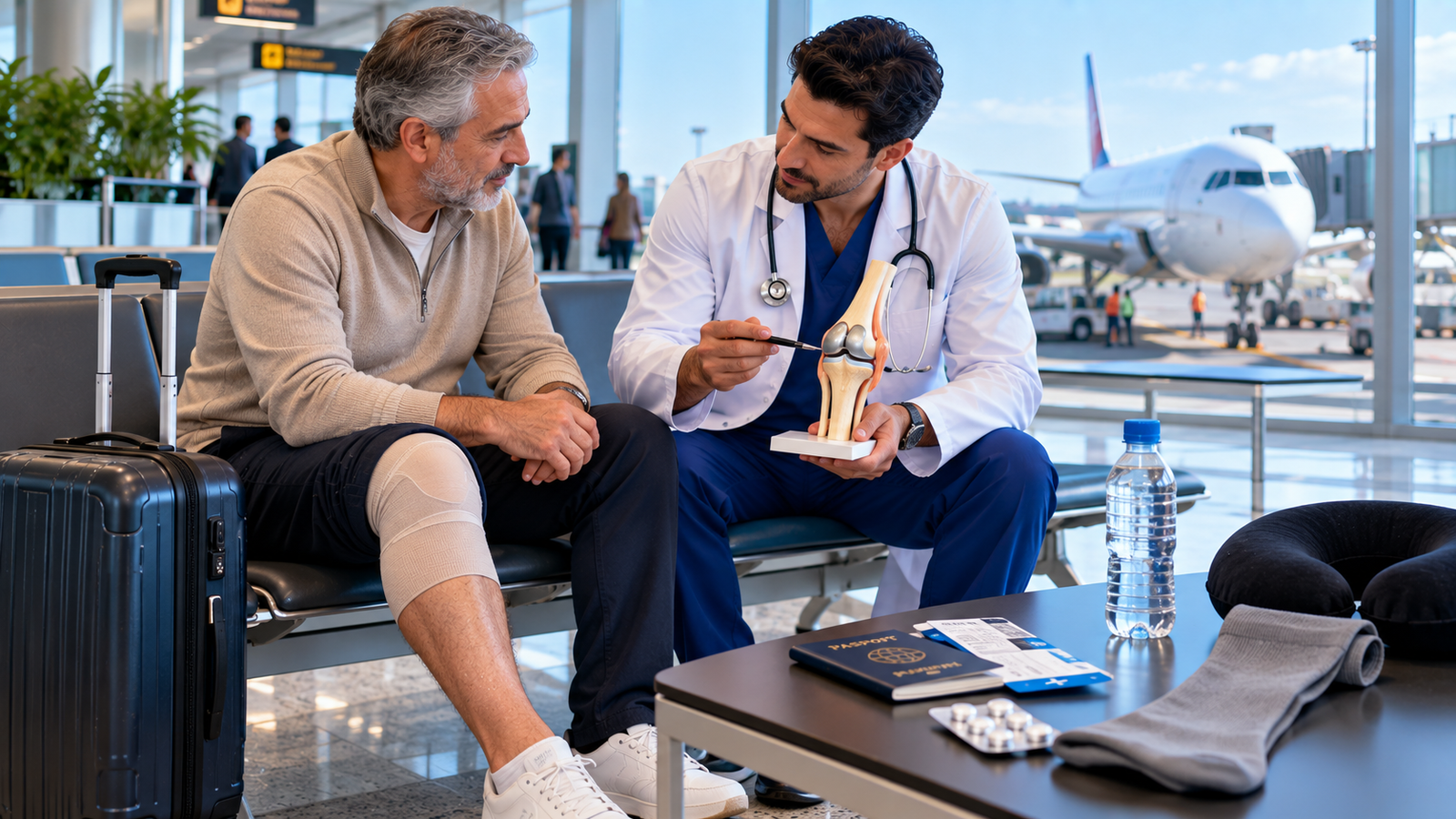
Flying after knee replacement needs an individual clot-risk and recovery plan because total knee replacement itself increases venous-thromboembolism risk and long periods of sitting can add another concern. There is no universal evidence-based day on which every patient is safe to fly. A 2025 review found limited data and no clear difference in clot risk between people who did and did not fly after hip or knee replacement in the available studies, many of which involved flights within seven days, but it also noted that long-haul flights over four hours carry higher venous-thromboembolism risk and that there is no consensus on the ideal prevention strategy. Start with our Total Knee Replacement page and have the treating surgeon confirm return-travel timing for your risk profile.
Why Flying After Knee Replacement Needs Extra Planning
Major lower-limb joint replacement temporarily increases the risk of deep-vein thrombosis and pulmonary embolism. Early recovery can also involve swelling, pain, reduced mobility, wound care and medication that make travel more difficult.
A flight therefore needs to be judged as part of the postoperative plan, not as a separate tourism decision.
There Is No Single Safe Number Of Days
Research and professional advice vary widely because clot risk depends on age, previous thrombosis, obesity, cancer history, varicose veins, mobility, medication, operation details and flight duration.
Your surgeon’s advice may differ from another patient’s even when both had the same operation.
What Does The 2025 Evidence Review Say?
A 2025 comprehensive review concluded that evidence is limited and that the available studies did not clearly show a higher clot rate in patients who flew after hip or knee replacement compared with those who did not, with much of the available flying occurring within seven days.
The review also stressed that long-haul travel longer than four hours is associated with higher clot risk and that patient-specific risk factors and prevention measures must be considered.
Why The Evidence Is Still Uncertain
Another retrospective study found a higher 90-day clot rate in patients who travelled by air around lower-limb arthroplasty, even though the average flight was short. Other pooled analyses have not shown a clear additional risk after surgery.
These conflicting findings are why a fixed internet rule such as “fly after exactly seven days” is not reliable for every patient.
Flying Home From Turkey After Knee Replacement
The decision should combine wound status, pain control, ability to walk safely, need for walking aids, knee swelling, medication, clot-prevention plan and the duration of the journey from hospital to final destination.
The flight itself is only one part of the trip. Airport queues, transfers, long sitting, stairs and carrying luggage can all add physical strain.
Long Flights Need More Attention
Flights longer than four hours are commonly treated as higher-risk travel for venous thrombosis. After knee replacement, that concern sits on top of the surgical clot risk.
Ask the surgeon whether your medication plan, compression strategy and movement plan need to be adjusted specifically for the long flight.
Clot Prevention Must Be Personalised
After total knee replacement, patients are commonly prescribed a thrombosis-prevention strategy that can include anticoagulant medication, early mobilisation and mechanical measures. The exact medicine and duration depend on the surgeon and your risk profile.
Do not add aspirin or change anticoagulant doses just because you are flying unless the treating clinician instructs you to do so.
Movement During The Journey
If the surgeon allows it, regular ankle movement, getting up at appropriate intervals and avoiding prolonged immobility can support circulation. An aisle seat can make movement easier.
Walking advice must still respect your fall risk, pain level and mobility aid. Do not walk without the assistance you need.
Compression Stockings Are Not A Universal Rule
Compression stockings may be recommended for some patients, but they must fit correctly and be appropriate for your vascular status and surgical plan.
Ask the treating team whether you should wear them, which type to use and how long to keep them on during travel.
Airline And Insurance Rules Can Be Different From Medical Advice
An airline may ask for medical clearance, assistance booking or documentation when a passenger has had recent major surgery. Travel insurance may also have its own conditions.
Medical clearance from the surgeon does not automatically mean the airline or insurer has no additional requirements, so check both before the travel date.
Airport Assistance Can Reduce Strain
Wheelchair or mobility assistance can reduce long walking distances through the airport. Pre-arrange it instead of waiting until you are already fatigued.
Keep walking aids, medicines and important records accessible and do not plan to carry heavy luggage yourself.
Warning Signs Before Or During Travel
Seek urgent medical help for new or rapidly increasing one-sided calf or thigh swelling, unexplained severe leg pain, sudden shortness of breath, chest pain, coughing blood, fainting or a sudden fast heartbeat.
Do not board a flight if the treating team wants to investigate a possible clot, wound infection, uncontrolled pain or another complication first.
Questions To Ask The Knee Surgeon Before Flying Home
- What date do you consider me medically fit for this specific flight?
- How does my clot risk change the timing?
- What anticoagulant or clot-prevention plan should I follow?
- Do I need compression stockings?
- How often should I move during the journey?
- Do I need an aisle seat or airport mobility assistance?
- What wound or swelling findings would delay travel?
- Do I need a fit-to-fly letter?
- What symptoms require emergency care after landing?
- Who coordinates physiotherapy and follow-up after I return home?
How Turkelite Medcare Coordinates Orthopaedic Return Travel
Turkelite Medcare is a patient coordination service, not the treating orthopaedic team. We do not decide when you are medically fit to fly or prescribe anticoagulants.
Our role is to organise provider questions, rehabilitation appointments, records, mobility assistance, travel and the return-home handover around the plan confirmed by the treating surgeon. See patient services.
Frequently Asked Questions
How Soon Can I Fly After Knee Replacement?
There is no universal safe day. The surgeon should decide based on clot risk, wound healing, mobility, medication and flight duration.
Is A Long Flight More Risky After Knee Replacement?
Long-haul travel over four hours is associated with higher venous-thromboembolism risk, so it deserves extra planning after major joint surgery.
Can I Fly Home From Turkey One Week After Knee Replacement?
Some published studies include patients who flew within seven days, but that does not make one week a universal clearance point. Individual assessment is still required.
Should I Take Extra Blood-Thinning Medicine For The Flight?
Only if your treating clinician specifically recommends it. Do not change anticoagulant or aspirin treatment on your own.
The Flight Date Should Follow Recovery Milestones
After knee replacement, the safest return plan is based on wound healing, mobility, clot prevention, pain control and the length of the journey. The surgeon should confirm those milestones before the flight is treated as fixed.
This content is for general information and does not replace individual medical advice, diagnosis or treatment. Discuss treatment suitability, risks and recovery with a qualified healthcare professional.