Quick answer
FUE vs DHI: What Actually Differs in Hair Transplant?: the right answer depends on diagnosis, the actual treatment plan and individual risk factors. Use this article to prepare for consultation, then have the treating clinic confirm timing, medicines, suitability and travel planning for your case.
- Do not confirm treatment before adequate clinical assessment.
- Get scope, risks, aftercare and return-travel criteria in writing.
- For care in Turkey, verify the authorised facility and responsible clinician.
The most important point in FUE vs DHI is that the names do not describe two completely separate biological procedures. Follicular-unit extraction mainly describes how individual follicular units are removed from the donor area. Direct hair implantation is commonly used to describe how harvested grafts are placed, often with a pen-shaped implanter. In many clinics, a so-called DHI procedure still uses follicular-unit extraction to obtain the grafts. That means the real comparison is usually extraction plus recipient-site and placement strategy, not one entirely different surgery versus another. Start with our DHI Hair Transplant page and ask the clinic to explain every step rather than relying on the label alone.
What FUE Actually Describes
Follicular-unit extraction describes removal of individual follicular units from the donor area using small punches. After extraction, grafts are protected, counted and then placed into recipient sites according to the surgical plan.
The name does not by itself tell you who creates the recipient sites, which instrument is used for placement, what density is planned or how long grafts remain outside the body.
Two clinics can both advertise follicular-unit extraction while using very different planning and implantation methods.
What DHI Usually Describes
Direct hair implantation is commonly used for an implantation approach in which a pen-like device holds a graft and inserts it into the recipient area. The extraction stage is still commonly based on individual follicular-unit extraction.
This is why saying “DHI instead of FUE” can be misleading. A more precise question is whether the clinic uses conventional site creation followed by placement, or an implanter-assisted placement method after the grafts have been extracted.
Ask what the clinic means by the term and which steps actually differ in your procedure.
FUE Versus DHI: Which Is Better?
There is no high-quality universal rule showing that one method is better for every patient. The result depends on donor quality, hair-loss pattern, hairline design, graft handling, target density, surgeon skill and who performs each step.
A small published study of an immediate-implantation modification showed that the approach was feasible and reduced time that grafts spent outside the body. An accompanying academic commentary noted that the claimed benefit had not been proven beyond doubt because stronger comparative studies were still needed.
That is a more accurate way to read the evidence than treating one marketing name as automatically superior.
Recipient-Site Creation Is A Major Difference
In a conventional pathway, the clinician may first create recipient sites at planned angles, directions and spacing, then place grafts with forceps or an implanter. In an implanter-assisted pathway, placement can be combined more closely with site creation depending on the device and technique.
Neither workflow removes the need for careful design. Hair direction, angle and spacing strongly affect how natural the result looks.
Ask who controls these variables and how the clinic adapts them for the frontal hairline, mid-scalp and crown.
Does DHI Give Higher Density?
No method can create unlimited density because the donor supply is finite and the recipient scalp has physical limits. Published hair-transplant guidance discusses typical planning densities and notes that dense packing is not suitable for every patient.
An implanter pen may be useful in selected areas, but the device does not override donor limitations or guarantee survival. A high headline graft count is not the same as natural visual density.
Ask for the planned recipient area in square centimetres, target density by zone and the safe donor reserve after the procedure.
Does DHI Reduce Time Outside The Body?
Some direct-implantation workflows are designed to shorten the interval between extraction and implantation. This has a biological rationale because graft dehydration, heat and poor handling can damage follicles.
However, total graft-out-of-body time depends on how the clinic sequences extraction and placement. A label alone does not tell you the actual timing.
Ask how grafts are stored, hydrated, counted and rotated through the procedure.
What About Recovery?
Both approaches create many small donor wounds and recipient sites, so early care is broadly similar: protect the grafts, follow washing instructions, avoid pressure, and use medication only as directed.
Claims that one method always has dramatically faster recovery should be treated cautiously. Punch size, number of grafts, recipient trauma, bleeding, skin type and aftercare all influence recovery.
The treating clinic should give a patient-specific schedule for washing, exercise, headwear, work and travel.
Sapphire FUE Versus DHI
Sapphire FUE is not a separate extraction biology. The term usually refers to using sapphire blades to create recipient sites during an extraction-based transplant. DHI usually refers to implanter-assisted placement.
They therefore describe different parts of the procedure and are not a perfect like-for-like comparison. A clinic may use follicular-unit extraction with sapphire recipient-site blades, or follicular-unit extraction with an implanter-assisted placement method.
A recent observational study reported higher graft survival with sapphire blades than steel blades in its patient groups, but this does not establish that sapphire is universally superior or that it is better than DHI for every patient. Study design, operator technique and patient selection still matter.
Hairline Design Matters More Than The Device Name
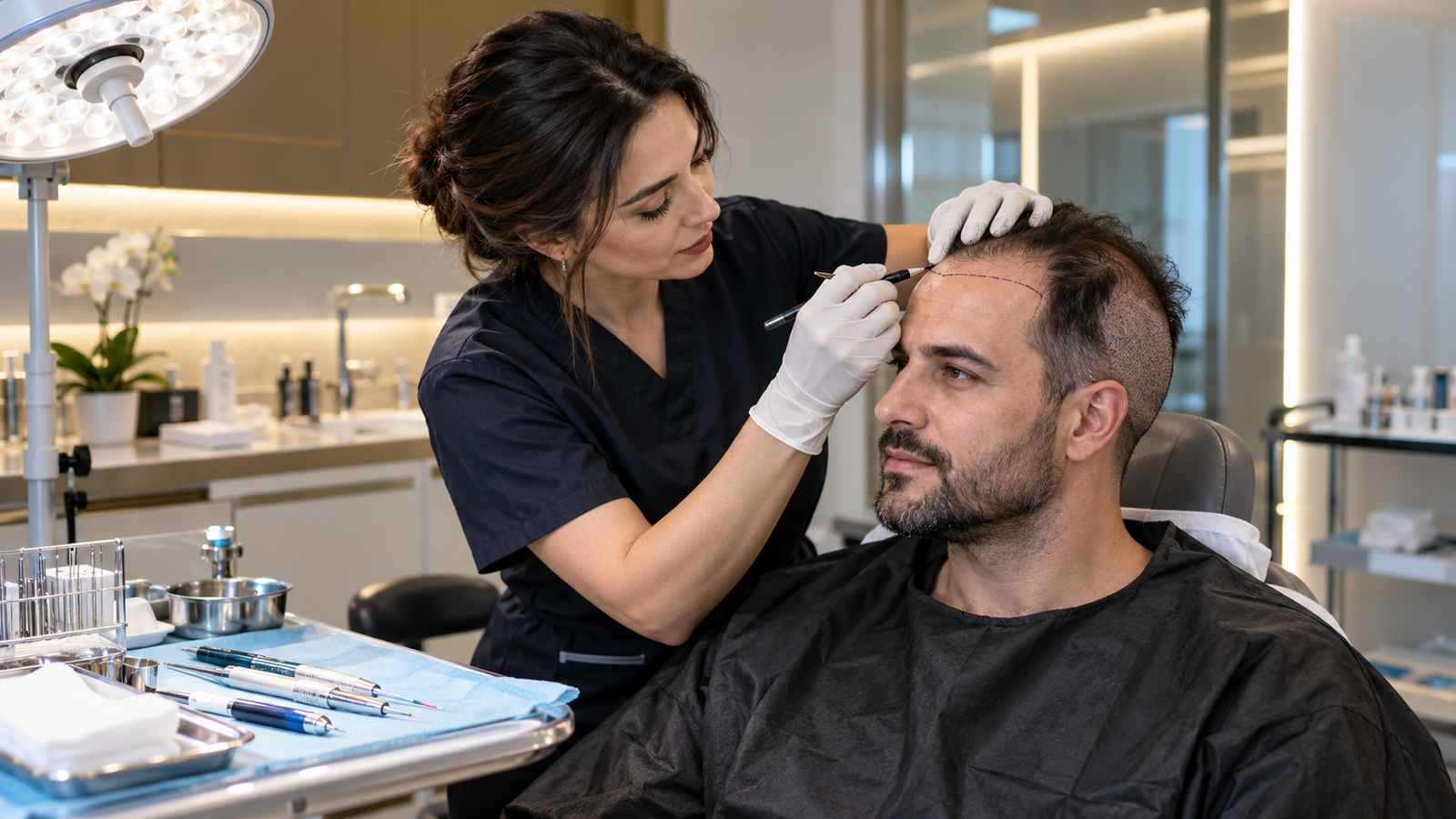
A natural hairline needs irregularity, correct direction, age-appropriate placement and careful use of single-hair grafts at the front. Neither extraction nor implantation branding automatically creates that design.
Ask who draws and approves the hairline and whether the same clinician controls recipient-site direction and density.
Before-and-after photographs should be judged by hair-loss pattern and follow-up time, not just by the technique written in the caption.
Donor Preservation Is The Same Problem In Both
Both pathways depend on the same limited donor area. Overharvesting can thin the back and sides regardless of how grafts are later implanted.
The clinic should assess donor density, hair calibre, miniaturisation and likely future loss before deciding the graft count.
If one technique is sold mainly because it allows a larger number of grafts, ask how the donor area will be protected.
Questions To Ask Before Choosing A Method
- What exactly do you mean by FUE and DHI in your clinic?
- Is graft extraction performed the same way in both options?
- Who performs donor harvesting?
- Who creates or controls recipient sites?
- Who places the grafts?
- How are grafts stored and protected between extraction and placement?
- What density is planned in each zone?
- How much donor reserve will remain afterward?
- Why does this implantation method suit my hair-loss pattern?
- What evidence supports the advantage you are claiming for me?
How Turkelite Medcare Coordinates Technique Questions
Turkelite Medcare is a patient coordination service, not the treating hair-transplant clinic. We do not select an extraction method, implantation device, graft count or hairline design.
Our role is to help organise provider questions, written treatment scope, appointments, travel, records and return-home follow-up after the independent treating provider confirms the clinical plan.
The patient services page explains that division of responsibility.
Frequently Asked Questions
Is DHI Better Than FUE?
Not universally. DHI usually describes implantation with a pen-like device, while FUE mainly describes extraction. The better plan depends on anatomy, donor capacity, hair-loss pattern, target area and the experience of the clinical team.
Does DHI Still Use FUE Extraction?
Often, yes. In many DHI pathways, individual follicular units are still extracted using an FUE-style method and then implanted with a pen-like device.
Does DHI Give More Graft Survival?
There is a plausible benefit to reducing graft handling and time outside the body, but current evidence does not support a universal guarantee that DHI produces higher survival for every patient.
Is Sapphire FUE Better Than DHI?
They are not directly equivalent categories. Sapphire usually refers to the blade material used for recipient-site creation, while DHI refers to an implantation method. The clinically relevant question is which complete workflow best fits your donor and recipient plan.
Which Method Is Better For The Hairline?
Natural hairline quality depends more on design, single-hair graft selection, angle, direction, spacing and operator skill than on the marketing name of the technique.
Compare The Workflow, Not Just The Acronym
The clearest way to compare FUE and DHI is to ask what actually happens to each graft from extraction to final placement. Once the workflow is visible, donor preservation, hairline design, operator responsibility and aftercare become more useful decision points than the technique label.
Sources and further reading
- NHS: Hair transplant
- NHS: Choosing who will do your cosmetic procedure
- Republic of Türkiye Ministry of Health: International health tourism regulation
These sources support general patient information. Individual medical recommendations must come from the treating clinician.
View the related treatment area
This content is for general information and does not replace individual medical advice, diagnosis or treatment. Discuss treatment suitability, risks and recovery with a qualified healthcare professional.