Quick answer
Gastric Sleeve Revision Surgery in Turkey: Options & Planning: the right answer depends on diagnosis, the actual treatment plan and individual risk factors. Use this article to prepare for consultation, then have the treating clinic confirm timing, medicines, suitability and travel planning for your case.
- Do not confirm treatment before adequate clinical assessment.
- Get scope, risks, aftercare and return-travel criteria in writing.
- For care in Turkey, verify the authorised facility and responsible clinician.
Gastric sleeve revision surgery in Turkey is not one standard operation. It is a second-line bariatric pathway used when a previous sleeve gastrectomy has produced a complication, inadequate response or later weight recurrence that needs further assessment. Current guidance from the American Society for Metabolic and Bariatric Surgery describes revision after sleeve gastrectomy as an individual decision that can involve another operation, an endoscopic treatment or obesity medication depending on the problem. Start with our Revisional Bariatric Surgery page and ask for the reason for revision before asking which operation is planned.
Revision Starts With The Problem, Not The Procedure Name
Common reasons for reassessment after sleeve gastrectomy include insufficient weight loss, weight recurrence, persistent or severe reflux, anatomical problems and other chronic complications. The correct revision depends on which problem is actually present.
A person seeking more weight loss may need a different strategy from a person whose main problem is reflux, narrowing, pain, vomiting or another structural complication.
Why Revisional Bariatric Surgery Is More Complex
Revisional surgery works through anatomy that has already been operated on. Scar tissue, altered blood supply, previous staple lines, adhesions and the exact shape of the remaining stomach can all change the technical plan.
Updated bariatric guidance notes that revisional metabolic and bariatric surgery may have higher perioperative complication rates because of this complexity. That does not mean revision is automatically inappropriate; it means patient selection, surgeon experience and hospital planning matter.
What Evaluation Is Usually Needed Before Revision?
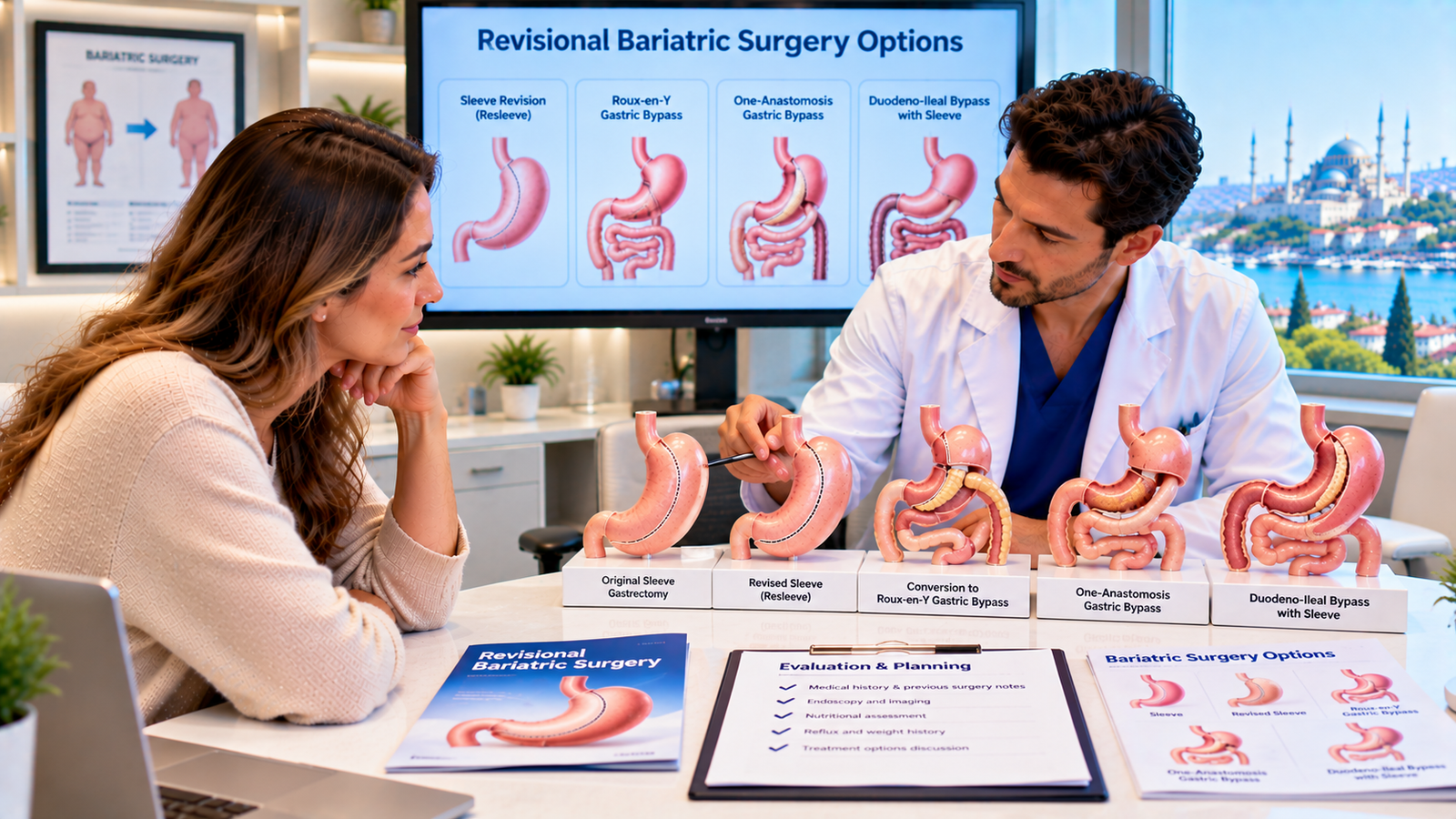
The treating team may need the original operation note, previous endoscopy or imaging, a current nutritional and medical assessment, weight history, reflux history and details of any previous complications.
Depending on the problem, the surgeon may request new endoscopy, contrast imaging, laboratory tests or other investigations before deciding whether another operation is justified.
Revision After Sleeve Gastrectomy: What Options May Be Discussed?
Current bariatric guidance lists several possible strategies after sleeve gastrectomy, including repeat sleeve surgery in selected cases, conversion to Roux-en-Y gastric bypass, conversion to one-anastomosis gastric bypass and conversion to single-anastomosis duodeno-ileal bypass with sleeve gastrectomy.
These options are not interchangeable. Reflux, weight-loss goals, anatomy, nutritional risk, previous complications and long-term follow-up capacity can change which options remain reasonable.
When Reflux Is The Main Problem
Conversion from sleeve gastrectomy to Roux-en-Y gastric bypass is commonly studied for severe or persistent reflux after sleeve surgery. A 2024 systematic review included 4 studies with 196 patients and reported reduced reflux symptoms and reduced use of acid-suppressing medication after conversion, with additional excess weight loss also reported.
That evidence does not prove that every person with reflux needs conversion. The cause and severity of symptoms still need clinical assessment, and other anatomical findings can change the plan.
When Weight Recurrence Is The Main Problem
Weight recurrence after sleeve gastrectomy does not automatically mean the sleeve has “failed.” The bariatric team should review eating patterns, medication, metabolic factors, anatomy, psychological factors and long-term follow-up before recommending another operation.
A 2026 statement from the American Society for Metabolic and Bariatric Surgery describes surgical revision, endoscopic treatment and newer obesity medications as possible parts of individualized care for non-response or weight recurrence after bariatric surgery.
What Does Comparative Research Say About Different Revisions?
A 2025 network meta-analysis compared several revisional operations after sleeve gastrectomy across 23 studies involving 3,266 participants. Weight-loss outcomes differed between procedures, while the authors did not identify one universal revision for every patient.
The practical message is that procedure selection should follow the clinical goal rather than a package name or a single headline statistic.
Nutritional Risk Can Increase After Revision
Some revisional procedures create more malabsorption than the original sleeve. A 2025 systematic review of revisions after sleeve gastrectomy highlighted risks involving protein status and micronutrients such as iron, vitamin B12, vitamin D and calcium.
Before travelling, ask what blood tests, supplements, dietetic follow-up and long-term monitoring will be required after the proposed revision.
What About Gastric Bypass Revision Surgery In Turkey?
Gastric bypass revision surgery in Turkey is a different clinical problem from revising a sleeve. After a previous Roux-en-Y gastric bypass, revision may be considered for weight recurrence, chronic complications or anatomical problems, and the options can include surgical, endoscopic or medical treatment.
Current bariatric guidance lists possibilities such as pouch-related revision, intestinal-length changes, conversion procedures and endoscopic approaches in selected patients. The original bypass anatomy must be understood before another intervention is chosen.
Revision May Be Surgical, Endoscopic Or Medical
Not every patient who has weight recurrence after bariatric surgery needs another operation. Current professional guidance supports a stepwise and multidisciplinary approach that can include nutrition treatment, obesity medication, endoscopic therapy or surgery depending on the cause and severity of the problem.
This is especially important because a second operation carries different technical and nutritional consequences from medication or an endoscopic procedure.
Questions To Ask Before Booking Revision Surgery
- What exact problem are you trying to correct?
- What evidence shows that my sleeve or previous bypass needs revision?
- What non-surgical options remain reasonable?
- Which revision are you proposing and why?
- How does my reflux history affect the choice?
- How much additional nutritional monitoring will the revision require?
- What previous records and tests do you need before I travel?
- What findings could change the planned operation after examination?
- What complications are more relevant because this is a repeat operation?
- Who will provide long-term bariatric and nutritional follow-up after I return home?
How Turkelite Medcare Coordinates Revisional Bariatric Care
Turkelite Medcare is a patient coordination service, not the treating bariatric team. We do not decide whether revision is necessary or choose between bypass, another sleeve procedure, an endoscopic treatment or medication.
Our role is to organise provider questions, previous records, appointment sequencing, travel and the return-home follow-up handover around the plan confirmed by the treating bariatric team. See patient services.
Frequently Asked Questions
Can A Gastric Sleeve Be Revised?
Yes, in selected patients. The type of revision depends on the reason for revision, anatomy, reflux, weight history, nutritional risk and other clinical factors.
Is Gastric Bypass Always The Best Revision After A Sleeve?
No. Roux-en-Y gastric bypass is an important option, particularly when reflux is a major problem, but other surgical, endoscopic or medical strategies may be more appropriate in other cases.
Is Revisional Bariatric Surgery Riskier Than A First Operation?
It can be more complex because of altered anatomy and scar tissue, and professional guidance notes that perioperative complication rates may be higher. The individual risk depends on the procedure, patient and treating centre.
Can Medication Be Used Instead Of Revision Surgery?
Sometimes. Current bariatric guidance includes obesity medication among the treatment options for inadequate response or weight recurrence after bariatric surgery.
The Revision Should Match The Reason For Revision
The safest starting point is not “Which revision package should I buy?” but “What problem has been demonstrated, and which options address that problem with an acceptable long-term nutritional and follow-up plan?”
Sources and further reading
- NHS: What is weight loss surgery?
- NHS: Overweight and obesity in adults
- Republic of Türkiye Ministry of Health: International health tourism regulation
These sources support general patient information. Individual medical recommendations must come from the treating clinician.
View the related treatment area
This content is for general information and does not replace individual medical advice, diagnosis or treatment. Discuss treatment suitability, risks and recovery with a qualified healthcare professional.