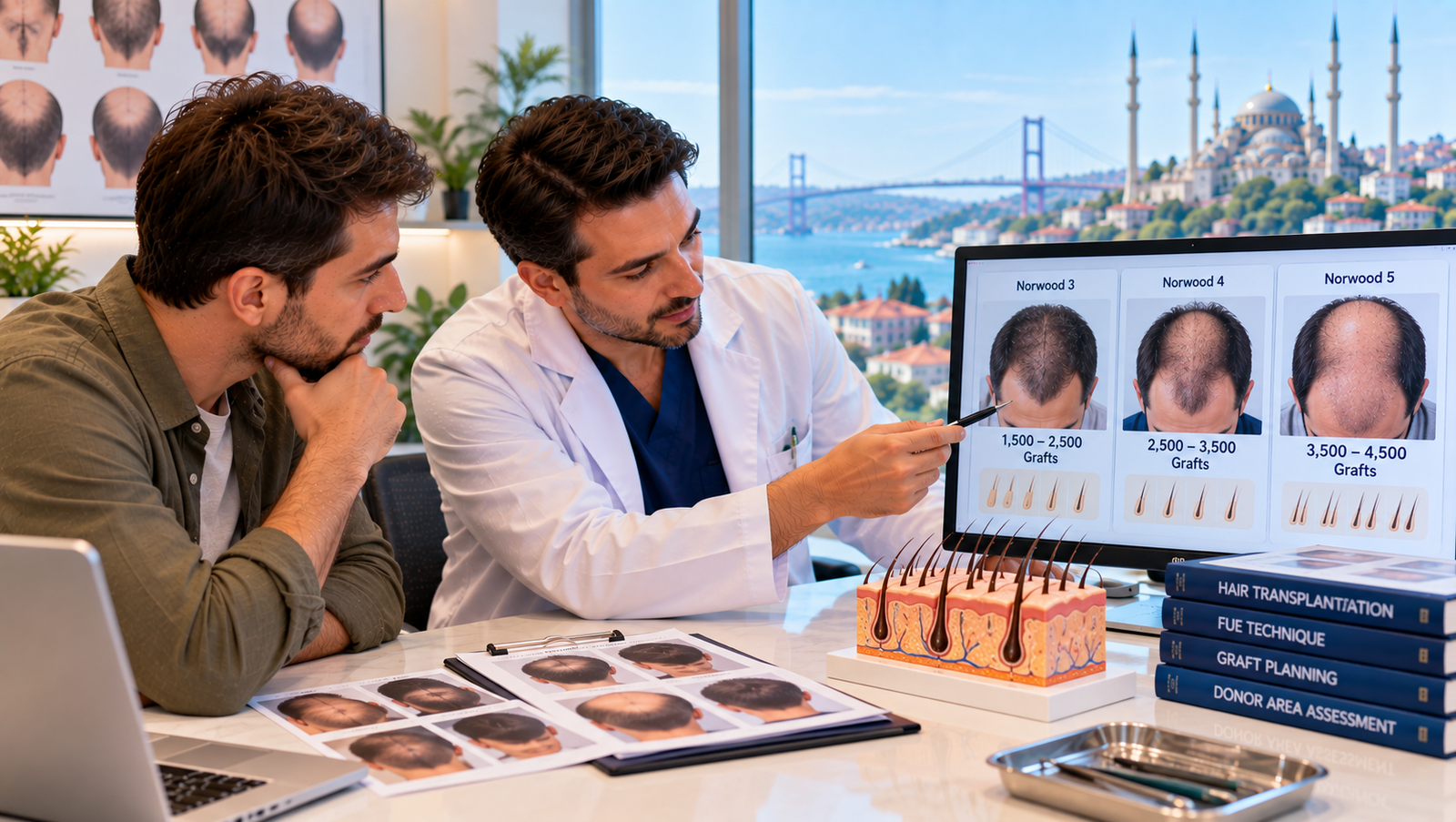
If you are asking how many grafts do I need, a Norwood stage can give a rough planning range, but it cannot give a reliable final number on its own. Graft planning depends on the actual recipient area, desired visual density, hair calibre, curl, hair-to-skin contrast, donor density, miniaturisation, future hair loss and whether the crown is being treated. Published hair-transplant guidelines discuss recipient densities around 35 to 45 follicular units per square centimetre as one planning reference, while donor-density research shows substantial person-to-person variation. Start with our FUE Hair Transplant page and treat any online graft calculator as a starting estimate rather than a surgical prescription.
A Graft Is Not The Same As A Hair
A follicular-unit graft can contain one, two, three or more hairs. A hairline usually needs more single-hair units at the front, while multi-hair units can add visual density behind it.
This means two patients receiving the same number of grafts can receive a different total number of hairs and a different visual result.
Ask the clinic to report both the number of grafts and, where available, the average hairs per graft.
Why The Norwood Stage Is Only The Starting Point
The Norwood scale describes the pattern and extent of male-pattern hair loss. It does not measure the exact surface area of your scalp, donor density or hair characteristics.
Two people labelled Norwood 4 can need very different plans if one has a narrow frontal loss pattern and the other has a wide front plus a larger crown.
The surgeon should therefore measure the actual area to be treated instead of choosing a graft count from the stage alone.
A Practical Planning Formula
A simplified planning concept is recipient area multiplied by target follicular-unit density, then adjusted for hair calibre, existing native hair, donor capacity and future loss. The exact density does not have to be the same across every zone.
The frontal hairline may be designed differently from the mid-scalp, and the crown often needs a lower visual-priority strategy because it can consume a large number of grafts.
The final number must also stay within what the donor area can safely provide over a lifetime.
How Many Grafts For Norwood 3?
A rough planning range often used for a typical Norwood 3 frontal pattern is around 1,500 to 2,500 grafts. This is not a medical standard or a promise.
A Norwood 3 vertex pattern can require more because it combines frontal recession with crown thinning. A low, dense new hairline can also increase the number compared with a more conservative design.
The donor area should still be measured before agreeing to the upper end of any range.
How Many Grafts For Norwood 4?
A broad planning estimate for Norwood 4 is often around 2,500 to 3,500 grafts when the plan includes significant frontal loss and some crown involvement. Published hair-restoration reports also show that selected Norwood 4 cases can be treated with numbers in this general region.
The important question is how the grafts are divided. A surgeon may prioritise the hairline and frontal third while leaving the crown lighter to preserve donor reserve.
If a clinic proposes full dense coverage everywhere, ask how much donor capacity will remain for future loss.
How Many Grafts For Norwood 5?
For Norwood 5, rough clinic-planning ranges commonly move into approximately 3,500 to 4,500 grafts for broader coverage, but the real number can be lower or higher depending on goals and donor supply.
At this stage the front, mid-scalp and crown can represent a large total area. Trying to restore every zone at the same density may exceed what is sensible in one session or over a lifetime.
A staged plan that gives priority to the front and mid-scalp may be more realistic than chasing maximum crown density immediately.
Why These Ranges Are Only Educational
Published academic literature does not provide one official graft prescription for each Norwood stage. The ranges above are practical planning estimates seen across clinical calculators and case planning, not a universal guideline.
Academic research is more useful for the principles: donor follicular-unit supply is finite, donor density varies, and recipient density must be balanced against tissue and donor limits.
Any clinic presenting a stage-based number as exact before examination is simplifying the problem too far.
Donor Density Can Change The Plan Completely
Research measuring the occipital donor scalp found follicular-unit densities roughly in the range of 65 to 85 units per square centimetre in the studied sample, with substantial variation in hair density and the proportion of one-, two- and three-hair units.
Another survey of experienced hair-transplant surgeons estimated very different lifetime donor yields depending on density and expected future hair-loss severity.
This is why a high-density donor area can support a different plan from a thin or miniaturising donor area even when the Norwood stage is the same.
Hair Calibre, Curl And Colour Contrast Matter
Coarser hair creates more visual coverage than fine hair. Curly or wavy hair can create more apparent volume, while straight fine hair may need more grafts for the same visual effect.
Lower contrast between hair and scalp can also make coverage look denser. These characteristics do not create more follicles, but they change the visual result produced by each graft.
A graft calculator that ignores hair characteristics is incomplete.
Existing Native Hair Can Reduce Or Complicate The Number
If a recipient zone still contains substantial native hair, fewer grafts may be needed to improve appearance. However, placing grafts among miniaturising native hair requires careful planning because that hair may continue to thin.
The clinic should assess miniaturisation and future loss rather than counting only the visible bald area.
A plan that looks sufficient today may become sparse later if native-hair progression is ignored.
The Crown Can Consume A Large Number Of Grafts
The crown has a spiral growth pattern and a broad surface area. Increasing crown density can consume many grafts while producing less visual framing benefit than using the same grafts in the frontal third.
For advanced hair loss, surgeons may prioritise the hairline and mid-scalp first and treat the crown more lightly or in a later session.
Ask the clinic to show a zone-by-zone allocation instead of only one total number.
More Grafts Are Not Automatically Better
A larger session can increase donor depletion, procedure time and handling demands. The goal is not to harvest the maximum possible number but to use the number that creates a reasonable visual result while preserving long-term donor options.
Published donor-supply research specifically warns against overly aggressive goals that ignore the long-term donor-to-recipient relationship.
If two clinics give very different numbers, ask each one to show the recipient area, target density and donor calculation behind the recommendation.
Questions To Ask About Your Graft Estimate
- What Norwood pattern do you think I have?
- What is the measured recipient area in each zone?
- What density are you planning in the hairline, front, mid-scalp and crown?
- What is my donor follicular-unit density?
- Is there miniaturisation in the donor area?
- How many hairs per graft do you expect on average?
- How much donor reserve should remain for future loss?
- Which zones are being prioritised and why?
- Could this plan require a second procedure later?
- What would make you reduce the graft number after examination?
How Turkelite Medcare Coordinates Graft-Planning Questions
Turkelite Medcare is a patient coordination service, not the treating hair-transplant clinic. We do not diagnose the Norwood stage, calculate donor capacity or decide the graft count.
Our role is to organise provider questions, written plans, appointments, travel, records and return-home follow-up after the independent treating provider confirms the clinical plan.
The patient services page explains that division of responsibility.
Frequently Asked Questions
How Many Grafts Do I Need?
The final number depends on measured recipient area, target density, donor supply, hair characteristics and future hair loss. A Norwood stage provides only a rough starting range.
How Many Grafts For Norwood 3?
A rough educational range is often around 1,500 to 2,500 grafts for a typical frontal Norwood 3 pattern. Vertex involvement or a lower, denser hairline can increase the requirement.
How Many Grafts For Norwood 4?
A broad planning range is often around 2,500 to 3,500 grafts, depending on how much front, mid-scalp and crown are being treated and how much donor reserve should be preserved.
How Many Grafts For Norwood 5?
Broader coverage often moves into roughly 3,500 to 4,500 grafts, but advanced loss may require staged treatment or lower density in the crown to protect the donor area.
Can A Clinic Know My Exact Graft Number From Photos?
Photos can support an estimate, but a reliable final plan should include direct assessment of donor density, miniaturisation, hair calibre, recipient area and long-term hair-loss pattern.
Use A Range Until The Donor Area Is Measured
Graft planning is a balance between what you want to cover and what the donor area can safely supply. Use Norwood ranges to understand scale, then let measured anatomy, hair characteristics and future-loss planning determine the final number.
This content is for general information and does not replace individual medical advice, diagnosis or treatment. Discuss treatment suitability, risks and recovery with a qualified healthcare professional.