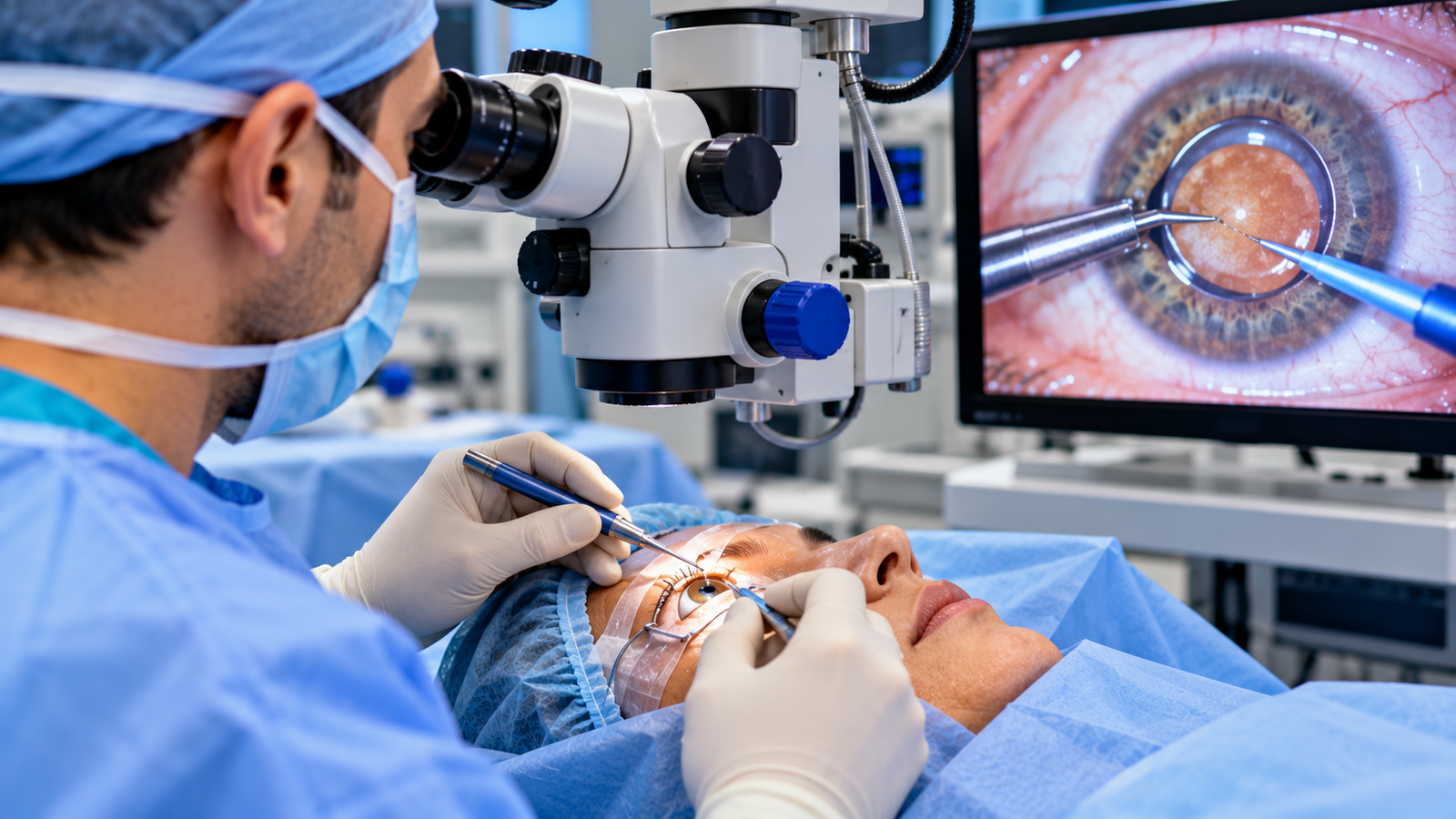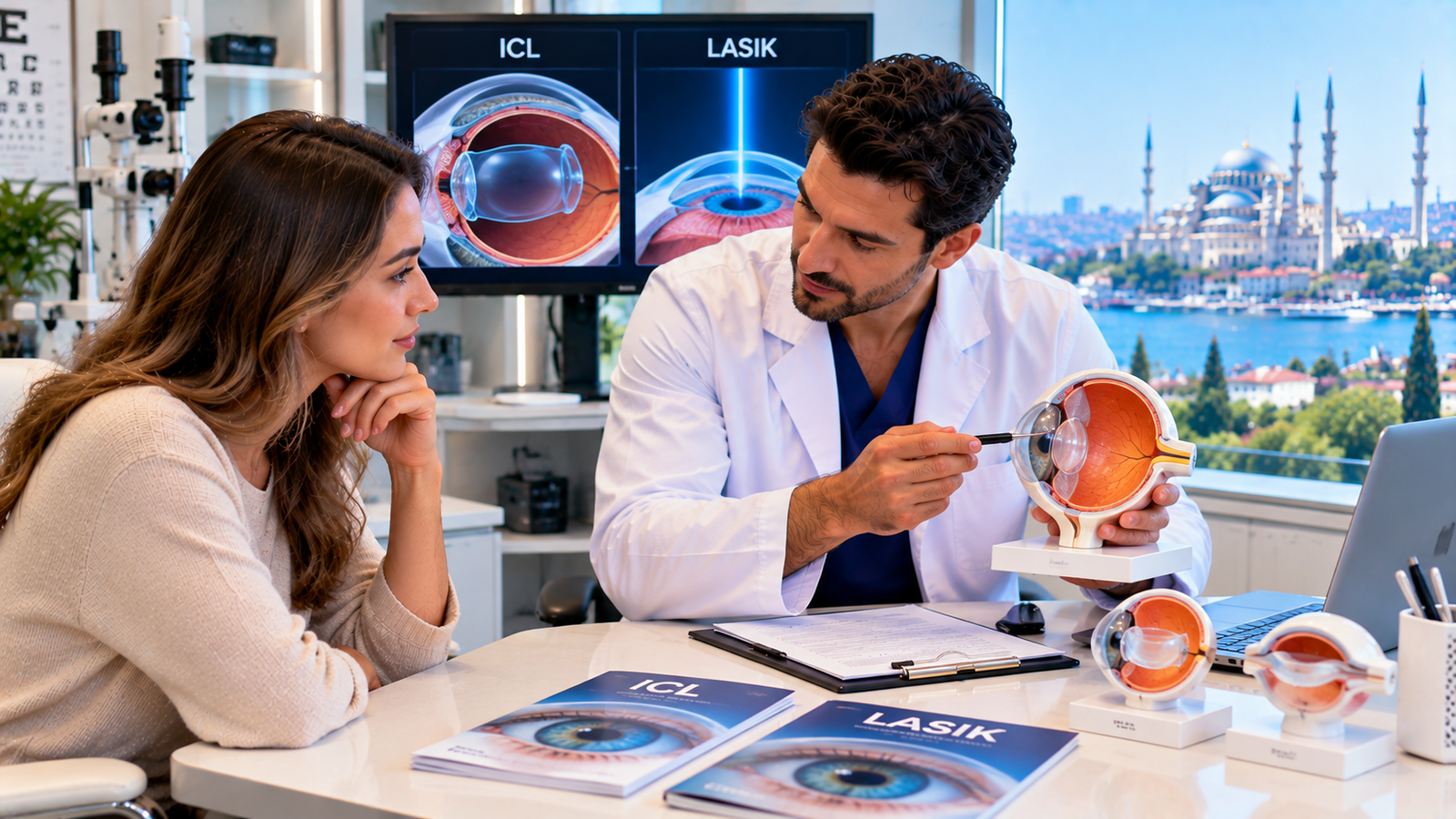
ICL vs LASIK compares two fundamentally different refractive-surgery approaches. Implantable Collamer Lens surgery places a phakic lens inside the eye, behind the iris and in front of the natural crystalline lens, without removing corneal tissue. LASIK creates a corneal flap and uses an excimer laser to reshape the cornea. Neither method is universally safer. The safer choice depends on prescription, corneal thickness and shape, dry-eye status, anterior-chamber anatomy, endothelial cell health, age, retinal findings and the surgeon’s measurements. Start with our Implantable Collamer Lens page and compare candidacy rather than choosing by procedure name alone.
The Main Difference: Inside The Eye Versus Reshaping The Cornea
Implantable Collamer Lens surgery adds a corrective lens inside the eye while leaving the natural lens in place. The cornea is not reshaped to create the refractive correction.
LASIK changes the focusing power of the eye by permanently reshaping corneal tissue beneath a flap. This difference creates different benefits, limitations and complication profiles.
Who Is More Likely To Be Considered For Implantable Collamer Lens Surgery?
Implantable Collamer Lens surgery is commonly considered for moderate to high myopia, especially when the cornea is too thin or otherwise unsuitable for the amount of laser reshaping required. Suitability still depends on internal eye measurements and ocular health.
As one regulatory example, the United States Food and Drug Administration approval for the current central-port implantable Collamer lens applies to selected patients aged 21 to 45 and requires adequate anterior-chamber anatomy and corneal endothelial cell density. Those United States criteria are not a universal rule for every country, but they show why detailed measurements matter.
Who Is More Likely To Be Considered For LASIK?
LASIK is commonly considered for suitable patients with stable refractive error, adequate corneal thickness and shape, and no important contraindication to corneal laser surgery.
United States Food and Drug Administration guidance specifically highlights thin corneas and dry eye as important issues to assess because LASIK can worsen dry eye and excessive tissue removal can increase the risk of corneal instability.
ICL vs LASIK: Which Is Safer?
There is no universal safer procedure because the risk categories are different. LASIK avoids placing an implant inside the eye but permanently changes corneal tissue. Implantable Collamer Lens surgery preserves corneal tissue but is an intraocular operation.
Safety therefore depends on matching the procedure to the eye. A method that is reasonable for one patient may be inappropriate for another with a different cornea, prescription or internal eye anatomy.
What Comparative Research Shows
A systematic review of 19 comparative studies examining toric implantable Collamer lenses and LASIK for myopia with astigmatism found refractive outcomes that were either similar or favoured the implantable lens, with better contrast sensitivity and fewer higher-order optical aberrations among the main advantages reported for the implantable lens.
The authors also emphasised the need for longer follow-up to compare long-term adverse effects systematically. Comparative results should therefore inform candidacy, not be turned into a claim that one procedure always wins.
Dry Eye Is A Major Difference
LASIK can cause or worsen dry-eye symptoms because corneal nerves are affected during flap creation and laser treatment. The United States Food and Drug Administration lists severe dry eye among important possible complications.
Implantable Collamer Lens surgery does not reshape the cornea, so it avoids the same corneal tissue removal. That does not make it risk-free; its risks arise from surgery inside the eye instead.
Corneal Thickness And Shape Can Change The Decision
LASIK requires enough suitable corneal tissue to create the flap and laser correction while leaving an adequate structural reserve. Thin or irregular corneas can make LASIK inappropriate.
Implantable Collamer Lens surgery does not depend on removing corneal tissue for the correction, but it requires suitable anterior-chamber dimensions, lens sizing and healthy corneal endothelial cells.
High Myopia Can Change The Balance
High levels of myopia require more corneal tissue removal with LASIK. Comparative research in moderate and high myopia has often found strong visual quality and refractive performance with implantable Collamer lenses.
High myopia can also be associated with retinal risks that exist independently of the refractive procedure, so the retinal examination remains important before either option.
LASIK Risks Are Mainly Corneal And Surface-Related
- Dry eye that can be persistent in some patients.
- Glare, halos, starbursts or reduced low-contrast vision.
- Under-correction, over-correction or regression.
- Flap-related problems.
- Corneal ectasia or structural weakening in susceptible eyes.
- Loss of lines of best-corrected vision in uncommon cases.
Implantable Collamer Lens Risks Are Intraocular
- Incorrect lens sizing or an unsuitable lens vault.
- Raised eye pressure.
- Lens rotation in toric models.
- Cataract formation.
- Loss of corneal endothelial cells over time.
- Inflammation, infection or the need to reposition, exchange or remove the lens.
Is Implantable Collamer Lens Surgery Reversible?
The implanted lens can usually be surgically removed or exchanged, which is different from the permanent corneal tissue removal of LASIK. However, this should not be described as complete biological reversibility.
Implantation and removal are intraocular operations, and the eye still experiences surgery. The decision should therefore be made as a long-term treatment choice rather than as a temporary trial.
ICL vs LASIK Long Term
Long-term follow-up looks at more than visual acuity. After implantable Collamer Lens surgery, clinicians may monitor lens position and vault, eye pressure, corneal endothelial cells, cataract development and retinal health. After LASIK, long-term concerns include refractive change, dry eye, visual symptoms and corneal stability.
Age-related presbyopia and later cataract can affect vision after either procedure because neither operation stops the normal ageing of the eye.
What Does Newer Implantable-Lens Evidence Show?
A 2025 systematic review and meta-analysis of 27 prospective studies included 2,204 myopic eyes treated with newer central-port implantable Collamer lenses. Mean follow-up was 13.84 months; 80.23% achieved uncorrected 20/20 vision or better and 87.45% were within plus or minus 0.50 dioptres of the intended refraction.
Serious adverse events were uncommon in the included studies, but the authors still called for longer follow-up and more geographically diverse evidence. Short- and medium-term performance should not be used to erase the need for long-term monitoring.
Which Procedure Gives Better Night Vision?
Comparative studies have often reported fewer higher-order aberrations and better contrast sensitivity after implantable Collamer Lens surgery than after LASIK in moderate to high myopia. That can matter for night vision quality.
Both procedures can still produce glare or halos, and pupil size, prescription, optical zone, lens sizing and individual healing can influence symptoms.
What Tests Should Be Done Before Choosing?
- Stable refraction and full eye examination.
- Corneal thickness and corneal topography or tomography.
- Dry-eye and ocular-surface assessment.
- Anterior-chamber measurements for implantable-lens candidacy.
- Corneal endothelial cell count when implantable-lens surgery is considered.
- Pupil assessment and refractive measurements.
- Dilated retinal examination, especially in higher myopia.
- Discussion of age, presbyopia and future cataract considerations.
Questions To Ask The Eye Surgeon
- Why am I a better candidate for one procedure than the other?
- What corneal findings affect LASIK suitability?
- What internal eye measurements affect implantable-lens suitability?
- What are my personal dry-eye risks?
- How does my prescription change the risk-benefit balance?
- What night-vision symptoms should I expect or consider?
- What long-term monitoring is required after each option?
- What would make you change the plan after the final examination?
How Turkelite Medcare Coordinates Refractive-Surgery Planning
Turkelite Medcare is a patient coordination service, not the treating eye clinic. We do not choose between implantable Collamer Lens surgery and LASIK, interpret eye measurements or declare one procedure safer for an individual patient.
Our role is to organise provider questions, eye records, appointments, travel and the return-home follow-up handover around the plan confirmed by the independent eye surgeon. See patient services.
Frequently Asked Questions
Is ICL Safer Than LASIK?
Not universally. It avoids corneal tissue removal but introduces an intraocular lens and intraocular surgical risks. The safer option depends on the individual eye.
Is ICL Better For High Myopia?
It is often considered for higher myopia because it avoids removing large amounts of corneal tissue, but candidacy still depends on internal eye anatomy and ocular health.
Is LASIK Better If My Prescription Is Lower?
LASIK can be a suitable option for lower or moderate prescriptions when the cornea and ocular surface are appropriate, but prescription level alone does not determine candidacy.
Which Has Better Long-Term Evidence?
Both have substantial clinical evidence, but the risk profiles and follow-up questions differ. Modern implantable Collamer Lens data are strong in the short and medium term, while continued long-term monitoring remains important.
The Safer Choice Is The Procedure That Fits The Eye
Implantable Collamer Lens surgery and LASIK solve refractive error in different ways. The decision should follow corneal measurements, internal eye anatomy, dry-eye assessment, prescription, retinal health and a clear discussion of the different long-term risks.
This content is for general information and does not replace individual medical advice, diagnosis or treatment. Discuss treatment suitability, risks and recovery with a qualified healthcare professional.