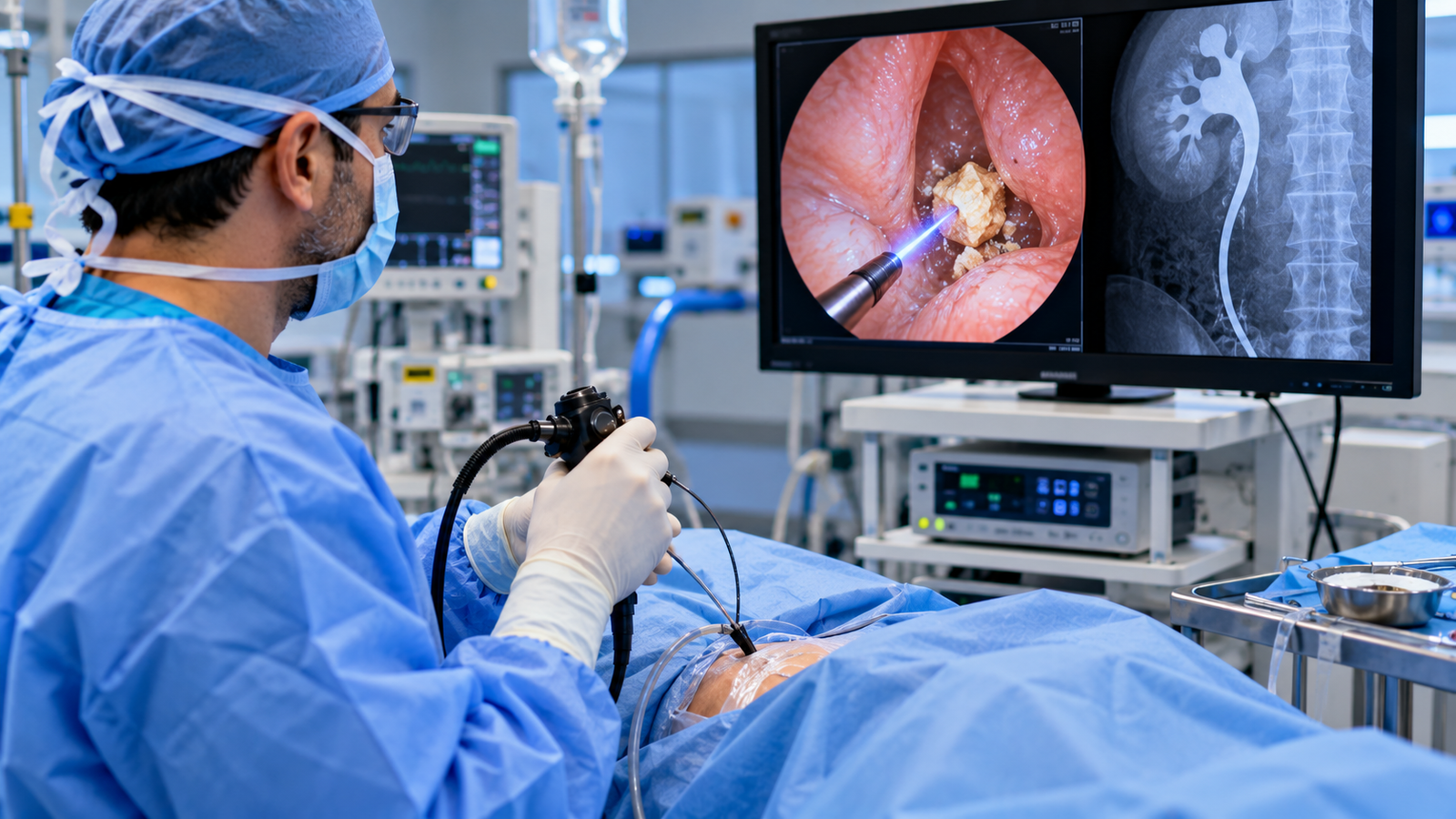
Kidney stone removal in Turkey should start with the stone, not the procedure name. Stone size, location, density, obstruction, infection, kidney function and urinary anatomy determine whether observation, medicines, shock-wave treatment, ureteroscopy, percutaneous surgery or another approach is appropriate. European urology guidance states that ureteroscopy offers a better chance of becoming stone-free with a single procedure than shock-wave treatment, but it also carries a higher complication rate. Start with our Ureteroscopy & Laser Lithotripsy page and ask why this method fits your stone rather than choosing it only because a package is available.
What Ureteroscopy And Laser Lithotripsy Do
A ureteroscope is a thin instrument passed through the urethra and bladder into the ureter and, when needed, into the kidney. The surgeon visualises the stone directly.
If the stone cannot be removed whole, laser energy can fragment or dust it into smaller pieces. Fragments may be removed with a basket or allowed to pass naturally, depending on the case.
Which Lasers Are Used?
Current European guidance strongly recommends holmium laser or thulium-fibre laser systems for flexible ureteroscopy. Both are established options for breaking urinary stones.
The useful question is not which laser has the most impressive marketing name, but whether the equipment, surgeon technique and stone plan are appropriate for your anatomy and stone burden.
When Is Active Stone Removal Needed?
European guidance lists reasons such as a low likelihood of spontaneous passage, persistent pain despite adequate pain treatment, ongoing obstruction or reduced kidney function. An obstructed kidney with infection or no urine output can be a urological emergency.
If obstruction is combined with infection or sepsis, urgent drainage may be needed before definitive stone treatment. That situation should not be managed as routine elective medical travel.
Ureteroscopy Versus Shock-Wave Treatment
For ureteric stones, ureteroscopy generally provides a higher early stone-free rate and fewer repeat treatments than shock-wave treatment. The trade-off is a higher complication rate and usually more procedural intervention.
Shock-wave treatment can still be appropriate in selected stones. Choice depends on size, location, stone density, body habitus, urinary anatomy, equipment and patient preference.
What About Large Kidney Stones?
For large renal stones, percutaneous nephrolithotomy is often the standard approach. Flexible ureteroscopy can still be used in selected situations when percutaneous treatment or shock-wave treatment is not suitable, but larger stone burden increases the chance of needing more than one procedure or a ureteric stent.
Ask whether the plan is expected to be a single definitive session or a staged treatment from the beginning.
Will I Need A Ureteric Stent?
A ureteric stent is a temporary tube placed between the kidney and bladder to maintain drainage. It may be used when swelling, ureteric trauma, infection risk, residual fragments or other factors make drainage support useful.
European guidance says a stent is not routinely required after an uncomplicated ureteroscopy. If one is placed, the removal date and responsible clinician should be written down before you travel home.
What Are The Main Risks?
European guidance reports an overall ureteroscopy complication rate of about 4% to 25%, with most complications being minor. Urosepsis is a serious complication with a reported risk up to about 5% in the guideline evidence base.
Other risks include bleeding, urinary infection, ureter injury, later narrowing of the ureter, residual stone fragments, pain related to a stent and the need for another procedure. Individual risk depends on infection, stone burden, procedure length, anatomy and medical conditions.
Why A Urine Test Matters Before Surgery
Urinary infection increases the risk of infectious complications. The treating team should check for infection and manage it before elective ureteroscopy when possible.
If you have fever, chills, severe illness or signs of urinary infection with an obstructing stone, urgent local assessment is more important than continuing a travel plan.
What Happens After Laser Stone Treatment?
You may have burning when passing urine, blood in the urine, urinary frequency, flank discomfort or stent-related symptoms during early recovery. The exact pattern depends on the procedure and whether a stent is used.
Hydration, pain medicines and other instructions should follow the treating urologist’s plan. Do not remove or ignore a stent without a confirmed removal pathway.
When Can You Fly Home?
There is no single travel date for every ureteroscopy patient. The team should confirm that pain is controlled, urine is passing, there is no concerning fever or infection and the stent plan is clear.
Long travel is a poor time to discover that a stent requires urgent removal, a fever is developing or obstruction persists. Make the follow-up plan before leaving Turkey.
Stone Analysis And Prevention Matter After Removal
Removing the current stone does not prevent another stone from forming. When a fragment is available, stone analysis can help guide prevention, and some patients need blood or urine testing for metabolic risk factors.
Ask what prevention advice should begin after recovery and who will manage recurrent-stone risk at home.
Questions To Ask Before Kidney Stone Surgery
- Where exactly is my stone and how large is it?
- Is there obstruction, infection or reduced kidney function?
- Why is ureteroscopy preferred over observation, shock-wave treatment or percutaneous surgery?
- Which laser system will be used?
- Is one procedure expected to be enough?
- What is the chance that I will need a ureteric stent?
- If a stent is placed, who removes it and when?
- What symptoms after surgery require urgent review?
- When will you decide that I am fit to fly?
- Will the stone be analysed for prevention planning?
How Turkelite Medcare Coordinates Kidney-Stone Treatment
Turkelite Medcare is a patient coordination service, not the treating urology clinic. We do not decide whether a stone needs surgery, choose the laser or determine whether a stent is required.
Our role is to organise provider questions, imaging and laboratory records, appointments, travel and the return-home handover around the plan confirmed by the treating urologist. See patient services.
Frequently Asked Questions
Is Laser Lithotripsy Used For Every Kidney Stone?
No. Stone size, location, obstruction, infection, anatomy and alternatives determine whether ureteroscopy and laser treatment are appropriate.
Is Ureteroscopy Better Than Shock-Wave Treatment?
It generally gives a better chance of early stone-free status with one procedure, but it also has a higher complication rate. The best option depends on the individual stone and patient.
Will I Definitely Need A Stent?
No. A stent is not routinely needed after every uncomplicated ureteroscopy, but it is useful in selected situations.
Can An Infected Obstructing Stone Wait Until I Travel?
No. Obstruction with infection can be a urological emergency and may require urgent drainage and antibiotics before definitive stone treatment.
The Stone Characteristics Should Choose The Procedure
Good kidney-stone planning links imaging, infection status, stone burden and anatomy to the treatment choice, then makes the stent, recovery and prevention plan clear before the patient travels home.
This content is for general information and does not replace individual medical advice, diagnosis or treatment. Discuss treatment suitability, risks and recovery with a qualified healthcare professional.