Quick answer
LASIK vs SMILE: Which Laser Eye Procedure Fits Which Patient?: the right answer depends on diagnosis, the actual treatment plan and individual risk factors. Use this article to prepare for consultation, then have the treating clinic confirm timing, medicines, suitability and travel planning for your case.
- Do not confirm treatment before adequate clinical assessment.
- Get scope, risks, aftercare and return-travel criteria in writing.
- For care in Turkey, verify the authorised facility and responsible clinician.
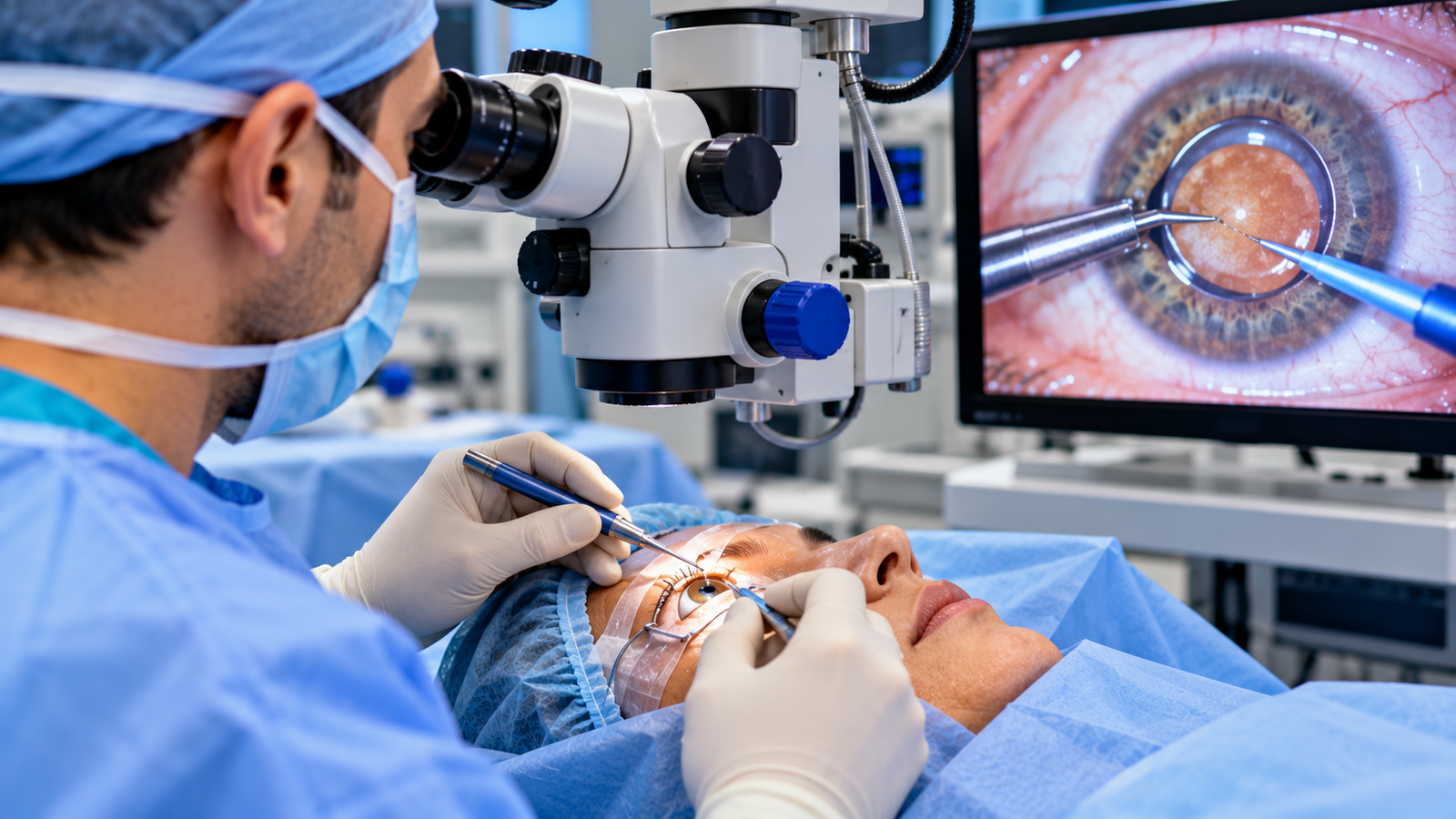
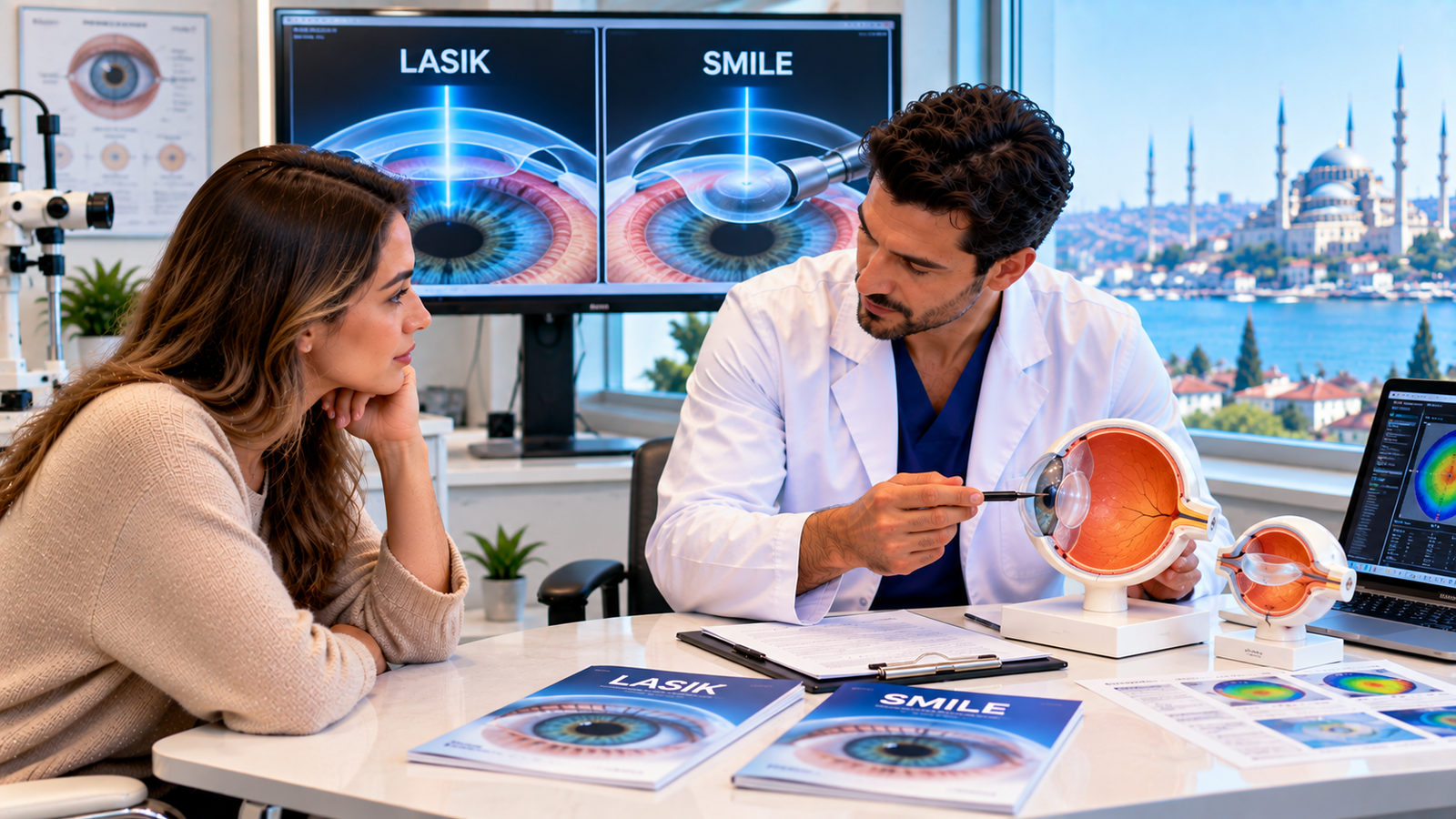
LASIK vs SMILE is not a simple contest in which one procedure is always safer or better. LASIK creates a corneal flap and then reshapes the underlying cornea with an excimer laser. SMILE uses a femtosecond laser to create a small lens-shaped piece of corneal tissue that is removed through a small incision, so no corneal flap is created. Reviews of randomised trials show that both procedures can be safe, effective and predictable for suitable patients with myopia or myopic astigmatism, but their strengths, limitations and retreatment options differ. Start with our SMILE Laser Eye Surgery page and let corneal measurements, prescription and eye-surface health determine the procedure rather than the marketing name.
How LASIK And SMILE Differ
LASIK uses a flap in the front of the cornea. After the flap is lifted, an excimer laser removes microscopic amounts of tissue to change corneal shape, and the flap is repositioned. SMILE does not use an excimer ablation under a flap; a femtosecond laser forms an internal lenticule that the surgeon removes through a small incision.
Do They Give Similar Vision Results?
For appropriately selected patients with myopia and myopic astigmatism, overall visual results are broadly similar. A meta-analysis of 11 randomised clinical trials found no meaningful difference in final refractive result, the proportion reaching 20/20 uncorrected vision, or the proportion within 1.0 dioptre of the intended target. LASIK had a small advantage for the stricter measure of being within 0.5 dioptre of target, while SMILE induced less spherical aberration.
Which Is Safer?
Neither procedure is universally safer. LASIK has flap-related risks because a corneal flap is created. SMILE avoids a flap but has its own risks, including difficult lenticule separation or removal and a different pathway if enhancement is later needed. The most important safety step is screening for corneal shape, thickness, refractive stability, dry eye, keratoconus risk and other eye disease before either procedure is offered.
Dry Eye: Does SMILE Have An Advantage?
SMILE may cause less early disruption of corneal nerves because the incision is smaller and there is no large flap. A 2025 systematic review and meta-analysis found better recovery in several dry-eye and corneal-sensitivity measures after small-incision lenticule extraction than after femtosecond LASIK. That does not mean SMILE prevents dry eye; both procedures can cause temporary dryness and fluctuating vision.
Which Has Faster Visual Recovery?
LASIK often gives faster early visual recovery. SMILE can also recover quickly, but some patients experience slightly slower sharpening of vision during the first days. Later visual outcomes are usually much closer, so early recovery speed should not be the only deciding factor.
Sports, Flap Concerns And Lifestyle
Because SMILE does not create a corneal flap, it can be attractive for people involved in contact sports or occupations with a higher chance of direct eye trauma. Lifestyle is only one part of candidacy, however; a flap-free procedure is not automatically suitable if the prescription, corneal anatomy or eye-surface findings point to another option.
Astigmatism, Hyperopia And Predictability
Both procedures can treat myopic astigmatism within suitable ranges. Some systematic reviews have found a tendency toward slightly more undercorrection of astigmatism with SMILE in certain low-to-moderate astigmatism groups. LASIK also has established applications for selected hyperopia, while SMILE is primarily established for myopia and myopic astigmatism.
What About Retreatment Or Enhancement?
Enhancement after LASIK is familiar to many refractive surgeons and can sometimes be performed by lifting the previous flap or using another laser approach. Enhancement after SMILE is possible, but repeat SMILE is not usually the standard route; options can include surface laser treatment or conversion to a flap-based approach depending on the original treatment and corneal measurements.
Questions To Ask Before Choosing
- What are my corneal thickness and topography results?
- Is my prescription stable enough for refractive surgery?
- Do I have dry-eye disease that should be treated first?
- Why is LASIK or SMILE more suitable for my exact prescription?
- What is the expected early recovery for my case?
- What complications are most relevant to me?
- What happens if some prescription remains after surgery?
- Which enhancement methods would be available?
- How soon will my eyes be reviewed before I fly home?
How Turkelite Medcare Coordinates Laser-Eye Planning
Turkelite Medcare is a patient coordination service, not the treating eye clinic. We do not choose LASIK or SMILE, interpret corneal scans or decide whether refractive surgery is safe for a patient.
Our role is to organise provider questions, appointments, records, travel and follow-up around the plan confirmed by the treating ophthalmologist. See patient services.
Frequently Asked Questions
Is SMILE Better Than LASIK?
Not universally. Both can provide excellent results in suitable patients. SMILE avoids a flap and may have an early dry-eye advantage, while LASIK has broader refractive applications and a more established enhancement pathway.
Which Is Safer Long Term?
Current evidence supports good long-term safety for both when patients are properly selected. The relevant risk profile depends on corneal health, prescription, technique and follow-up rather than the procedure name alone.
Which Has Less Dry Eye?
Several studies favour SMILE for early dry-eye and corneal-sensitivity recovery, but dryness can occur after either procedure.
Which Gives Better Vision?
For suitable myopic patients, final uncorrected visual outcomes are generally similar. Small differences in predictability, astigmatism correction and visual-quality measures can matter in an individual case.
The Better Procedure Is The One Your Eyes Fit
The useful comparison is not “LASIK wins” or “SMILE wins.” It is whether your corneal anatomy, prescription, dry-eye status, lifestyle and enhancement needs fit one technique better than the other after a complete ophthalmic assessment.
Sources and further reading
- FDA: LASIK
- FDA: LASIK risks and choosing a doctor
- Republic of Türkiye Ministry of Health: International health tourism regulation
These sources support general patient information. Individual medical recommendations must come from the treating clinician.
View the related treatment area
This content is for general information and does not replace individual medical advice, diagnosis or treatment. Discuss treatment suitability, risks and recovery with a qualified healthcare professional.