Quick answer
Lens Replacement vs Laser Eye Surgery: Key Differences: the right answer depends on diagnosis, the actual treatment plan and individual risk factors. Use this article to prepare for consultation, then have the treating clinic confirm timing, medicines, suitability and travel planning for your case.
- Do not confirm treatment before adequate clinical assessment.
- Get scope, risks, aftercare and return-travel criteria in writing.
- For care in Turkey, verify the authorised facility and responsible clinician.
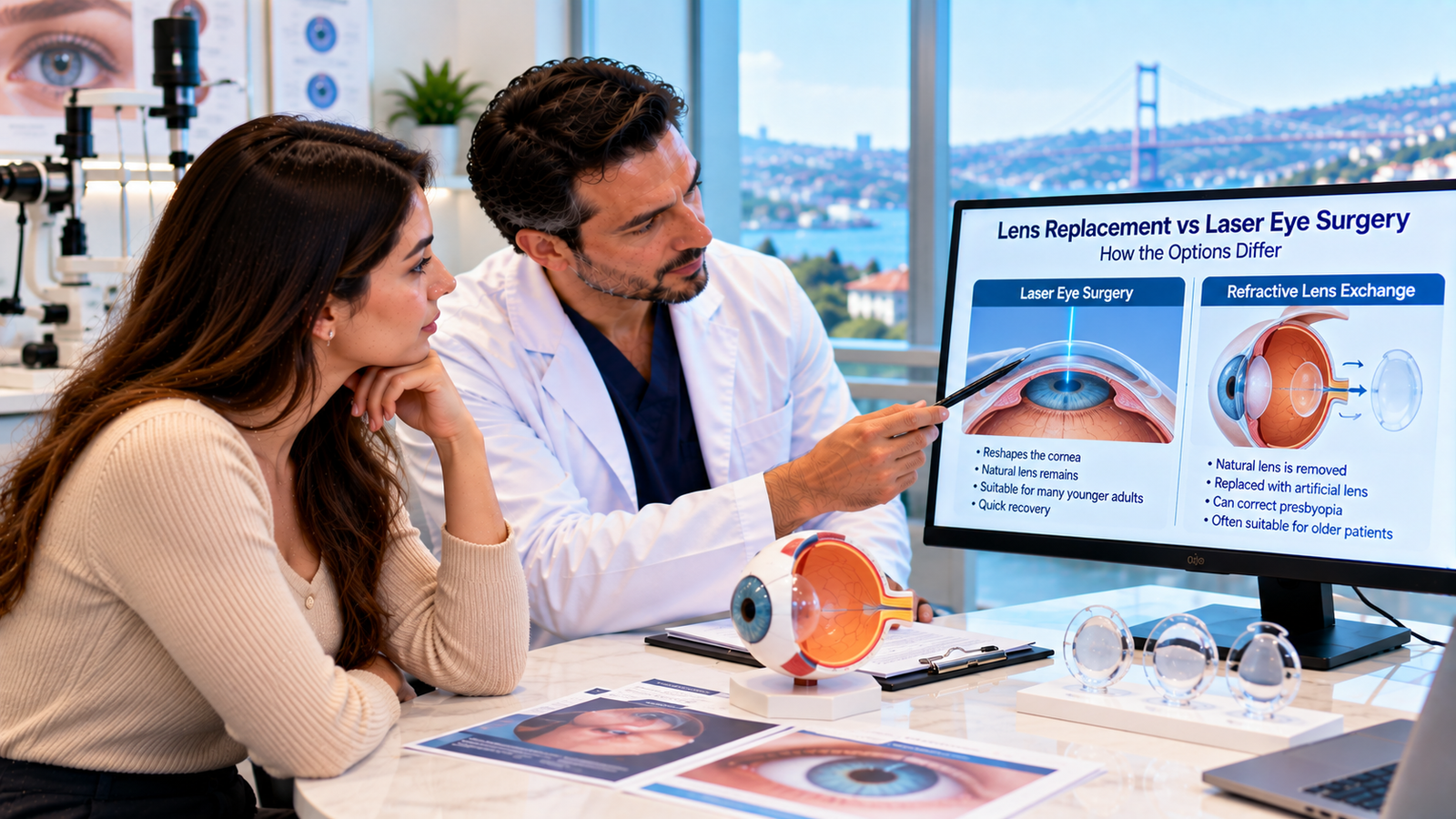
Lens replacement vs laser eye surgery compares two fundamentally different ways of correcting vision. Laser procedures such as LASIK reshape the cornea while leaving the natural lens inside the eye. Refractive lens exchange removes the natural lens and replaces it with an artificial intraocular lens using a cataract-style operation. The Royal College of Ophthalmologists states that laser treatment or phakic lens implantation are generally better options than refractive lens exchange for younger patients who still have a clear, flexible natural lens, while lens exchange becomes more relevant as presbyopia and early lens ageing increase. Start with our Refractive Lens Exchange page and compare the eye, not just the headline procedure.
What Laser Eye Surgery Changes
Laser vision correction changes the curvature of the cornea to alter how light focuses on the retina. The natural lens remains inside the eye.
LASIK, surface laser procedures and small-incision lenticule extraction use different techniques, but they all work primarily at the cornea rather than replacing the lens.
What Refractive Lens Exchange Changes
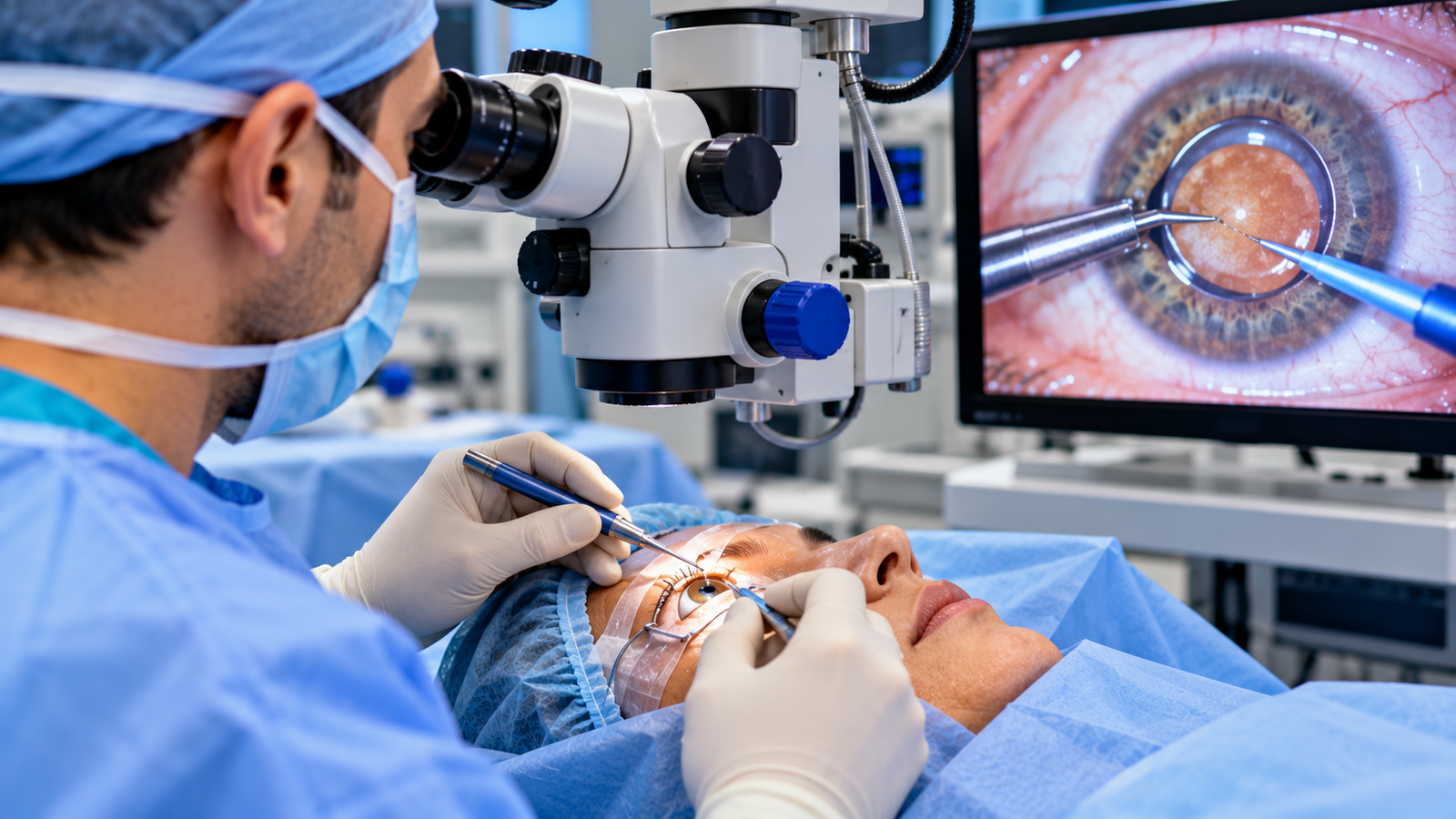
Refractive lens exchange removes the natural crystalline lens and replaces it with an artificial intraocular lens. The operation is essentially the same type of surgery used for cataract removal, but it is performed for refractive goals when the natural lens may still be relatively clear.
Once the natural lens is removed, it cannot be restored. That makes the decision fundamentally different from reshaping the cornea.
Age And The Natural Lens Matter
The Royal College of Ophthalmologists notes that refractive lens exchange is commonly a default vision-correction option in the over-65 age group, while laser correction may still be better for some people with no cataract and a healthy ocular surface.
For many people under 50 who still have a clear and flexible natural lens, laser correction or a phakic lens is generally considered before lens exchange.
Presbyopia Changes The Discussion
Presbyopia is the age-related loss of near focusing caused by reduced flexibility of the natural lens. Laser surgery can use strategies such as monovision, but it does not remove the ageing natural lens.
Lens exchange replaces the natural lens and can use monofocal, multifocal or extended-focus lens designs to change the balance between distance, intermediate and near vision.
Lens Replacement Surgery: Potential Advantages
- It removes the natural lens, so cataract cannot later develop in that lens.
- It can address a wide range of refractive prescriptions in suitable patients.
- Different lens designs can target distance, intermediate and near vision.
- It may be more suitable than corneal laser treatment for some older patients.
Lens Replacement Surgery: Important Limitations And Risks
Refractive lens exchange is intraocular surgery. The Royal College of Ophthalmologists states that permanent serious vision loss is significantly more common after lens exchange than after laser vision correction or phakic lens implantation, affecting approximately 1 in 500 patients.
Serious complications can include retinal damage, retinal detachment, infection, inflammation or bleeding. Less severe problems can still require medication changes or additional surgery.
Laser Eye Surgery: Potential Advantages
- It does not remove the natural lens.
- Recovery after LASIK can be rapid in suitable patients.
- It avoids the intraocular risks of lens-removal surgery.
- It is often considered for younger adults with stable prescriptions and healthy corneas.
Laser Eye Surgery: Important Limitations And Risks
Laser procedures depend on corneal shape, thickness, prescription stability and ocular-surface health. Dry eye, glare, halos, under-correction, over-correction and the need for further treatment can occur.
LASIK also creates a corneal flap, while other laser methods avoid a flap but have different recovery profiles.
What About Multifocal Lens Side Effects?
Multifocal and extended-focus lens implants can reduce dependence on glasses at more than one distance, but they may create optical side effects such as halos, glare or reduced contrast in some patients.
Not everyone is a good candidate for a multifocal lens. Eye disease, visual priorities and tolerance of optical effects matter.
Who May Be Better Suited To Laser Correction?
A younger adult with a stable prescription, healthy corneas, no significant cataract and a clear natural lens may be more logically assessed for laser correction before lens replacement.
The final decision depends on prescription, corneal measurements, dry-eye status, pupil characteristics and lifestyle needs.
Who May Be Better Suited To Lens Exchange?
Lens exchange may become more relevant with older age, presbyopia, early cataract change or a prescription that is less suitable for corneal laser correction.
This does not mean age alone decides the treatment. A full eye examination is needed to assess the retina, cornea, lens, pressure and other ocular health factors.
Lens Replacement Surgery Pros And Cons Need To Be Individual
The main advantage is that the ageing natural lens is replaced and a lens implant can be selected around visual goals. The main trade-off is that this is an intraocular operation with a different and generally higher serious-risk profile than laser correction.
For some patients the trade-off is reasonable; for others preserving a clear natural lens is more important.
What Should International Patients Ask Before Lens Exchange In Turkey?
- Why is lens exchange preferred over laser correction in my eyes?
- Do I have any cataract or retinal risk factors?
- Which lens design is proposed and why?
- What vision should I expect at distance, intermediate and near?
- What optical side effects are possible?
- What is the surgeon’s plan if a complication occurs?
- When are the first postoperative examinations?
- How long should I remain in Turkey before flying?
- What records and lens information will I take home?
- Who provides long-term eye follow-up after I return?
How Turkelite Medcare Coordinates Refractive-Surgery Planning
Turkelite Medcare is a patient coordination service, not the treating eye clinic. We do not choose laser surgery or lens exchange, select an implant lens or decide candidacy.
Our role is to organise provider questions, examinations, appointment timing, travel and the return-home handover around the plan confirmed by the treating ophthalmologist. See patient services.
Frequently Asked Questions
Is Lens Replacement Better Than Laser Eye Surgery?
Not universally. Lens exchange and laser correction suit different eyes, ages and visual goals, and their risk profiles are different.
Does Lens Replacement Stop Cataracts?
Once the natural lens has been removed and replaced, a cataract cannot later form in that removed lens, although other eye conditions can still develop.
Is Lens Replacement Riskier Than LASIK?
It is more invasive because it is intraocular surgery, and the Royal College of Ophthalmologists reports a higher risk of permanent serious vision loss than with laser correction.
Can Laser Eye Surgery Correct Presbyopia?
Laser strategies such as monovision can reduce dependence on reading glasses in selected patients, but they do not restore the natural lens’s lost flexibility.
Choose The Procedure That Matches The Eye, Not The Age Label Alone
Lens replacement and laser eye surgery solve refractive problems in different ways. The decision should come from corneal measurements, lens ageing, prescription, retinal health, dry-eye status and visual priorities after a complete ophthalmic assessment.
Sources and further reading
- FDA: LASIK
- FDA: LASIK risks and choosing a doctor
- Republic of Türkiye Ministry of Health: International health tourism regulation
These sources support general patient information. Individual medical recommendations must come from the treating clinician.
View the related treatment area
This content is for general information and does not replace individual medical advice, diagnosis or treatment. Discuss treatment suitability, risks and recovery with a qualified healthcare professional.