
Quick answer
Penile Implant Surgery in Turkey: Devices, Risks & Follow-Up: the right answer depends on diagnosis, the actual treatment plan and individual risk factors. Use this article to prepare for consultation, then have the treating clinic confirm timing, medicines, suitability and travel planning for your case.
- Do not confirm treatment before adequate clinical assessment.
- Get scope, risks, aftercare and return-travel criteria in writing.
- For care in Turkey, verify the authorised facility and responsible clinician.
Penile implant surgery in Turkey is a surgical treatment for selected erectile dysfunction when less invasive options are unsuitable, unwanted or have not worked well enough. European urology guidance states that penile prosthesis implantation may be considered for patients who are not suitable for other treatments, prefer a definitive surgical option or do not respond to other treatment methods. The decision should follow a urological assessment of the cause of erectile dysfunction, previous treatments, infection risk, medical conditions and device expectations. Start with our Penile Implant Surgery page and ask for the exact device type, surgeon responsibility and revision pathway in writing.
What A Penile Implant Does
A penile implant places a prosthetic device inside the penis to create the rigidity needed for penetrative sex. It treats the mechanical problem of obtaining or maintaining an erection; it does not directly create sexual desire or treat every cause of reduced sensation or orgasm difficulty.
The device becomes part of the long-term erectile pathway, so consent should cover how it is used, what it can and cannot change and what happens if it later needs revision or removal.
Who May Be Considered For Surgery?
Penile prosthesis surgery is generally discussed after the diagnosis of erectile dysfunction is clear and conservative options have been reviewed. These can include tablets, injections, intra-urethral medicines and vacuum devices, depending on the patient.
Some people choose an implant because other treatments have failed or are unsuitable, while others prefer a surgical solution after understanding the risks and permanent implications of implantation.
Inflatable And Malleable Implants Are Different
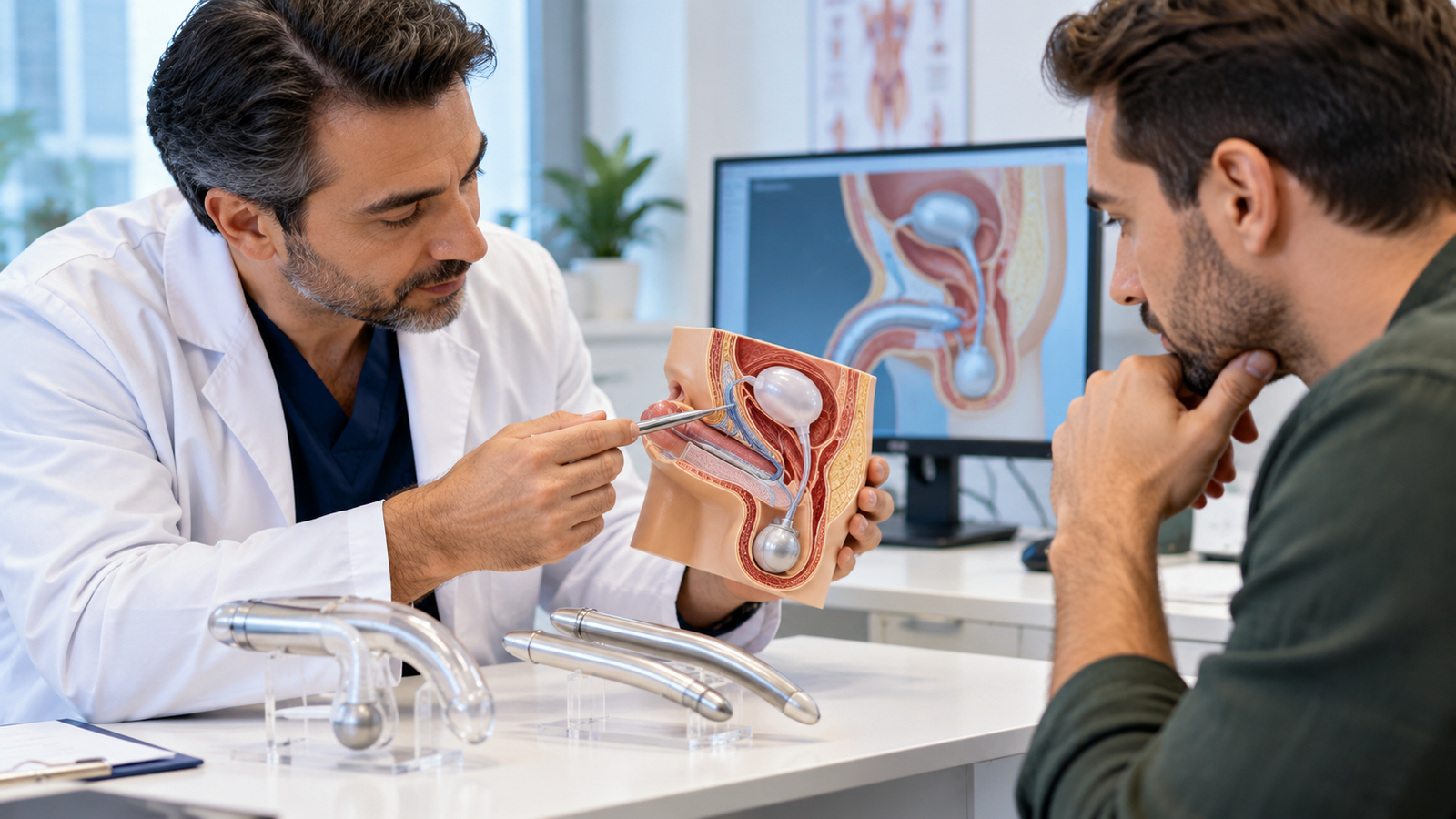
Two main device groups are used: inflatable systems and semi-rigid or malleable rods. Inflatable devices can usually be deflated when not in use and inflated for intercourse. Malleable devices remain firm and are manually positioned.
European guidance notes that there is no clear evidence that one manufacturer or implant class is universally superior. Device choice depends on hand function, anatomy, previous pelvic surgery, infection risk, preference and the surgeon’s experience.
Two-Piece And Three-Piece Inflatable Devices
Inflatable systems may have two or three components. Three-piece devices use cylinders, a scrotal pump and a fluid reservoir, while two-piece systems do not use a separate abdominal reservoir.
A previous abdominal or pelvic operation can affect reservoir planning. Ask where each component will be placed and why the proposed design fits your anatomy and history.
What Does The Evidence Say About Satisfaction?
A 2024 systematic review and meta-analysis included 83 studies and 12,132 patients. The pooled patient satisfaction rate was 83%, with the reported estimate ranging from 80% to 86%. Mean follow-up across the included studies was about 47.6 months.
The same review reported long-term complication rates of about 3% for erosion and 4.6% for mechanical failure. These pooled results are not guarantees for an individual patient and are not specific to Turkey.
Infection Is A Major Risk To Discuss
Device infection can require antibiotics, device removal, replacement or staged surgery. Risk is influenced by patient health, diabetes control, previous prosthesis surgery, skin or urinary infection and surgical factors.
Ask how the clinic screens for infection, what antibiotic and operating-room protocols are used and what happens if infection is suspected after you return home.
Mechanical Failure And Revision Matter Long Term
Penile implants are mechanical devices and can fail over time. Pumps, cylinders, tubing or other components may eventually need revision or replacement.
The written plan should identify the device manufacturer, model, warranty information where applicable and who will manage device problems if they occur years later.
What Happens During Surgery?
The surgeon places the selected prosthesis through an incision and positions the components according to the device type. Anaesthesia, incision location, drainage, catheter use and hospital stay vary by patient and surgical approach.
The exact plan should be confirmed after examination. A package should not decide device size, device type or surgical approach.
What Should You Expect During Early Recovery?
Swelling, bruising, soreness and temporary changes in comfort are expected after surgery. The surgeon may prescribe wound care, pain control, activity restrictions and instructions about supporting the genital area.
The device is not necessarily ready for sexual use immediately. The surgeon decides when healing is sufficient for activation, cycling or intercourse, depending on the implant and recovery.
When Can The Implant Be Activated?
There is no single activation date that applies to every patient. The timing depends on wound healing, swelling, pain, device type and the surgeon’s protocol.
Ask for written instructions showing when the first device teaching session will occur and whether that session must happen before you leave Turkey.
How Long Should You Stay In Turkey?
The stay should cover hospital discharge, early wound review, pain and urination assessment and any planned device teaching. International travel should not be scheduled around a fixed package date before the surgeon confirms the early recovery plan.
If a catheter, drain or significant swelling remains, the treating team should explain how that affects the return-travel date.
Warning Signs That Need Urgent Review
- Fever or rapidly worsening redness and swelling.
- Pus or foul-smelling drainage from the wound.
- Severe pain that is increasing rather than settling.
- Difficulty passing urine.
- Wound opening or visible device material.
- Sudden device malfunction associated with pain, swelling or suspected infection.
Questions To Ask Before Penile Prosthesis Surgery
- Why is an implant appropriate for my erectile dysfunction?
- Which non-surgical options have been considered?
- Which exact implant type and model do you recommend?
- Why is an inflatable or malleable device better for my situation?
- What is your plan to reduce infection risk?
- What happens if the device becomes infected?
- What happens if a component fails years later?
- When will the device be activated and taught to me?
- How long should I remain near the hospital before flying?
- What device records will I take home?
How Turkelite Medcare Coordinates Penile Implant Surgery
Turkelite Medcare is a patient coordination service, not the treating urology clinic. We do not diagnose erectile dysfunction, choose the prosthesis or decide when the implant can be activated.
Our role is to organise provider questions, requested medical records, appointments, travel and the return-home handover around the plan confirmed by the treating urologist. See patient services.
Frequently Asked Questions
Is A Penile Implant A Last-Resort Treatment?
It is usually considered after less invasive options have been reviewed, but some well-informed patients may prefer a definitive surgical option when they understand the risks and alternatives.
Which Is Better: Inflatable Or Malleable?
There is no universal winner. The best fit depends on anatomy, hand function, previous surgery, preference, infection risk and surgeon experience.
How Satisfied Are Patients With Penile Implants?
A 2024 meta-analysis reported pooled patient satisfaction of 83%, but individual outcomes vary and the figure is not a guarantee.
Can A Penile Implant Need Another Operation Later?
Yes. Infection, erosion, mechanical failure or other problems can require revision, replacement or removal.
Choose The Device And Follow-Up Plan Together
Penile implant surgery is not only about getting a device placed. The important plan includes device selection, infection prevention, early teaching, long-term records and a clear revision pathway if a problem develops after you return home.
Sources and further reading
- EAU Patient Information: Kidney stones
- EAU Patient Information: Side effects of kidney stone treatments
- Republic of Türkiye Ministry of Health: International health tourism regulation
These sources support general patient information. Individual medical recommendations must come from the treating clinician.
View the related treatment area
This content is for general information and does not replace individual medical advice, diagnosis or treatment. Discuss treatment suitability, risks and recovery with a qualified healthcare professional.