
Quick answer
Root Canal and Crown in Turkey: How They Fit Together: the right answer depends on diagnosis, the actual treatment plan and individual risk factors. Use this article to prepare for consultation, then have the treating clinic confirm timing, medicines, suitability and travel planning for your case.
- Do not confirm treatment before adequate clinical assessment.
- Get scope, risks, aftercare and return-travel criteria in writing.
- For care in Turkey, verify the authorised facility and responsible clinician.
Root canal and crown in Turkey often appear in the same treatment plan because root canal treatment manages infected or inflamed tissue inside a tooth, while the later restoration protects and rebuilds the tooth for function. The American Association of Endodontists states that most root canals can be completed in one to two appointments and that a permanent crown or other restoration should be placed after endodontic treatment as appropriate. Back teeth such as molars and premolars commonly need full-coverage crowns because they carry higher chewing forces, while front teeth do not always require a crown. Start with our Root Canal Treatment page and ask for both the endodontic plan and the final restoration plan before you travel.
What Root Canal Treatment Does
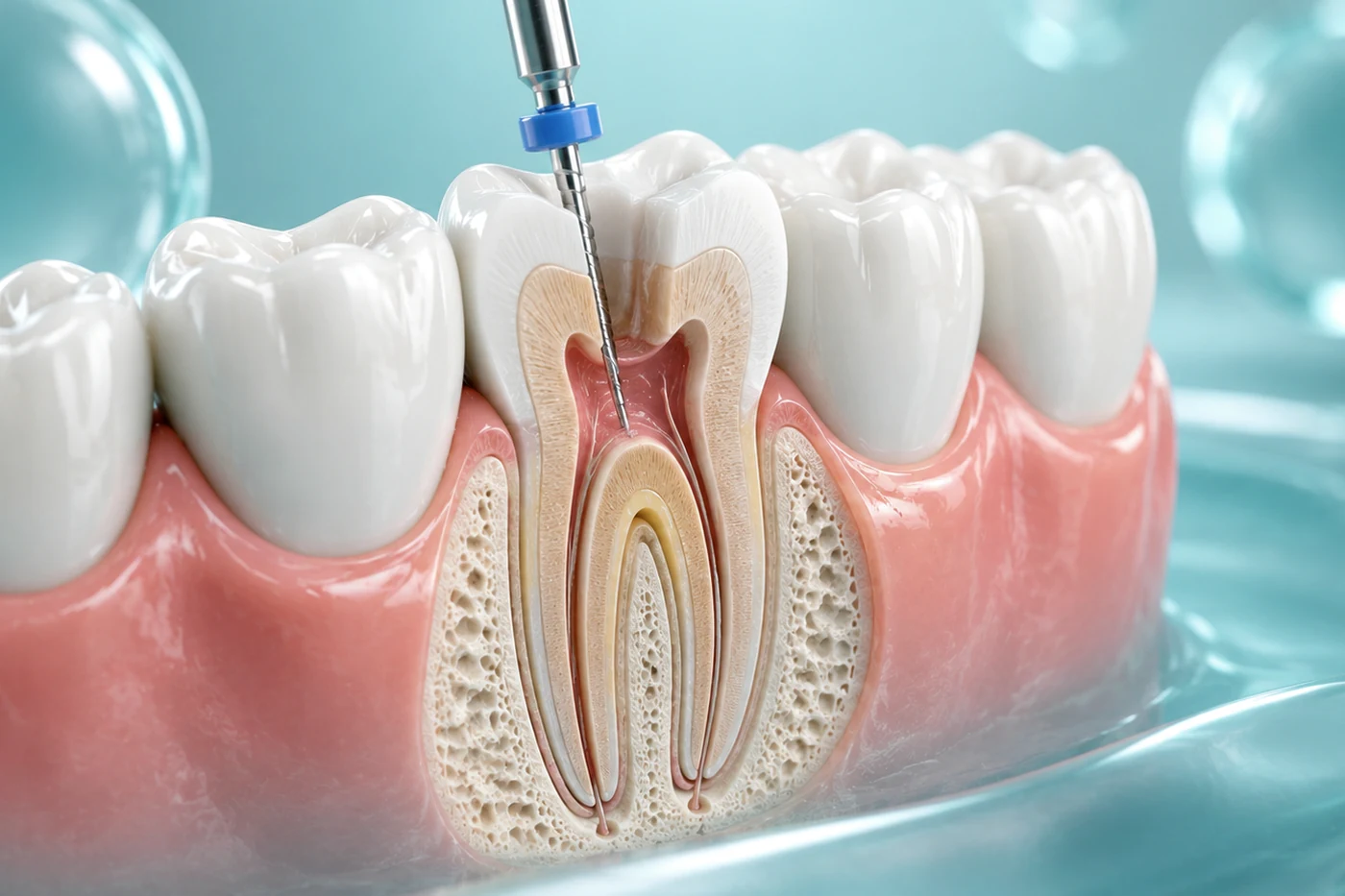
Root canal treatment removes inflamed or infected tissue from inside the tooth, cleans and shapes the root-canal system and seals it with a filling material. The goal is to retain the natural tooth when that is clinically appropriate.
After the canal treatment, the access opening still has to be restored. The tooth is not considered fully rehabilitated simply because the infected canal space has been treated.
Why A Crown May Be Needed Afterwards
A root-canal-treated tooth may already have lost substantial tooth structure because of decay, an old filling, fracture or the access opening needed for treatment. Posterior teeth also face high chewing forces.
A crown can provide full-coverage protection when the remaining tooth structure needs it. The decision depends on tooth position, remaining walls, cracks, bite, existing restorations and how much sound tooth structure remains.
Does Every Root Canal Need A Crown?
No. The American Association of Endodontists notes that back teeth generally require crowns, while incisors and canines do not always need full coverage. Some front teeth can be restored with a bonded filling or another conservative restoration if sufficient sound structure remains.
The treating dentist should explain why a crown is required for that specific tooth rather than using the same restoration automatically after every root canal.
Can Root Canal And Crown Be Done On The Same Trip?
Often they can be organised within the same travel period, but the number of appointments depends on diagnosis, canal complexity, symptoms, infection, laboratory workflow and whether the tooth is ready for a definitive restoration.
Some root canals are completed in one visit, while others need a second endodontic appointment. A temporary filling or temporary crown may be used until the dentist confirms that the tooth is ready for the final restoration.
Why The Final Restoration Should Not Be Delayed Unnecessarily
Endodontic guidance warns that delayed placement of the crown or other permanent restoration can contribute to failure if the tooth becomes contaminated or structurally compromised.
Ask exactly when the final restoration is planned and what temporary protection will be used between appointments.
Root Canal Treatment In Turkey: What Should Be Confirmed Before Travel?
A remote quotation should not be treated as a final diagnosis. The treating dentist or endodontist needs appropriate examination and imaging to confirm whether the tooth is restorable, whether root canal treatment is indicated and whether a crown is the correct final restoration.
Ask whether the case will be treated by a general dentist or an endodontist, what imaging is required and who will place the final restoration.
What Happens During Root Canal Treatment?
The clinician opens the tooth, removes infected or inflamed pulp tissue, cleans and shapes the canals and fills them with a biocompatible root-filling material. A temporary filling may be placed over the access opening until the final restoration is completed.
If the tooth does not have enough remaining structure to retain the final restoration, an additional core build-up or post may be considered. A post is not required for every root-canal-treated tooth.
What Is Root Canal Retreatment?
Root canal retreatment in Turkey is a second attempt to treat a tooth that previously had root canal therapy but did not heal as expected or later developed a new problem. The tooth is reopened, old root-filling material is removed and the canals are re-examined, cleaned and filled again.
Retreatment is different from simply replacing a crown. The clinician has to identify why the previous endodontic treatment failed and whether the tooth is still realistically restorable.
Why Might A Previous Root Canal Need Retreatment?
- Narrow or curved canals were missed or could not be treated initially.
- Complex canal anatomy was not identified.
- The permanent restoration was delayed.
- The crown or filling did not prevent leakage and contamination.
- New decay exposed the root filling to bacteria.
- A crown or filling became loose, cracked or broken.
- The tooth developed a fracture or a new infection.
Can A Crown Stay In Place During Retreatment?
Sometimes access can be made through an existing restoration, but in other cases the crown, post or core has to be removed to reach the canals safely. The American Association of Endodontists notes that complex restorative materials may need to be disassembled during retreatment.
Ask whether the current crown is expected to be preserved, repaired or replaced after the canals are retreated.
When Extraction May Be Discussed Instead
Not every painful or previously treated tooth can be saved. A vertical root fracture, severe structural loss, advanced periodontal damage or another poor-prognosis finding can make extraction more realistic than repeated endodontic and restorative treatment.
The clinician should explain why the tooth is considered restorable or non-restorable and what replacement options would follow if extraction becomes necessary.
Warning Signs After Root Canal Treatment
Some tenderness can occur after treatment, but severe pain or pressure lasting more than a few days, visible swelling, a bite that feels significantly uneven, loss of the temporary filling or crown, or return of the original symptoms should be reported to the treating dentist or endodontist.
If facial swelling is rapidly increasing or you have difficulty swallowing or breathing, seek urgent local medical care rather than waiting for an overseas reply.
Questions To Ask Before Booking
- Is the tooth definitely restorable?
- Why is root canal treatment indicated?
- Will a general dentist or an endodontist perform the canal treatment?
- How many root-canal appointments are currently expected?
- Does this tooth need a crown afterwards, and why?
- What temporary restoration will protect the tooth between appointments?
- Will the final crown be fitted during the same trip?
- If this is retreatment, why did the previous treatment fail?
- Will the existing crown or post need to be removed?
- Who provides clinical review if symptoms return after I go home?
How Turkelite Medcare Coordinates Root Canal And Crown Treatment
Turkelite Medcare is a patient coordination service, not the treating dental clinic. We do not diagnose pulp disease, decide whether a tooth can be saved or choose whether a crown is necessary.
Our role is to organise provider questions, records, appointment sequencing, travel and follow-up around the plan confirmed by the treating dentist or endodontist. See patient services.
Frequently Asked Questions
Do I Need A Crown After A Root Canal?
Many back teeth do because of chewing forces and structural loss, but not every root-canal-treated tooth automatically needs a full crown.
Can A Root Canal And Crown Be Done In One Trip To Turkey?
Often yes, but the schedule depends on the diagnosis, number of endodontic visits, symptoms, laboratory timing and whether the tooth is ready for the definitive restoration.
Can A Failed Root Canal Be Treated Again?
Sometimes. Retreatment can address missed anatomy, leakage or new infection, but the tooth must still be restorable and have a reasonable prognosis.
Why Can A Root Canal Fail After A Crown?
Possible reasons include untreated canal anatomy, leakage, new decay, fracture or another infection. The cause should be diagnosed before another procedure is planned.
The Root Canal And The Crown Solve Different Problems
Root canal treatment treats disease inside the tooth. The crown or other final restoration protects and restores the remaining tooth structure. A good travel plan explains both stages, their order and what happens if the tooth cannot proceed to the expected final restoration.
Sources and further reading
- Guy’s and St Thomas’ NHS: Dental implants
- NHS: Dental treatments
- Republic of Türkiye Ministry of Health: International health tourism regulation
These sources support general patient information. Individual medical recommendations must come from the treating clinician.
View the related treatment area
This content is for general information and does not replace individual medical advice, diagnosis or treatment. Discuss treatment suitability, risks and recovery with a qualified healthcare professional.