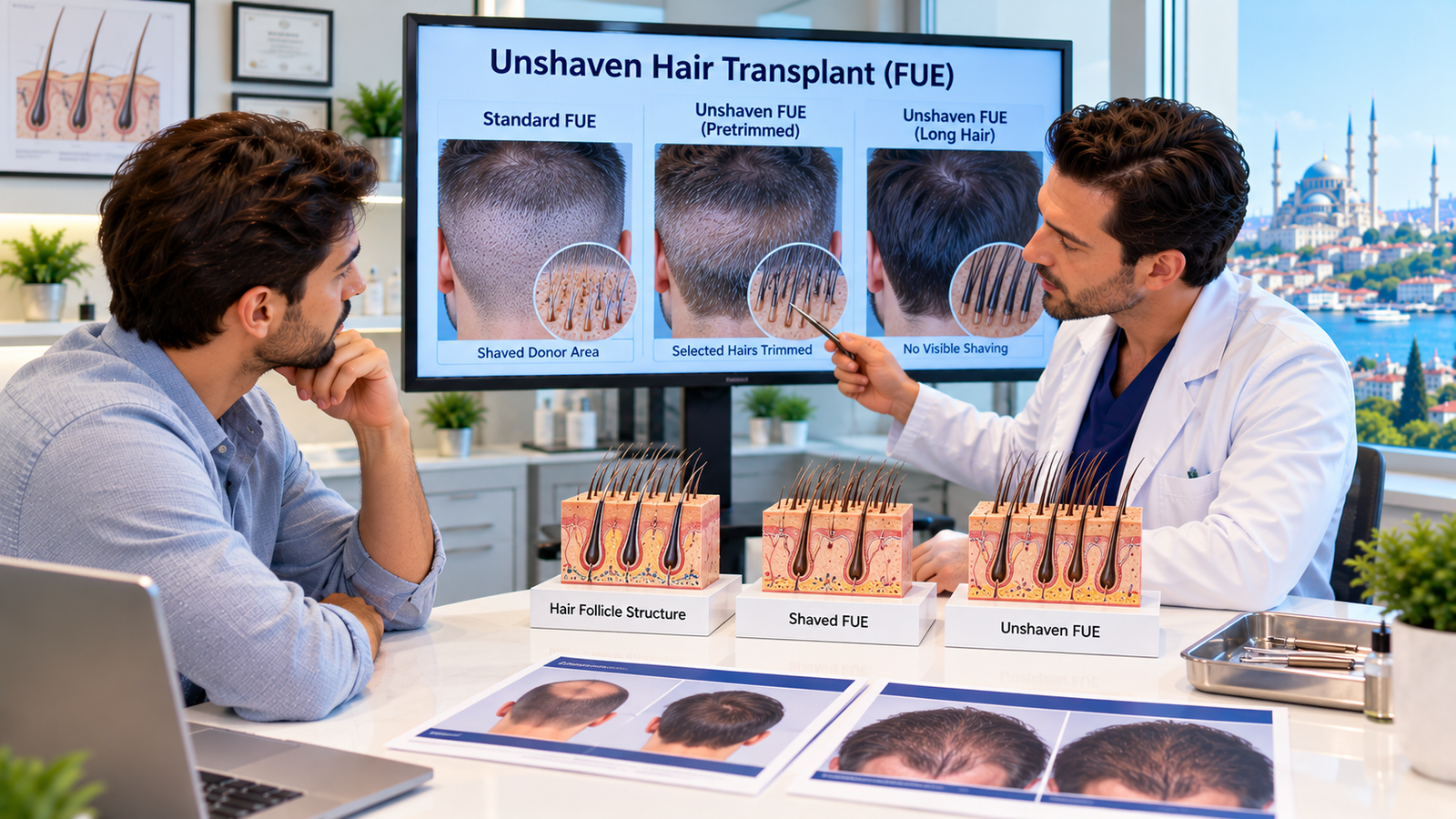
Unshaven hair transplant usually refers to follicular-unit excision performed with little or no visible shaving of the donor area, the recipient area or both. The aim is discretion, not a different biological type of transplant. The donor still has to be assessed, individual follicular units still have to be harvested and the recipient sites still have to be planned. Published technical reports describe direct nonshaven, pretrimmed and long-hair approaches, but they also show that the method is more technically demanding than standard shaved extraction. Start with our Unshaven FUE page and ask exactly which areas will be shaved, trimmed or left long.
What “Unshaven” Can Mean
Unshaven does not always mean that every hair remains full length. Some techniques trim selected donor hairs while surrounding hair stays long enough to camouflage the extraction points.
Other techniques extract genuinely long hairs without shaving them first. The clinic should explain the exact method instead of using “no shave” as a single undefined label.
How It Differs From Standard FUE
Standard follicular-unit excision commonly exposes the donor area by shaving or clipping hair so the surgeon can see hair direction and place the punch around each follicular unit.
In an unshaven approach, the team works around longer hair shafts. The extraction principle is still follicular-unit excision, but visibility, handling and punch alignment become more demanding.
Direct Nonshaven And Pretrimmed Techniques Are Not The Same
Published descriptions divide nonshaven extraction into approaches such as direct extraction of untrimmed hairs and pretrimming selected donor hairs before extraction.
The choice depends on hair length, donor characteristics, recipient goal, number of grafts and operator technique. Patients should ask which version is being proposed and why.
What Long-Hair FUE Adds
Long-hair follicular-unit excision keeps the visible hair shaft attached during extraction and implantation. A 2026 review describes this as an approach that can avoid donor shaving and can help the team assess curl and immediate visual direction.
The same review also discusses disadvantages and technical demands. Keeping the hair long does not make graft harvesting easier or remove the need for careful donor management.
Why Patients Consider Unshaven FUE
- Less visible evidence of donor-area shaving.
- Easier camouflage with surrounding long hair in selected patients.
- Potentially less disruption to hairstyle during early recovery.
- Ability to see the direction or curl of long hair during planning in some techniques.
What The Technique Does Not Change
Unshaven extraction does not create unlimited donor hair, prevent future hair loss or guarantee a denser result. Donor capacity, hair calibre, hair-loss pattern and safe spacing still limit how much can be transplanted.
It also does not remove the small extraction wounds in the donor area or the recipient sites. Healing and aftercare are still required.
Why The Procedure Can Take More Time
Long hair can obstruct the view of the scalp and make alignment around individual follicular units more difficult. Extra handling is required to protect the hair shafts while maintaining the correct extraction angle.
That is one reason published authors describe nonshaven and long-hair techniques as skill-intensive and potentially more time-consuming than standard shaved extraction.
What Does The Evidence Show?
A 2019 case series reported 658 patients treated with nonshaven follicular-unit extraction and an average graft transection rate of 8.2%. The series demonstrated feasibility across several indications, but it was not a randomised comparison proving that nonshaven extraction is better than standard extraction.
More recent technical reports remain encouraging, but much of the evidence is based on case series and technique reports. Results therefore depend heavily on patient selection, donor characteristics and operator experience.
Is Unshaven FUE Suitable For Large Sessions?
It can be used for substantial graft numbers in selected hands, but larger sessions increase the technical workload and donor-management challenge. Some clinics may recommend partial shaving when the planned graft number or donor pattern makes it safer or more efficient.
There is no universal graft number above which every patient must be shaved. The surgeon should explain what can be done safely in that specific donor area.
Does The Long Hair Stay After Surgery?
The visible transplanted hair shafts may shed during the normal post-transplant cycle even when the follicles remain in place. Long hair can help with immediate visualisation, but it should not be mistaken for the final result.
New growth still develops over later months according to the normal hair-transplant timeline.
Recovery Is Still Hair-Transplant Recovery
The donor and recipient areas still need protection, washing instructions and follow-up. Small crusts, redness, tenderness or temporary shedding can occur even when shaving is avoided.
Follow the treating team’s instructions for washing, sleeping, exercise, sun exposure and return to normal hair care rather than assuming an unshaven procedure means no downtime.
Questions To Ask Before An Unshaven Hair Transplant
- Which parts of my donor and recipient areas will actually be shaved or trimmed?
- Is the plan direct nonshaven extraction, pretrimming or long-hair extraction?
- Why is this method suitable for my donor characteristics?
- How many grafts are planned and how is donor capacity measured?
- Who performs the extraction and recipient-site creation?
- How does the technique affect procedure time?
- What happens if visibility or graft quality is poor during surgery?
- Would partial shaving make the procedure safer or more predictable?
How Turkelite Medcare Coordinates Unshaven Hair-Transplant Planning
Turkelite Medcare is a patient coordination service, not the treating hair-transplant clinic. We do not decide whether an unshaven technique is suitable or how many grafts can be safely harvested.
Our role is to organise provider questions, records, appointments, travel and the return-home handover around the plan confirmed by the treating clinician. See patient services.
Frequently Asked Questions
Is Unshaven FUE The Same As Long-Hair FUE?
Not always. Some unshaven techniques pretrim selected donor hairs, while long-hair techniques keep the extracted hair shafts long. Ask which method the clinic means.
Is Unshaven FUE Better Than Standard FUE?
Not universally. Its main advantage is discretion, while the technical demands can be higher. The choice should be based on donor characteristics, graft needs and operator experience.
Does Unshaven FUE Mean No Recovery?
No. The donor and recipient sites still have small wounds and still need normal hair-transplant aftercare.
Can The Transplanted Long Hairs Shed?
Yes. The visible hair shafts can shed after transplantation while the follicles remain in place and later produce new growth.
The No-Shave Benefit Is Cosmetic, Not Biological
The main benefit of an unshaven approach is reducing visible shaving. It does not change the finite donor supply, the need for careful graft handling or the months required for a mature result.
This content is for general information and does not replace individual medical advice, diagnosis or treatment. Discuss treatment suitability, risks and recovery with a qualified healthcare professional.