Quick answer
Tummy Tuck Recovery Week by Week: Healing Timeline: the right answer depends on diagnosis, the actual treatment plan and individual risk factors. Use this article to prepare for consultation, then have the treating clinic confirm timing, medicines, suitability and travel planning for your case.
- Do not confirm treatment before adequate clinical assessment.
- Get scope, risks, aftercare and return-travel criteria in writing.
- For care in Turkey, verify the authorised facility and responsible clinician.
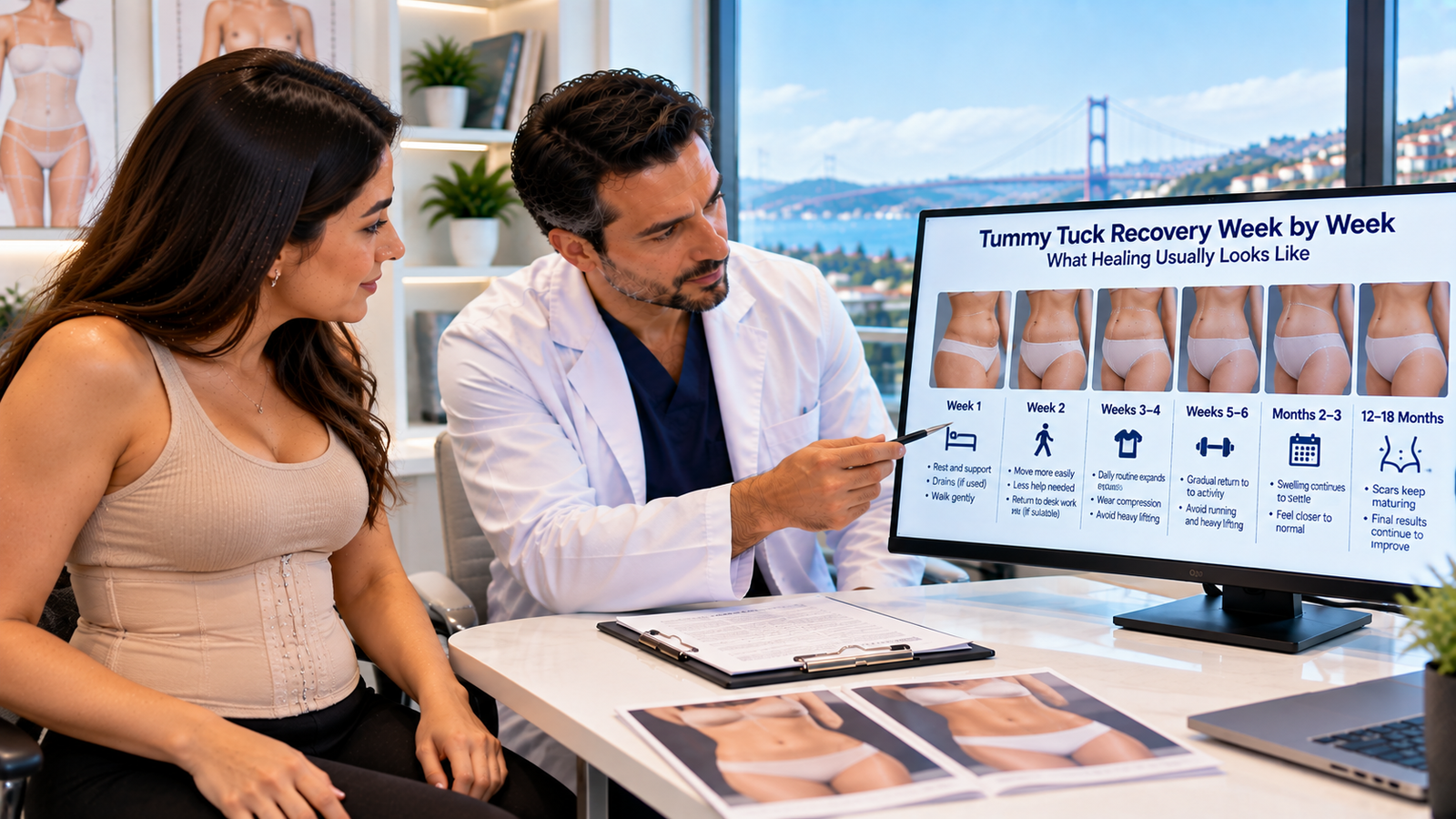
Tummy tuck recovery week by week is a general framework, not a promise that every patient reaches the same milestone on the same day. American Society of Plastic Surgeons guidance notes that patients are usually encouraged to walk on the day of surgery, may need to stay flexed at the waist for about 7 to 10 days, may have drains for roughly 1 to 2 weeks, may wear compression for about 4 to 6 weeks, often return to desk work around 2 weeks and commonly avoid running or lifting for about 6 weeks. Swelling can continue to reduce for around 3 months, while scars may keep changing for 12 to 18 months. Start with our Tummy Tuck / Abdominoplasty page and let the treating surgeon adjust the timeline to the exact operation performed.
Why A Week-By-Week Timeline Is Only A Guide
A full abdominoplasty, mini abdominoplasty and extended abdominoplasty do not create identical recoveries. Muscle or fascial repair, liposuction, previous surgery, smoking, medical conditions and wound healing can also change the pace.
Use the timeline to understand the usual sequence, but use the surgeon’s examination and instructions to decide what you personally can do.
Day 0 To Day 2: Early Recovery Starts With Movement And Support
Dressings are placed over the incisions, and a compression garment or elastic support may be used. Drains may also be present to remove fluid that collects under the skin.
Light walking is commonly encouraged very early, including on the day of surgery, because movement supports circulation and helps reduce blood-clot risk. Walking should still be slow and within the limits given by the surgical team.
First Week Of Tummy Tuck Recovery
The first week is usually the most restrictive period. Soreness, tightness, swelling and difficulty standing fully upright are common, especially when the abdominal wall has been tightened.
American Society of Plastic Surgeons guidance describes staying bent at the waist while standing or lying for about 7 to 10 days in some standard recovery pathways to reduce tension on the incision while the skin adapts.
Week 1: Drains, Wound Care And Short Walks
If drains are used, you may still be measuring and recording the output during this week. Drain removal depends on the amount of fluid rather than on a fixed calendar date.
Many surgeons remove drains around 1 to 2 weeks when the output is low enough, but some patients need them for longer. Do not remove or shorten drain care because a travel date is approaching.
Week 2: More Comfortable Movement
During the second week, many patients begin to stand more upright, move more comfortably and need less help with normal daily tasks. Bruising and swelling are usually still present but should be moving in the right direction.
Some patients can return to desk-based work at around 2 weeks if pain control, mobility, wound healing and the nature of the job allow it. A physical job generally needs more time.
Weeks 3 To 4: Daily Routine Expands, But Healing Is Not Finished
Walking and ordinary light activities usually become easier. The abdomen can still feel tight, numb or swollen, and the scar remains biologically active.
A compression garment may still be part of the plan. Do not treat improved comfort as permission for heavy lifting, abdominal training or strenuous exercise unless the surgeon has cleared it.
Weeks 5 To 6: Gradual Return Toward More Activity
Many standard recovery pathways keep running, heavy lifting and strenuous exercise restricted until around 6 weeks. The exact return depends on the extent of surgery and whether muscle repair or another procedure was added.
At this stage, activity should increase gradually rather than switching suddenly from restricted movement to full training.
Months 2 To 3: Swelling Continues To Settle
By this stage, many patients feel much closer to their normal routine. American Society of Plastic Surgeons information notes that swelling can continue to diminish until around 3 months.
The abdomen can look flatter before all internal healing is complete, so the early visible result should not be confused with the final healed result.
Months 6 To 18: Scar Maturation Continues
The scar does not finish healing when normal activity resumes. American Society of Plastic Surgeons guidance notes that scars may continue becoming thinner and lighter over roughly 12 to 18 months.
Follow the surgeon’s scar-care instructions and protect the healing scar from unnecessary sun exposure.
What Can Make Recovery Slower?
- An extended rather than limited abdominoplasty.
- Muscle or fascial repair.
- Combined liposuction or another operation.
- Smoking or nicotine exposure.
- Diabetes or another condition that affects healing.
- Wound problems, infection or fluid collections.
- Returning to lifting or strenuous activity too early.
Compression Garment Timing
Compression is commonly used to support the abdomen and manage swelling. One American Society of Plastic Surgeons recovery discussion describes 4 to 6 weeks of compression after tummy tuck surgery, while individual protocols vary.
The garment should fit according to the surgeon’s instructions. Excessive tightness, skin injury or breathing difficulty is not something to “push through.”
When Is A Recovery Stall Actually A Problem?
Recovery does not improve in a perfectly straight line. A day with more swelling after increased activity can happen, but the overall direction should be toward greater comfort and function.
New or progressive redness, drainage, fever, worsening pain, opening of the wound, sudden shortness of breath, chest pain or one-sided leg swelling needs medical assessment rather than simply more rest.
Questions To Ask About Your Personal Timeline
- Is my operation full, mini or extended abdominoplasty?
- Is muscle or fascial repair included?
- Will I have drains, and what determines removal?
- How long should I remain flexed at the waist?
- How long should I wear the compression garment?
- When can I return to desk work?
- When can I lift luggage or heavier objects?
- When can I resume running, gym work or abdominal exercise?
- Which symptoms should trigger urgent review?
- When will you consider the result mature enough to assess?
How Turkelite Medcare Coordinates The Recovery Journey
Turkelite Medcare is a patient coordination service, not the treating surgical clinic. We do not set your activity restrictions, remove drains or decide when a wound has healed sufficiently.
Our role is to organise appointments, travel, records and the return-home handover around the recovery plan confirmed by the treating surgeon. See patient services.
Frequently Asked Questions
What Is The First Week Of Tummy Tuck Recovery Like?
The first week commonly includes soreness, tightness, swelling, limited upright posture, short walks, wound care and sometimes drain care.
When Can I Stand Straight After A Tummy Tuck?
Some standard recovery pathways keep patients flexed for about 7 to 10 days, but your own surgeon should decide when full upright posture is appropriate.
When Can I Return To Work After A Tummy Tuck?
Desk-based work is often possible around 2 weeks in an uncomplicated recovery, while physically demanding work generally requires more time.
When Can I Exercise After A Tummy Tuck?
Many standard pathways restrict running, heavy lifting and strenuous exercise for about 6 weeks. The exact date depends on the operation and your healing.
Healing Continues Long After The First Month
The useful way to read a tummy tuck timeline is as a sequence: protect the wound and walk early, regain posture and routine gradually, return to heavier activity only after clearance, and expect swelling and scar maturation to continue for months.
Sources and further reading
- NHS: Before you have a cosmetic procedure
- NHS: Choosing who will do your cosmetic procedure
- Republic of Türkiye Ministry of Health: International health tourism regulation
These sources support general patient information. Individual medical recommendations must come from the treating clinician.
View the related treatment area
This content is for general information and does not replace individual medical advice, diagnosis or treatment. Discuss treatment suitability, risks and recovery with a qualified healthcare professional.