Quick answer
Turkey Teeth vs Composite Bonding: What’s the Difference?: the right answer depends on diagnosis, the actual treatment plan and individual risk factors. Use this article to prepare for consultation, then have the treating clinic confirm timing, medicines, suitability and travel planning for your case.
- Do not confirm treatment before adequate clinical assessment.
- Get scope, risks, aftercare and return-travel criteria in writing.
- For care in Turkey, verify the authorised facility and responsible clinician.
Turkey teeth vs composite bonding is not really a country-versus-material comparison. “Turkey teeth” is an informal phrase that may refer to crowns, porcelain veneers or mixed cosmetic dental treatment, while composite bonding usually means tooth-coloured resin applied directly to existing teeth. Current research shows that ceramic veneers generally have stronger long-term survival than direct composite veneers, while composite restorations can often be easier to repair or modify. A 10-year practice-based study found higher failure risk for direct composite veneers than for ceramic veneers, and a 2025 systematic review found that ceramic veneers bonded mainly to enamel had better survival and fewer complications than those bonded to more exposed dentine. Start with our Dental Veneers page and ask exactly which material, preparation and maintenance plan is being proposed.
What Composite Bonding Is
Composite bonding uses tooth-coloured resin that is placed and shaped directly on the tooth, then hardened and polished. It can be used to change small chips, edges, shape, spacing or colour in selected cases.
Because the material is placed directly, repairs and adjustments can often be made without replacing an entire laboratory-made restoration.
What Porcelain Veneers Are
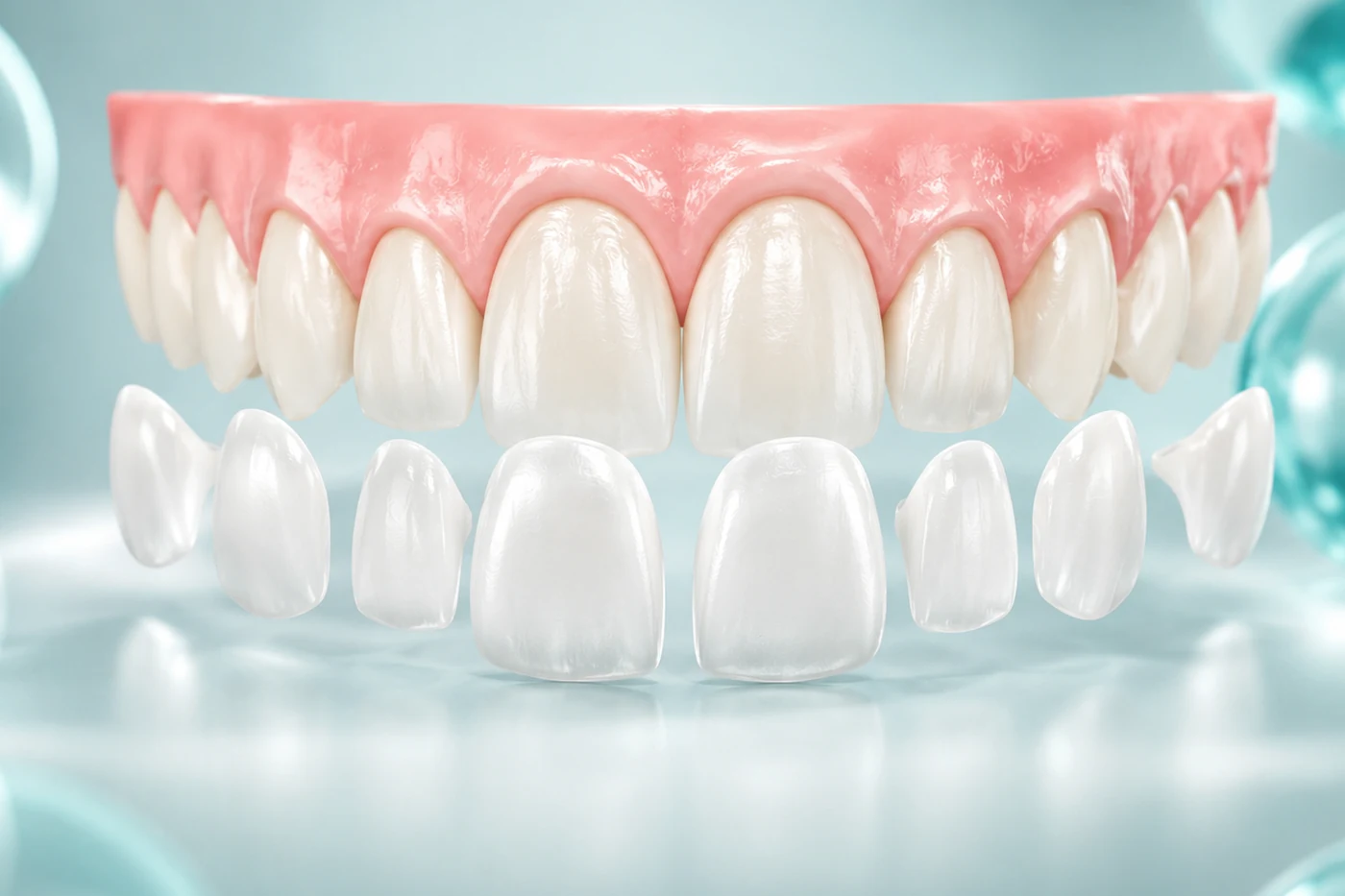
Porcelain veneers are thin ceramic restorations made outside the mouth and bonded to the visible surface of the tooth. They are used to change shape, colour or proportion while covering less tooth structure than a full crown in many cases.
Ceramic veneers can provide excellent colour stability and long-term appearance, but they still require careful planning, bonding and maintenance.
Composite Veneers Versus Porcelain Veneers
Composite veneers are commonly created directly with resin and are generally easier to repair if they chip or wear. Porcelain veneers are laboratory-made ceramics and usually provide better resistance to staining and stronger long-term survival in available clinical studies.
The better choice depends on enamel, bite, tooth position, existing fillings or restorations, colour change required, maintenance expectations and how much tooth structure would need to be removed.
How Much Tooth Preparation Is Needed?
Composite bonding can sometimes be additive or require very little reduction, but not every case is suitable for a no-preparation approach. Porcelain veneers may also be conservative, but the amount of enamel removal depends on tooth position, shade and the planned shape.
Preserving enamel matters. Recent evidence suggests ceramic veneers perform particularly well when bonding is mainly to enamel rather than to heavily exposed dentine.
What About Crowns?
A crown covers the entire visible tooth and usually requires more circumferential tooth preparation than a veneer. If a cosmetic package is described only as “Turkey teeth,” ask whether each tooth is receiving composite bonding, a veneer or a full crown.
Those choices are not equivalent because they remove different amounts of tooth structure and have different maintenance and repair pathways.
Staining And Colour Stability
Composite resin can pick up surface staining or change in colour over time, especially depending on polishing, diet, smoking and oral habits. It may need repolishing, repair or replacement.
Porcelain is generally more colour stable, although the surrounding teeth, margins and bonding material can still change over time.
Chipping, Wear And Repair
Composite can chip or wear, but small defects can often be repaired directly. Porcelain veneers can also chip, fracture or debond, and repair may be more complex depending on the damage.
The practical question is not only which material lasts longer, but also how easy it will be to maintain or repair after you return home.
What Does The Research Say About Longevity?
A practice-based study following ceramic and direct composite veneers for up to 10 years found better survival and success for ceramic veneers. A separate systematic review of resin-composite laminate veneers reported a pooled survival of about 88% across studies with follow-up ranging from roughly 2 to 8 years.
These results should not be treated as a guarantee for an individual patient. Tooth preparation, bonding surface, bite, habits and operator technique all affect outcomes.
Is It Worth Going To Turkey For Composite Bonding?
Travel may make sense for some patients, but composite bonding often needs periodic polishing, adjustment or repair. The decision should therefore include who will maintain the work after you return home.
A lower initial price may not be the lowest long-term cost if routine maintenance or a small repair requires another international trip.
Questions To Ask Before Choosing
- Is the proposal composite bonding, composite veneers, porcelain veneers or crowns?
- How much enamel or tooth structure will be removed?
- Why is this material suitable for my bite and tooth position?
- Can the restoration be repaired locally if it chips?
- How often might polishing or maintenance be needed?
- How will staining or shade changes be managed?
- Are my teeth and gums healthy enough for cosmetic treatment?
- Would orthodontics or another approach preserve more tooth structure?
- Who provides follow-up after I return home?
How Turkelite Medcare Coordinates Cosmetic Dental Planning
Turkelite Medcare is a patient coordination service, not the treating dental clinic. We do not choose the restorative material or decide how much enamel should be removed.
Our role is to organise provider questions, written treatment plans, appointments, travel and follow-up around the plan confirmed by the treating dentist. See patient services.
Frequently Asked Questions
Is Composite Bonding The Same As Veneers?
No. Composite bonding is usually direct resin placed on the tooth, while porcelain veneers are laboratory-made ceramic shells bonded to the tooth surface.
Does Composite Bonding Stain?
It can stain or change colour over time, depending on material, polishing, diet, smoking and oral habits.
Do Porcelain Veneers Last Longer Than Composite?
Current clinical studies generally show stronger long-term survival for ceramic veneers, but individual results depend on tooth structure, bonding, bite and maintenance.
Is Composite Bonding Better Because It Can Be Less Invasive?
It can preserve more tooth structure in selected cases, but suitability depends on how much correction is required and whether the bite and tooth condition support that approach.
Compare The Actual Restorations, Not The Marketing Phrase
The useful comparison is direct composite resin versus ceramic veneers or crowns, including preparation, repairability, staining, bite and long-term maintenance. “Turkey teeth” by itself is not a treatment specification.
Sources and further reading
- Guy’s and St Thomas’ NHS: Dental implants
- NHS: Dental treatments
- Republic of Türkiye Ministry of Health: International health tourism regulation
These sources support general patient information. Individual medical recommendations must come from the treating clinician.
View the related treatment area
This content is for general information and does not replace individual medical advice, diagnosis or treatment. Discuss treatment suitability, risks and recovery with a qualified healthcare professional.