
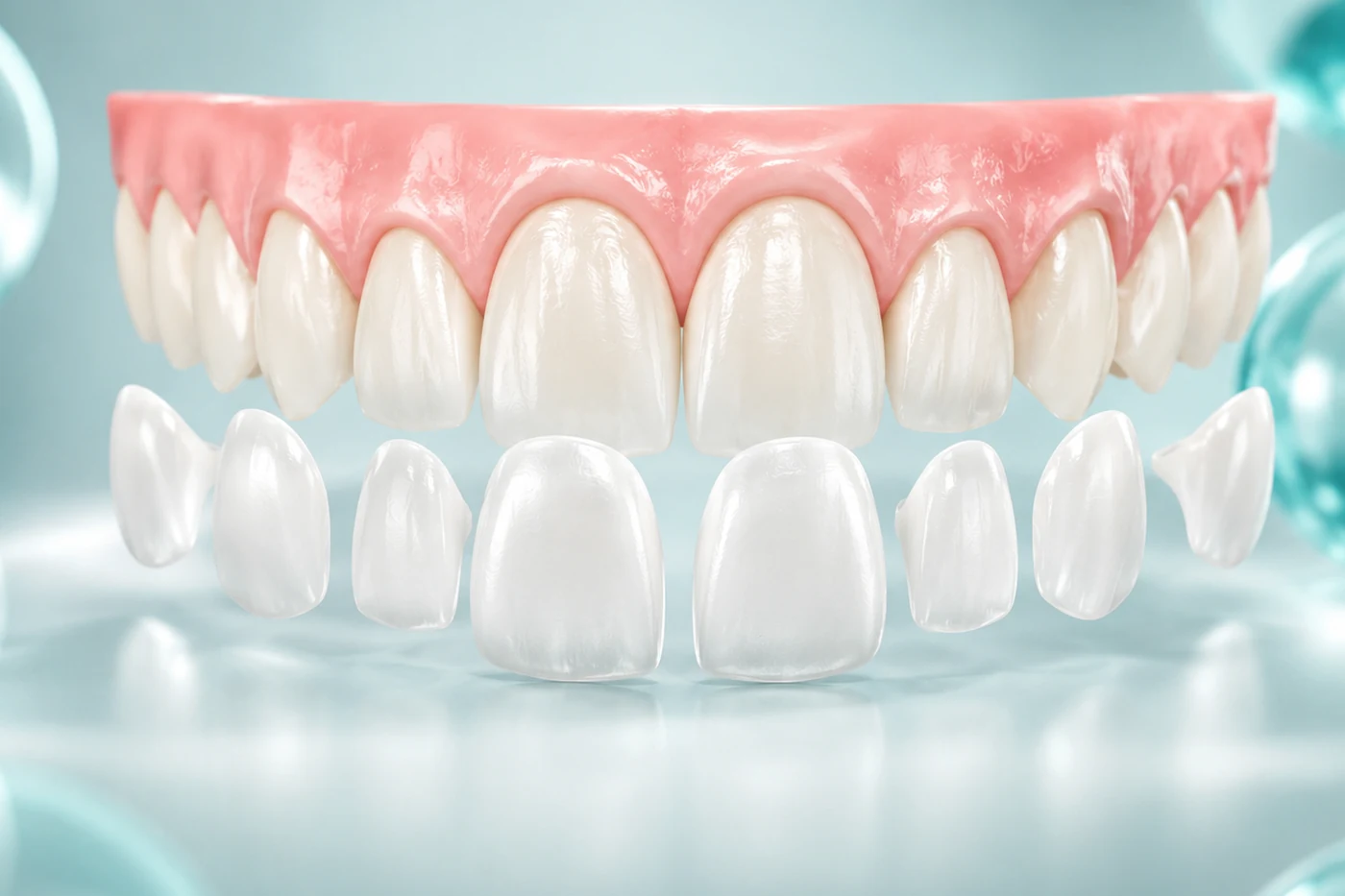
If you are comparing cosmetic dentistry abroad, a common search, are Turkey teeth veneers or crowns, can hide a much more important decision. “Turkey teeth” is not a clinical treatment name. It is an informal label used for cosmetic dental work carried out in Türkiye, and the finished smile may involve veneers, crowns, or a mixture of restorations. Those treatments are not interchangeable. A veneer usually covers mainly the front surface of a tooth, while a crown covers a prepared tooth much more completely. Before you agree to any irreversible tooth preparation, ask for the clinical name of the restoration planned for each tooth. You can review the basic veneer pathway on our dental veneers page.
Are Turkey Teeth Veneers or Crowns? Start With The Treatment Name
The most accurate answer is that they can be either. The phrase “Turkey teeth” describes neither a material nor a recognised dental procedure. It is commonly used online to describe a very even, bright smile produced through cosmetic or restorative dentistry in Türkiye. Some people receive porcelain or ceramic veneers. Others receive full-coverage crowns. A treatment plan can also combine the two, depending on the condition of individual teeth.
That distinction matters because a veneer and a crown change the natural tooth in different ways. The NHS describes a veneer as a facing placed over the front of a tooth. It describes a crown as a cap that completely covers a real tooth after that tooth has been shaped so the crown can fit. The visual result can look similar in photographs, but the preparation underneath may be very different.
There is no reliable national dataset showing that every smile described online as “Turkey teeth” follows one specific procedure. Clinic blogs often state that most such cases are crowns, but that is not a figure you should treat as a population statistic. The useful question is narrower and more practical: what exactly is being proposed for your own teeth, and why?
What A Dental Veneer Actually Changes
A dental veneer is a thin restoration bonded mainly to the visible front surface of a tooth. It can be used to change colour, shape, proportion, small edge defects or selected spacing concerns when the treating dentist considers a veneer appropriate. Some veneer designs require a small amount of enamel preparation, while other designs may involve minimal or no preparation. The amount depends on the starting tooth position, colour, enamel, planned material and the final shape being created.
Veneers are often described as conservative because they usually require less tooth reduction than a complete crown. That does not make them reversible in every case. If enamel is removed to create space or an appropriate bonding surface, that tooth has been permanently altered. A patient should therefore know how much preparation is planned before the procedure begins, not after the teeth have already been prepared.
A 2002 laboratory study by Edelhoff and Sorensen compared several preparation designs on model anterior teeth. In that experiment, veneer preparations removed about 3% to 30% of coronal tooth structure by weight, while complete crown preparations removed about 63% to 72%. These figures are useful for showing the difference in scale between the preparation types. They are not a prediction of how much tissue will be removed from your teeth, because real clinical preparation varies by tooth, restoration and treatment plan.
What A Dental Crown Actually Changes
A crown provides much more complete coverage. The natural tooth is prepared around its surfaces so a custom restoration can fit over it. Crowns are established restorative treatments and can be appropriate when a tooth needs substantial coverage because it is broken, heavily restored, worn or otherwise structurally compromised. The decision depends on an examination, imaging where indicated, the remaining tooth structure, the bite and the clinician's assessment.
The preparation is more extensive than for a typical veneer because space must be created around the tooth rather than mainly on its front surface. The same Edelhoff and Sorensen study found substantially greater tooth-structure removal for complete crown preparations than for veneer designs. This is why the words “veneer” and “crown” should never be treated as two marketing names for the same procedure.
If a crown is proposed, ask the treating dentist to explain the clinical reason for that tooth specifically. A crown is not automatically inappropriate because a tooth is visible when you smile, and a veneer is not automatically preferable because it is more conservative. The condition of the tooth determines whether a conservative facing is enough or fuller coverage is being recommended. Our dental crowns page explains the crown pathway separately.
Crowns Vs Veneers In Turkey: Compare The Tooth Preparation, Not The Label
Marketing language can make cosmetic packages sound more similar than they are. A quotation might focus on ceramic type, shade, number of units or the appearance of the final smile without making the preparation design obvious. Before comparing two offers, make sure the word used on the quotation matches what the clinician intends to do to each tooth.
For veneers, the questions should include whether preparation is planned, which surfaces will be prepared, whether the dentist expects to remain mainly in enamel and why the proposed material suits the tooth. For crowns, ask why full coverage is being recommended, how much healthy structure is expected to remain and whether there are more conservative alternatives for any tooth in the plan.
Material names alone do not answer the question. Zirconia, lithium disilicate and other ceramics can be used in different restorative designs depending on the clinical situation and product. Instead of trying to identify the treatment from a material word in an advertisement, ask for a tooth-by-tooth written plan that says “veneer” or “crown” beside every treated tooth.
The Tooth-By-Tooth Plan Is More Useful Than A Smile Package
A full smile does not have to use the same restoration on every tooth. One tooth may already contain a large restoration and need more coverage. Another may be structurally sound and require little or no restorative treatment. A third may have a colour or alignment issue that could have options other than ceramic coverage. Treating every visible tooth identically can make the quotation easy to understand, but it does not tell you whether the plan reflects the condition of each tooth.
The General Dental Council's patient guidance for treatment abroad says patients should be assessed by a qualified dentist before receiving a treatment plan and estimate. It also recommends asking who will carry out the treatment, what qualifications they have, how aftercare works, what happens if complications occur and who can be contacted after treatment. For a crown-versus-veneer decision, add one more requirement: ask the dentist to record why each tooth needs the proposed level of preparation.
Before committing, use this checklist:
- Ask for the exact restoration on every tooth. The written plan should distinguish veneers, crowns and any teeth receiving no restoration.
- Ask what will be removed. Confirm which surfaces will be prepared and whether the preparation is expected to remain mainly in enamel or extend further.
- Ask why a crown is needed. If full coverage is proposed, request the clinical reason for that specific tooth.
- Ask about alternatives. Depending on the problem, the treating dentist may discuss options such as whitening, orthodontic treatment, bonding or no treatment.
- Ask what happens after you return home. Know who handles sensitivity, a loose restoration, bite problems, fractures or other concerns.
Our questions before booking guide can help you organise the broader provider, treatment and follow-up questions before travel.
Why Healthy Enamel Matters In Veneer Planning
Enamel is not simply spare material that can be removed without consequence. Veneer bonding often performs best when a large proportion of the bonding surface remains enamel. A 2025 systematic review and meta-analysis in the Journal of Prosthetic Dentistry found better survival and success outcomes for ceramic veneers bonded to enamel than for veneers with greater dentine exposure. The authors also found more complications when bonding involved more exposed dentine.
That evidence does not mean every veneer must be completely within enamel or that a dentist can decide suitability from a photograph. It does explain why preparation depth matters. A plan that preserves appropriate enamel where clinically possible is different from a plan that removes substantial tooth structure simply to standardise the appearance quickly.
This is also why you should not judge treatment quality from the final whiteness alone. Shade, symmetry and surface finish are visible immediately. The amount of natural tooth preserved underneath is not. Your consent discussion should cover both the visible goal and the biological cost of reaching it.
When A Less Invasive Option Should At Least Be Discussed
If the main concern is colour, shape, small spacing or mild visual irregularity, there may be more than one way to approach it. That does not mean whitening, bonding, orthodontics or veneers will be suitable for you. It means the clinical conversation should identify what problem is being solved before an irreversible restoration is selected.
A patient asking for a very white, uniform smile may be focused on the appearance rather than the treatment name. The clinician's role is to assess the teeth, gums and bite, explain realistic options and obtain informed consent for the chosen approach. If one option removes more natural structure, the reason for accepting that trade-off should be clear before treatment starts.
Use our informed consent guide to prepare for that discussion. It can help you separate a cosmetic preference from the clinical steps required to achieve it.
Risks To Understand Before Veneers Or Crowns
Both veneers and crowns are established dental treatments, but neither is free of possible complications. Depending on the restoration and preparation, concerns can include postoperative sensitivity, discomfort, gum irritation, marginal problems, chipping, debonding, fracture, bite issues or the later need for repair or replacement. More extensive preparation can also bring the work closer to the dental pulp, which is one reason treatment planning should not be reduced to the colour and shape of the final ceramic.
Distance changes how these problems are managed. If the treating dentist is in Türkiye and you are back in the UK or another country, a review may require remote communication, local dental care or, in some cases, a return visit. The General Dental Council advises patients considering overseas dental treatment to ask what aftercare is provided, who pays for additional travel or remedial work, what happens if complications occur and who can be contacted afterwards.
After treatment, do not wait for a scheduled trip if you develop a problem that needs urgent assessment. NHS guidance advises urgent dental help for severe pain that is affecting daily life, swelling that is increasing or not resolving, and broken or loose crowns, bridges or veneers. Heavy bleeding that will not stop or severe swelling affecting breathing requires emergency medical care. Your treating clinic should also give you its own written escalation instructions.
Do Not Approve The Final Smile From A Photo Alone
Photographs are useful for discussing goals, but they cannot replace a clinical examination. They do not fully show decay, cracks, the amount of sound enamel, existing restoration margins, the health of the supporting tissues or how your teeth meet when you bite. Radiographs or other records may also be needed depending on the case.
A remote review can help a clinic understand what you are hoping to change, but the final clinical plan should be confirmed by the treating dentist after appropriate assessment. If the in-person findings are different from what was expected remotely, the plan may need to change. Build that possibility into your travel expectations rather than treating the first online proposal as a guaranteed final plan.
Our choosing a clinic guide explains what to verify about providers, records, communication and follow-up before making a booking.
How Turkelite Medcare Coordinates A Veneer Or Crown Enquiry
Turkelite Medcare is a patient coordination service, not a dental clinic. We do not diagnose teeth, decide whether a veneer or crown is appropriate, or tell a treating dentist how much tooth structure to remove. Those decisions belong to the independent clinic and qualified clinician after assessment.
Our role is to help make the decision process clearer before travel. That can include arranging communication with independent providers, helping you obtain a written treatment plan, coordinating questions about what is proposed on each tooth, supporting language communication and organising travel only after the clinical pathway is clear. If two proposals use different treatment names, the useful next step is to clarify the clinical reasoning rather than compare only the number of units.
Turkelite can also help keep practical planning connected to the provider's confirmed treatment schedule, including appointments, flights, transfers, accommodation and the return-home handover. The patient services page explains the coordination role in more detail.
Frequently Asked Questions
Can “Turkey Teeth” Be Veneers Or Crowns?
They can be either. “Turkey teeth” is an informal description, not a clinical procedure. Some patients receive veneers, some receive crowns and some plans use a mixture. A veneer mainly covers the front of a tooth, while a crown provides much fuller coverage. Ask the treating dentist to identify the restoration planned for every tooth in writing before any irreversible preparation.
What Are Turkey Teeth?
“Turkey teeth” is a non-clinical phrase commonly used for cosmetic or restorative dental work completed in Türkiye, often with the aim of creating a brighter and more uniform smile. The term does not tell you whether the treatment involves veneers, crowns or another procedure. The actual treatment should be confirmed through a clinical assessment and written tooth-by-tooth plan.
Do Veneers Require Teeth To Be Shaved?
Some veneers require enamel preparation and some designs may involve minimal or no preparation. The amount depends on tooth position, colour, available enamel, restorative material and the planned result. Because any removed enamel does not grow back, ask the treating dentist how much preparation is expected and which surfaces will be altered before you consent.
Do Crowns Remove More Tooth Structure Than Veneers?
Complete crowns generally require more tooth preparation because they cover the prepared tooth more fully. In a laboratory study of anterior preparation designs, complete crown preparations removed substantially more coronal structure than veneer preparations. Those figures demonstrate the difference between designs but cannot predict the exact amount that would be removed in an individual clinical case.
How Can I Tell If A Quote Is For Crowns Or Veneers?
Ask for the clinical restoration name beside every tooth number, not only a package title. The plan should state whether each unit is a veneer or crown, what preparation is planned and why. Material names and marketing terms alone may not tell you how the natural tooth will be prepared, so the treating dentist should confirm the procedure in writing.
What Should I Do If I Am Unsure About A Crown Recommendation?
Ask the treating dentist to explain why full coverage is being recommended for that tooth, what alternatives were considered and what additional tooth preparation the crown requires. You can also seek an independent dental opinion before irreversible treatment. Turkelite can coordinate provider communication, but the clinical recommendation must come from a qualified treating dentist after assessment.
Know What Is Being Done Before You Travel
The phrase “Turkey teeth” should never be enough information to consent to treatment. What matters is whether each tooth is receiving a veneer, a crown or another option, how much preparation is planned, why that treatment was selected and what happens if the plan changes after examination. Get those points in writing before travel and before irreversible work begins.
If you want help coordinating provider communication and travel around a clinician-confirmed dental plan, Start your private enquiry.
This content is for general information and does not replace individual medical advice, diagnosis or treatment. Discuss treatment suitability, risks and recovery with a qualified healthcare professional.