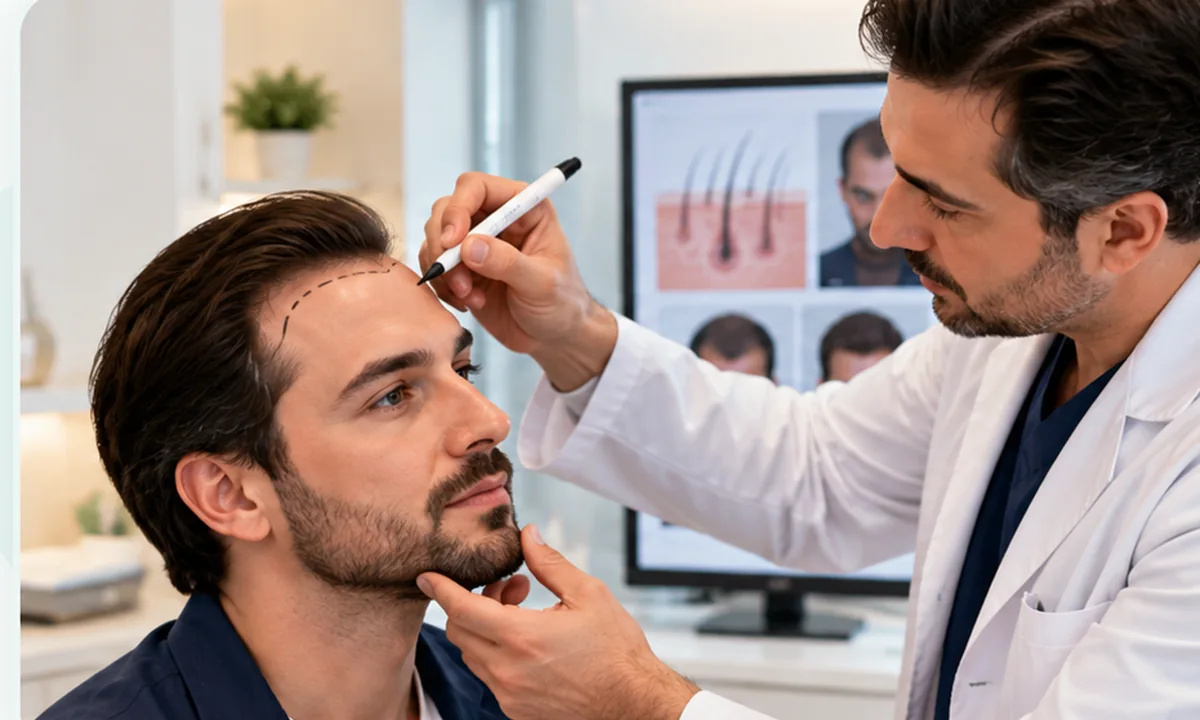
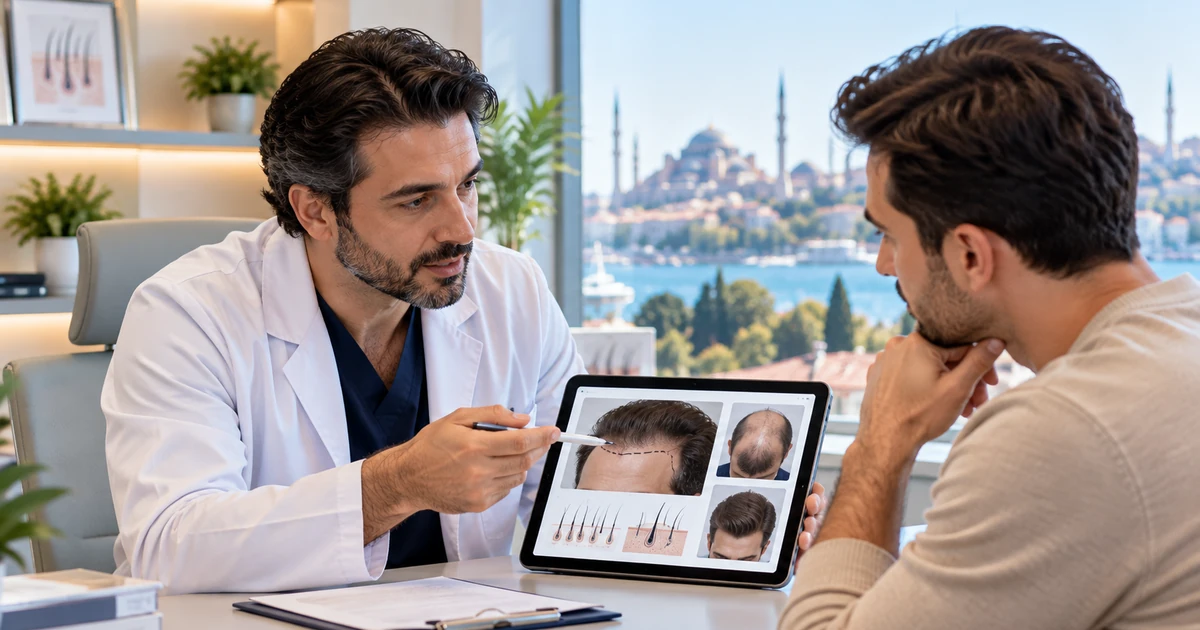
When comparing a hair transplant clinic in Istanbul, start with the person responsible for your surgery, not the number of hotel nights in a package. A clinic may have attractive photos, fluent coordinators and reassuring online reviews, yet these alone cannot establish whether its clinical plan is appropriate for your hair loss.
Illustrative consultation: ask for an individual clinical plan and the name of the responsible surgeon.This guide is specifically about how to choose a hair transplant clinic in Istanbul: checking the surgeon's role, understanding donor-area planning, comparing written evidence and preparing follow-up after travelling home. It complements Turkelite Medcare's general guide to evaluating a clinic abroad without repeating a generic travel checklist.
Quick answer: what makes a clinic worth shortlisting?
A credible option should be able to identify the actual treating facility and clinician, explain who performs each surgical stage, provide an individual medical rationale, outline risks and realistic limits, and document how complications and follow-up will be handled. If these facts are still unclear, do not make a non-refundable booking.
1. Verify the treating surgeon, not just the clinic brand
Ask for the surgeon's full name, relevant medical licence, specialty and hair-restoration experience. A famous brand or a consultation with a sales coordinator does not identify who will perform the operation. Confirm who personally examines your scalp, designs the hairline, manages local anaesthesia, harvests grafts, creates recipient sites and supervises care afterwards.
Professional guidance from the International Society of Hair Restoration Surgery (ISHRS) highlights the importance of physician-led diagnosis, planning and surgical work; the exact tasks legally delegated can vary by jurisdiction. Ask the clinic to explain each person's qualifications and permitted role under the applicable rules in Türkiye.
Ask for a clinician consultation before paying. A responsible clinic should be able to discuss reasons not to operate immediately, including uncertain diagnosis, unsuitable donor resources or expectations that a transplant cannot meet.
2. Confirm the facility and its medical authorisation
Request the actual operating facility name and address. Check the facility's relevant healthcare authorisation and the surgeon's professional registration with appropriate official Turkish authorities or directly with the issuing body. Advertising claims, social-media badges and memberships are not interchangeable with a valid facility licence.
Check where the consultation, procedure and early review will each take place. If the advertising company, booking agent and treating facility have different names, ask the clinic to set out their roles in writing. The Turkelite clinic-matching service is designed to organise these provider-identity and practical questions before an introduction; it is not a medical endorsement or guarantee.
3. Demand donor-area assessment and a long-term hairline plan
Hair transplants redistribute existing follicles; they do not create unlimited new donor hair. Before committing to a graft number, a clinician should evaluate the type of hair loss, donor density, hair calibre, possible scalp disease, past operations and likely future thinning. A plan should describe both the immediate coverage and the donor supply that may be needed later.
Compare how clinics justify their estimates. A promise of a very high graft count without a donor examination can be a reason to seek another opinion. Ask what happens if the graft estimate changes after an in-person assessment.
For technical background, read the FUE hair transplant treatment guide; the DHI implantation guide describes a commonly marketed implantation approach. Labels and tools alone are not proof of medical quality.
4. Compare clinics with one evidence-based decision table
| Compare this | Evidence to request | Warning sign |
|---|---|---|
| Surgeon and team | Named clinician, credentials, written surgical roles | "Our team handles everything" without names |
| Individual suitability | Diagnosis, donor assessment, reasons for this plan | Identical graft number for everyone |
| Facility authorisation | Exact treating location and verifiable documentation | Only badges and marketing statements |
| Risks and consent | Discussion of bleeding, infection, scarring, failed growth and alternatives | Guaranteed results or no discussion of risks |
| Written quotation | Clinical inclusions, exclusions, revisions and refund policy | Pressure to pay without a detailed scope |
| Return-home care | Named medical contact, records, review schedule and urgent-care plan | Only a generic support-chat promise |
Use the same questions with every clinic. A decision table helps compare accountable medical care rather than promotional package features.
5. What photos and patient reviews can—and cannot—tell you
Before-and-after photos may help you discuss hairline style and achievable density, but they cannot prove a result is typical, that the pictured patient had the same baseline condition, or that the named surgeon performed the work. Ask when photographs were taken, how comparable the cases are, and whether consent for their use was obtained.
Read positive and negative reviews critically. Look for specific descriptions of the medical assessment, surgeon involvement and follow-up rather than focusing on airport transfers or hotel quality alone. A claim of zero complications or universally perfect results is not a substitute for documented risk disclosure.
6. Ask what happens if the outcome is different from the promise
Ask who evaluates persistent redness, unusual swelling, significant pain, suspected infection or problems in the donor area. Have a plan for getting urgent medical assessment locally if needed. Hair growth takes time and no clinic should promise a particular final density or a complication-free procedure.
Ask about record transfer, postoperative photographs, review intervals and the clinician's process for assessing concerns about growth months later. Revision surgery may not always be possible because donor supply is limited. The hair transplant repair guide explains why correcting an unsatisfactory transplant requires a separate specialist assessment.
7. Build the follow-up plan before travelling home
If you are travelling from Germany, the UK or another country, ask when the treating team expects to review your scalp, what signs require prompt attention and which activities must be limited. Flights should be scheduled only after the clinician has confirmed an appropriate plan; travel timing is not a fixed guarantee for every patient.
Turkelite's international patient services can coordinate appointments, accommodation, transport and communication around the treatment plan. Clinical advice and consent remain with the independent treating clinician. For cross-border recovery questions, see the travel-after-treatment guidance.
Frequently asked questions
How do I identify the best hair transplant clinic in Istanbul?
There is no universally best clinic for every patient. Shortlist providers that can demonstrate appropriate authorisation, a named qualified surgeon, an individual donor plan, transparent costs and a workable aftercare arrangement.
Should the surgeon perform every step of the procedure?
The treating team must describe who performs each step and whether that person's role is permitted under local professional rules. The responsible physician should lead the clinical assessment, planning and the aspects of surgery that require medical expertise.
Can online reviews prove a clinic is safe?
No. Reviews are one source of patient experience, but cannot independently establish medical qualifications, surgical supervision, facility authorisation or the complication response plan.
What should I receive before leaving Istanbul?
Request treatment records, medication and wound-care instructions, a follow-up schedule, signs that need urgent review and direct details for the responsible treating team.
Next step: request a transparent clinic comparison
A shortlist should help you ask better questions—not push you toward an immediate operation. If you are considering Istanbul for hair restoration, start a private treatment enquiry with Turkelite Medcare. We help organise provider questions and travel logistics; the independent treating facility and clinician make all medical decisions.
Medical disclaimer: This educational article is not medical advice. Hair transplantation is a surgical procedure with possible infection, bleeding, scarring, anaesthetic reactions, unsatisfactory growth and continued native-hair loss. A qualified clinician must assess your case. Seek prompt medical care for severe or unexpected symptoms.
Medical information sources
This content is for general information and does not replace individual medical advice, diagnosis or treatment. Discuss treatment suitability, risks and recovery with a qualified healthcare professional.