Quick answer
Hair Transplant Month by Month: Growth Timeline: the right answer depends on diagnosis, the actual treatment plan and individual risk factors. Use this article to prepare for consultation, then have the treating clinic confirm timing, medicines, suitability and travel planning for your case.
- Do not confirm treatment before adequate clinical assessment.
- Get scope, risks, aftercare and return-travel criteria in writing.
- For care in Turkey, verify the authorised facility and responsible clinician.
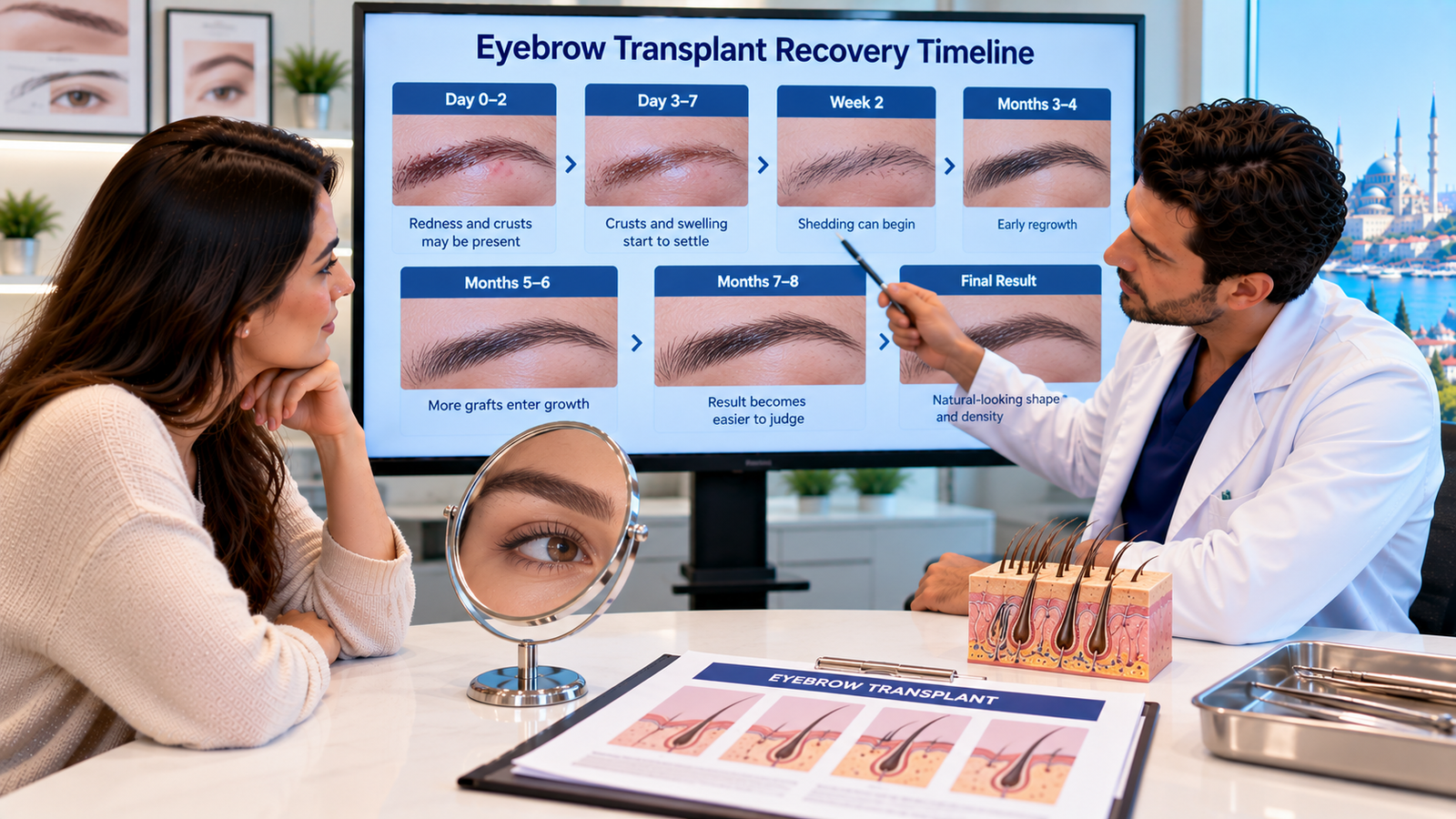
Hair transplant month by month progress is not linear. The American Academy of Dermatology notes that transplanted hair commonly sheds between about two and eight weeks, may look thinner around the third month, and usually becomes visibly more rewarding later. Most patients see results between six and nine months, while some need about twelve months. Use our Hair Restoration pathway as a planning reference, but let the operating clinic assess your own photographs and scalp.
Month 1: Healing And Early Shedding
By the end of the first month, surface healing is usually well advanced. Crusts should have resolved, but redness, dryness or numbness can persist.
Some transplanted shafts may already be shedding. This is expected and is not the same as loss of the transplanted follicles.
Month 2: The Shedding Phase
Shedding can continue through the second month. The recipient area may appear thinner than it did immediately after surgery.
This can still be part of normal recovery.
Month 3: The Quiet Phase
The American Academy of Dermatology notes that by the third month the hair can look thinner than before the transplant. New growth may be limited or uneven.
Some hairs begin to emerge, but density is not ready to judge.
Months 4 To 5: Early New Growth
More new hairs commonly begin to appear. Early hairs can be fine, soft, curly or uneven in direction while they mature.
Do not compare this stage with a twelve-month result.
Months 6 To 9: Visible Improvement
This is the period in which many patients begin to see a clearly fuller result. The American Academy of Dermatology states that most patients see results between six and nine months.
Hair can continue to thicken in calibre, lengthen and blend better with native hair.
Months 10 To 12: Maturation
By around twelve months, many cases can be judged much more meaningfully. Some patients still continue to mature beyond this point.
The crown can appear to mature more slowly than the frontal hairline.
What Can Change The Timeline?
- Hair calibre and curl.
- Recipient area and crown involvement.
- Scalp inflammation or skin disease.
- Smoking, general health and healing.
- Ongoing native-hair loss.
- Temporary shock loss.
When Will I See Hair Transplant Results?
Visible improvement often becomes more obvious around months six to nine, while fuller assessment may require about twelve months.
A clinic promising a complete result in the first few months is setting an unrealistic timeline.
How Turkelite Medcare Coordinates Long-Term Follow-Up
Turkelite Medcare is a patient coordination service, not the treating hair-transplant clinic. We do not decide whether growth is normal or prescribe hair-loss medication.
Our role is to keep provider communication, scheduled reviews, photographs, records and the return-home handover organised around the clinician’s plan. See patient services.
Frequently Asked Questions
Why Does My Hair Look Worse At Month 2 Or 3?
Because transplanted hair commonly sheds in the first several weeks and early regrowth may not yet be visible.
Is Month 6 The Final Result?
No. Density and hair calibre commonly continue to mature through months 9 to 12 and sometimes longer.
When Should I Judge The Hairline?
Do not judge it in the shedding phase. A much more useful assessment happens later.
Can Native Hair Keep Thinning After A Transplant?
Yes. A transplant does not stop the underlying cause of native-hair loss.
Think In Months, Not Days
The first months are a transition from healing to shedding and then to regrowth. The final result is a long-term process.
Sources and further reading
- NHS: Hair transplant
- NHS: Choosing who will do your cosmetic procedure
- Republic of Türkiye Ministry of Health: International health tourism regulation
These sources support general patient information. Individual medical recommendations must come from the treating clinician.
View the related treatment area
This content is for general information and does not replace individual medical advice, diagnosis or treatment. Discuss treatment suitability, risks and recovery with a qualified healthcare professional.