If you are planning treatment abroad, how long to stay in Turkey for hair transplant care is not just a hotel question. Your stay has to cover the procedure, the first clinical review the provider expects, early scalp care and a return flight that does not force you to leave before the treating team is satisfied with your immediate recovery. Many commercial itineraries are built around a short stay of roughly three to four nights, but that is a planning pattern, not a universal medical rule. The correct departure point depends on your procedure, whether treatment spans more than one day, the donor and recipient areas, your general health and the clinic's own aftercare protocol. Start with our Hair Restoration page, then build travel around the clinician-confirmed plan.
How Long to Stay in Turkey for Hair Transplant Care
There is no single evidence-based number of nights that applies to every patient. Current clinic pages commonly describe itineraries of about three to four nights, often covering arrival, assessment, the procedure, a first review or wash and departure. That pattern can be useful for understanding how providers organise international care, but it should not be mistaken for an official medical standard.
NHS guidance describes hair transplantation as an outpatient procedure that usually takes a day, while noting that a large treatment area may require two or more sessions on different days. The same guidance says the scalp may be tight, achy and swollen for a few days and that transplanted hair needs particular care for the first two weeks because the grafts are not yet secure. Those facts explain why a travel plan should leave room for early recovery instead of treating the procedure as a same-day tourism activity.
The useful question is therefore not, “What is the minimum number of hotel nights?” It is, “Which clinical steps does my treating team want completed before I leave?” For one patient that may be a post-operative review and washing demonstration. For another it may include a second procedure day, dressing removal, reassessment of bleeding or swelling, or a different timetable because FUT stitches or another clinical issue need follow-up.
Build The Stay Around Clinical Milestones, Not A Package
A package may list three nights, four nights or another fixed duration because hotels and transfers need dates. Your scalp does not heal according to the hotel booking. Before paying for flights, ask the provider to separate the clinical schedule from the travel package so you know what must actually happen while you are still in Türkiye.
The International Society of Hair Restoration Surgery describes hair transplantation as minor outpatient surgery, usually performed with local anaesthesia and sometimes oral or intravenous sedation. Its patient information also notes that written postoperative instructions should be provided. That makes the discharge plan important: you should know how to protect the grafts, care for the donor area, use any prescribed products and contact the treating team if something unexpected happens.
A practical stay should therefore include enough time for the provider's planned early check, not just enough time to finish the transplant itself. If the clinic expects to inspect the recipient area, remove or change a donor dressing, demonstrate washing or review swelling before departure, those steps belong in the travel calendar before you buy a non-refundable flight.
A Practical Short-Stay Model
This model is for travel planning only. It is not a treatment recommendation, and your treating clinic may use a different sequence.
- Before travel: confirm who will assess you, whether the procedure is expected to take one day or more, what records are needed, and which post-operative appointment must occur before departure.
- Arrival and assessment: complete the in-person examination, confirm the hairline and donor plan, review consent and allow the clinician to change the proposed plan if the physical findings differ from photographs or a video consultation.
- Procedure day: keep the rest of the day free. Hair transplantation can take several hours, and large sessions may be divided across more than one day.
- Early recovery and review: follow the clinic's instructions on sleeping, sprays, dressings, washing and contact with the grafts. Attend the planned review before assuming you are ready to travel.
- Departure: fly only after the treating provider has confirmed that the immediate plan is complete and you feel well enough to travel. Leave with written aftercare instructions and a clear contact route for problems after you return home.
The key point is that “procedure finished” and “travel plan complete” are not always the same moment. A short stay can be reasonable when the clinician has planned it that way, but the flight should follow the medical schedule rather than force it.
What Can Make You Need More Days In Turkey?
A larger treatment area is one straightforward reason. NHS guidance notes that a large area may require two or more sessions on different days. If your procedure is split across days, your stay needs to cover all planned sessions plus whatever early review the clinic requires afterwards.
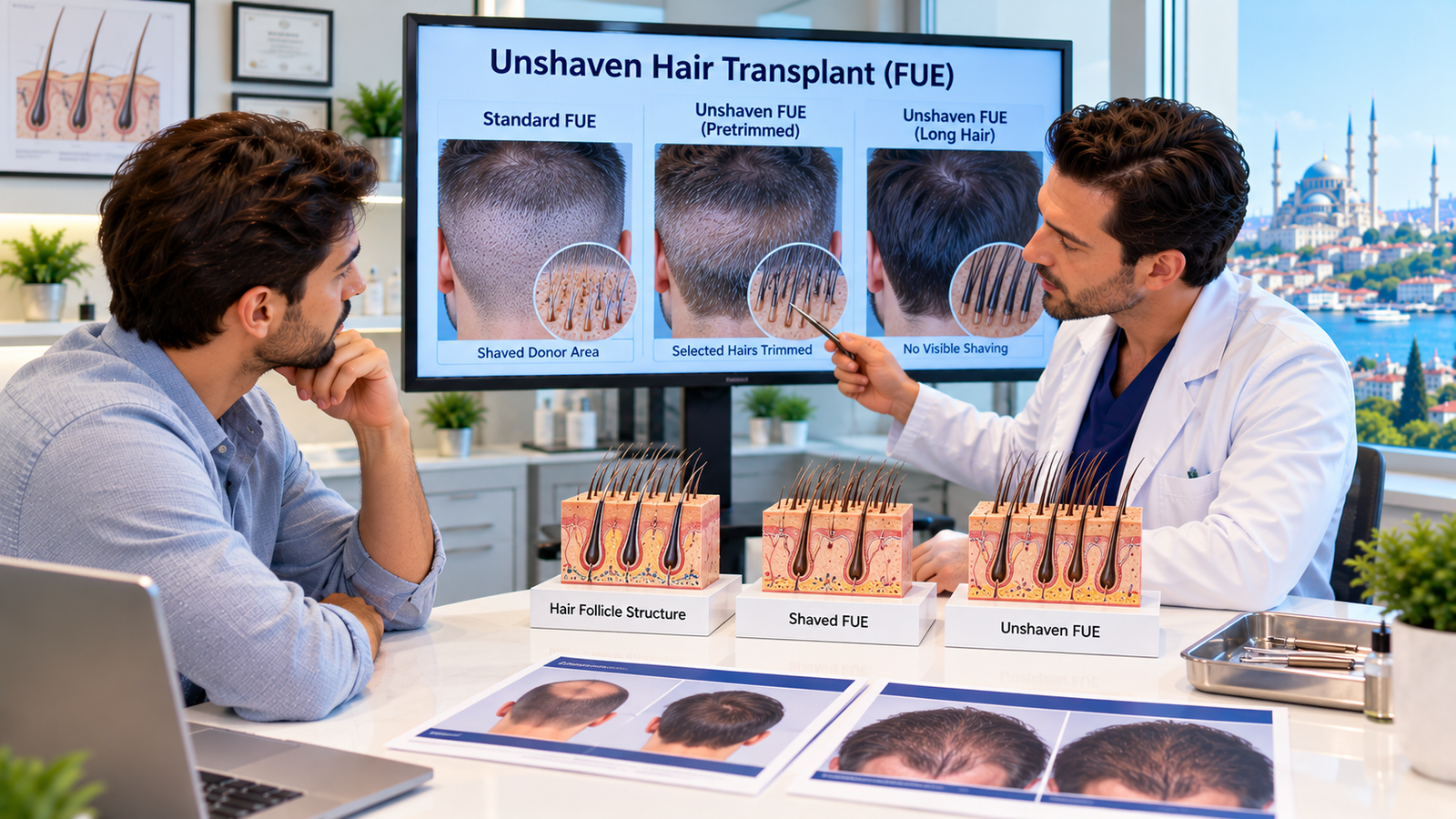
The technique can also affect follow-up. FUE removes individual grafts and leaves many small donor sites. FUT removes a strip of hair-bearing skin, so the donor area is closed with stitches or staples. NHS guidance says non-dissolvable stitches can usually be removed after about 10 to 14 days. ISHRS patient information gives a similar general range of 7 to 14 days for suture or staple removal. That does not necessarily mean you must remain in Türkiye for the whole period, but the treating team should state who will remove them and where before you travel home.
Your immediate recovery matters too. Bleeding, unexpected pain, notable swelling, problems with the donor wound or feeling generally unwell may justify another assessment before travel. Extra nights can also be practical if your flight is very long, you are travelling alone, the clinic wants another in-person review, or your itinerary would otherwise require rushing through an airport immediately after treatment.
Flying Home After Hair Transplant Surgery Needs A Separate Decision
There is no NHS hair-transplant rule saying every patient must wait the same number of hours or days before boarding a commercial flight. That means a generic online statement such as “everyone can fly the next day” should not replace the treating clinician's decision. The provider knows whether your procedure lasted one day or several, whether sedation was used, how the donor area looks and whether your early recovery has been straightforward.
Long-distance travel also has risks that are separate from the grafts themselves. The US Centers for Disease Control and Prevention defines long-distance travel as generally more than four hours and explains that prolonged sitting can contribute to blood-clot risk. Recent surgery is one of the factors that can increase that risk. Hair transplantation is usually minor outpatient surgery rather than major chest or abdominal surgery, so major-surgery waiting periods should not simply be copied onto hair-transplant patients. The relevant point is that your clinician should consider your personal risk factors and flight duration rather than relying on a package timetable.
If you have a history of blood clots, clotting disorders, significant heart or lung disease, limited mobility or another factor that could change travel risk, tell the treating team before the procedure and before the return flight is booked. Do not start blood thinners, compression treatment or other preventive medication on the basis of a blog. Those decisions require individual medical assessment.
The Airport Can Be Harder On Fresh Grafts Than The Seat Number Suggests
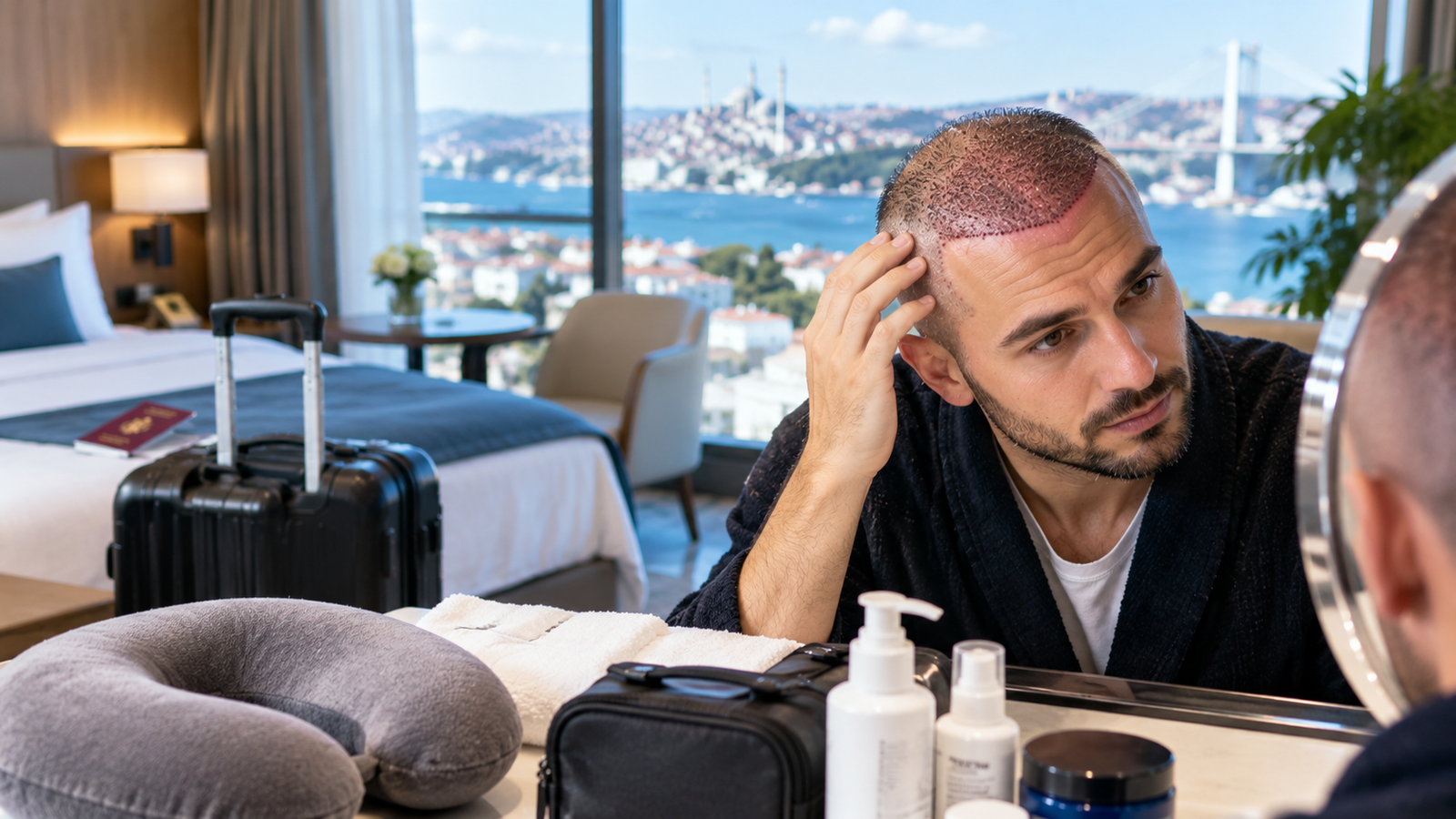
The first trip through an airport after surgery is mostly a logistics problem. NHS guidance says transplanted hair needs very careful handling during the first two weeks because the grafts are not secure. In a crowded terminal, that means thinking about accidental knocks, low door frames, overhead lockers, tight hats and anything that can rub the recipient area.
Ask the clinic how they want you to position your head during the flight and whether any neck pillow, head covering or travel accessory is acceptable. Do not assume that an ordinary cap is safe simply because you want to cover the scalp. The answer depends on where grafts were placed and what the treating team has told you about contact and pressure.
Travel light enough that you do not need to lift a heavy cabin bag over your head. Keep discharge papers, clinic contact details and any prescribed scalp products or medicines in accessible hand luggage, subject to airline security rules. If you have a connection, allow enough time that you do not have to run between gates.
When A Booked Flight Should Not Control The Decision
A non-refundable ticket is not a clinical clearance. NHS guidance says you should contact the clinic that performed the transplant as soon as possible if you have severe pain or any unexpected symptoms. Hair transplantation also carries recognised surgical risks such as bleeding, infection and reactions to anaesthetic medicines.
If you develop symptoms that need assessment before departure, contact the treating clinic and follow their advice. If you are seriously unwell, have uncontrolled bleeding, breathing difficulty or another emergency, seek urgent local medical care rather than waiting for an online reply or trying to board a flight. In Türkiye, the emergency medical number is 112.
The UK Foreign, Commonwealth & Development Office also advises people travelling for medical treatment to research providers carefully, arrange appropriate insurance and understand that complications may require further treatment. That is particularly relevant when a planned procedure is followed quickly by international travel.
What Happens After You Fly Home?
The return flight does not end the recovery period. NHS guidance says the grafts still require particular care during the first two weeks. It notes that bandages can often be removed after two to five days, gentle hand washing may be possible around day six, and non-dissolvable stitches are commonly removed after 10 to 14 days. Your treating clinic may use a different protocol, so follow its written instructions rather than changing the schedule to match a general article.
You should know who reviews photographs, who answers questions outside normal hours, what symptoms need local medical attention and whether any in-person review is expected in your home country. If you need a local doctor or dermatologist to assess a problem, having an operation note and written aftercare instructions can make that conversation clearer.
Our aftercare guide and travel after treatment guide can help you prepare those questions before the return flight.
More Nights Are Not Automatically Better
Staying longer can make travel feel less rushed, but extra hotel nights are not automatically a medical advantage. If the treating clinic has completed its planned reviews and is comfortable with your departure, staying an additional week simply because another patient did so does not create a new clinical benefit by itself.
On the other hand, the shortest possible itinerary is not automatically better either. Leaving immediately after a long procedure may mean you miss a planned review, travel while tired or swollen, or discover an aftercare question only after you are already at the airport. The useful target is enough time to complete the provider's early-care plan without unnecessary delay.
This is why Reddit experiences and clinic package pages vary so widely. One person may fly the next day without difficulty, while another wishes they had stayed longer. Those stories are useful for understanding practical concerns, but they cannot tell you what your scalp, medical history or procedure requires.
Questions To Answer Before You Book The Return Flight
- Is my procedure expected to take one day or more than one day?
- Which post-operative review must happen before I leave Türkiye?
- Will the clinic remove or change a donor dressing before departure?
- When does the clinic want me to begin washing, and will they demonstrate it in person?
- If I have FUT stitches or staples, who will remove them and when?
- What symptoms would mean I should delay the flight and be reassessed?
- Does my flight length or medical history change the provider's fit-to-travel advice?
- Who do I contact after I return home, including outside normal clinic hours?
Our questions before booking guide can help you organise the wider provider, consent and follow-up questions before you commit to travel.
How Turkelite Medcare Coordinates Hair Transplant Travel
Turkelite Medcare is a patient coordination service, not the treating clinic. We do not decide whether a hair transplant is suitable for you, how many grafts should be placed, how long you must stay or when you are medically ready to fly. Those decisions belong to the independent treating clinic and qualified clinician after assessment.
Our role is to connect the practical plan to the clinical one. Once the provider confirms the expected procedure schedule and departure window, Turkelite can coordinate clinic communication, flights, accommodation, airport and clinic transfers, language support and the return-home handover. If the clinical plan changes after the in-person assessment, the travel plan should be adjusted around it rather than asking the medical team to fit a fixed ticket.
Before you leave Türkiye, the practical handover should include written aftercare, the clinic's contact route, the expected follow-up schedule and a plan for what to do if a problem develops at home. Our patient services page explains how this coordination works.
Frequently Asked Questions
How Many Days In Turkey For Hair Transplant Treatment Are Usually Planned?
Many commercial itineraries use roughly three to four nights, but there is no universal medical number that fits every patient. Your stay should cover the procedure, any additional treatment day and the early review required by the treating clinic. A large treatment area, FUT follow-up, unexpected symptoms or a provider-specific washing and review schedule can change the departure date.
Can I Fly Home The Day After A Hair Transplant?
Some providers schedule early departures, but there is no rule that makes next-day flying appropriate for everyone. The treating clinician should confirm that the planned early checks are complete and that your recovery is suitable for travel. Flight duration, sedation, general health, bleeding, swelling and any personal blood-clot risk factors may also affect the decision.
Does A Long Flight Change The Plan After A Hair Transplant?
It can. The CDC notes that travel lasting more than four hours involves prolonged sitting and that recent surgery is one factor associated with higher blood-clot risk. That does not create one waiting period for every hair-transplant patient. Tell the treating team your flight duration and relevant medical history so they can give individual travel advice.
Should I Stay Until All Scabs Have Gone?
Not necessarily. NHS guidance says temporary scabbing is common and that transplanted hair needs careful handling for the first two weeks. Whether you need to remain in Türkiye until a particular scalp milestone depends on the treating clinic's protocol, not on a forum rule. Ask what must be checked in person and what can be managed safely after you return home.
What If I Feel Unwell On The Day I Am Due To Fly?
Contact the treating clinic before travelling if you have severe pain or unexpected symptoms. If you are seriously unwell, have uncontrolled bleeding, breathing difficulty or another emergency, seek urgent local medical care instead of boarding the flight. A booked ticket should not override the need for assessment.
Do I Need A Follow-Up Plan After I Return Home?
Yes. Before departure, you should know how to contact the treating clinic, what photographs or reviews they expect, which symptoms need local medical assessment and whether stitches or staples require removal. Written aftercare instructions and an operation note can also help if a clinician in your home country needs to review you.
Plan The Clinical Schedule Before The Flight
A sensible hair-transplant itinerary is built from the procedure and early aftercare backwards. Confirm how many treatment days are expected, which review must occur before departure, what would delay travel and how follow-up will work once you are home. Then book flights and accommodation around that plan.
If you want help coordinating provider communication and travel around a clinician-confirmed hair restoration plan, Start your private enquiry.
This content is for general information and does not replace individual medical advice, diagnosis or treatment. Discuss treatment suitability, risks and recovery with a qualified healthcare professional.