Quick answer
Gastric Sleeve Requirements in Turkey: BMI & Eligibility: the right answer depends on diagnosis, the actual treatment plan and individual risk factors. Use this article to prepare for consultation, then have the treating clinic confirm timing, medicines, suitability and travel planning for your case.
- Do not confirm treatment before adequate clinical assessment.
- Get scope, risks, aftercare and return-travel criteria in writing.
- For care in Turkey, verify the authorised facility and responsible clinician.
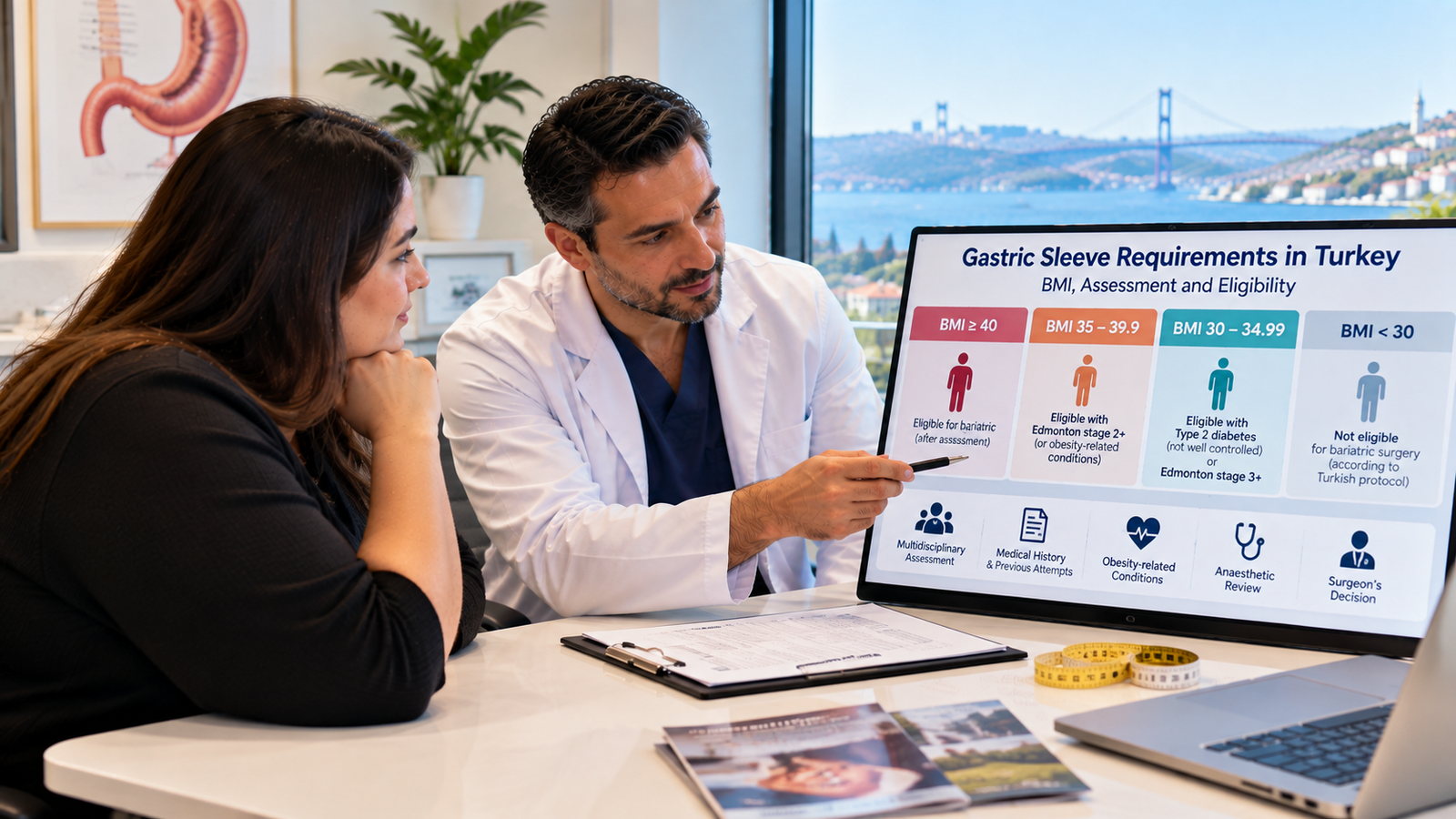
Gastric sleeve requirements in Turkey are not set by a travel package. The treating bariatric team has to decide whether surgery is medically appropriate after reviewing weight history, obesity-related disease, previous treatment, nutrition, mental health, anaesthetic risk and the findings of an in-person assessment. Turkey’s Ministry of Health updated its national obesity and metabolic surgery clinical protocol in 2026. For adults whose weight has not been controlled with lifestyle and other methods, the protocol lists bariatric-metabolic surgery eligibility at a body mass index of 40 kg/m² or higher; at 35–39.9 kg/m² with Edmonton stage 2 or higher; and at 30–34.99 kg/m² for people with type 2 diabetes that is not adequately controlled by other methods or Edmonton stage 3 or higher. The protocol states that bariatric-metabolic surgery should not be performed when body mass index is below 30 kg/m². Start with our Sleeve Gastrectomy guide and let the surgeon confirm eligibility before travel is fixed.
The Turkish Criteria Are More Specific Than A Simple BMI Cut-Off
The 2026 Turkish protocol combines body mass index with the severity of obesity-related health problems. That means two people with the same body mass index can have different eligibility depending on diabetes, sleep apnoea, cardiovascular disease, liver disease, functional limitations and other obesity-related effects.
A clinic should therefore explain which criterion you meet rather than saying only that your body mass index is “high enough.”
Body Mass Index 40 kg/m² Or Higher
The Turkish protocol lists adults with a body mass index of 40 kg/m² or higher among the groups eligible for bariatric-metabolic surgery after unsuccessful weight control with lifestyle and other methods.
This does not mean surgery is automatically safe or appropriate. The surgeon still has to assess operative risk, anatomy, previous surgery, current disease, medicines and the ability to complete long-term follow-up.
Body Mass Index 35–39.9 kg/m²
For adults in the 35–39.9 kg/m² range, the Turkish protocol links surgical eligibility to Edmonton stage 2 or higher. Edmonton stage 2 includes established obesity-related disease or moderate effects on daily function or wellbeing.
Examples in the protocol include conditions such as hypertension, type 2 diabetes, obstructive sleep apnoea and clinically significant fatty liver disease, but the treating team decides how the staging applies to an individual patient.
Body Mass Index 30–34.99 kg/m²
For adults in the 30–34.99 kg/m² range, the Turkish protocol is more selective. It includes people with type 2 diabetes whose blood glucose has not been adequately controlled by other methods, or people at Edmonton stage 3 or higher.
The protocol separately notes that 2022 international guidance allows surgery to be considered more broadly in selected people with this body mass index range when non-surgical methods do not achieve sufficient weight loss or improvement in metabolic disease. For treatment in Turkey, the current Turkish protocol and the treating team’s assessment remain the practical basis for eligibility.
Body Mass Index Below 30 kg/m²
The 2026 Turkish protocol states that bariatric-metabolic surgery should not be performed in people with a body mass index below 30 kg/m².
This is different from endoscopic or medical weight-management options, which have their own indications. A clinic should not relabel a non-surgical treatment as sleeve gastrectomy to avoid surgical criteria.
Previous Weight-Management Attempts Are Part Of The Assessment
The Turkish protocol places surgery after adequate attempts at lifestyle management and medical treatment when those approaches have not provided sufficient benefit. The purpose is not to make a patient repeatedly “prove failure,” but to confirm that obesity has been treated as a chronic disease and that reasonable non-surgical options have been considered.
Bring a clear history of previous diets, structured programmes, anti-obesity medicines, weight regain and the effects of obesity on your health.
Multidisciplinary Assessment Is A Core Requirement
The Turkish protocol describes obesity treatment as multidisciplinary. Assessment can involve general surgery, endocrinology, anaesthesiology, gastroenterology, psychiatry or psychology, nutrition and dietetics, and other specialties when a patient’s conditions require them.
The exact team depends on the case, but sleeve gastrectomy should not be confirmed only from a weight and height form.
Medical History And Obesity-Related Conditions Matter
The pre-operative review should cover previous operations, heart and lung disease, diabetes, sleep apnoea, liver disease, kidney function, reflux symptoms, medicines and possible endocrine causes of weight gain.
These findings can change whether surgery is appropriate, which operation is preferred, what tests are needed and how anaesthesia and postoperative monitoring are planned.
Nutrition And Deficiency Screening Come Before Surgery
Bariatric surgery changes food intake and creates long-term nutritional responsibilities. The team should review eating patterns, hydration, protein intake and relevant blood tests, then correct important deficiencies before surgery when necessary.
The patient also needs a realistic plan for staged eating, vitamin and mineral supplementation, blood monitoring and dietetic follow-up after returning home.
Mental-Health And Behavioural Assessment Is Not A Pass-Or-Fail Personality Test
The Turkish protocol includes psychiatric assessment because untreated major psychiatric illness, active substance dependence, eating behaviour and the ability to follow long-term care can affect safety and outcomes.
The protocol lists untreated major depression or psychosis and active drug or substance dependence among contraindication considerations. A finding can lead to treatment and postponement rather than a permanent refusal in every case.
Anaesthetic Fitness Has To Be Confirmed
Sleeve gastrectomy is an operation under general anaesthesia. The pre-anaesthetic assessment considers airway, heart and lung risk, clot risk, medicines, previous anaesthetic problems and other conditions that may change peri-operative care.
A condition that makes general anaesthesia unsafe can prevent or postpone surgery even if body mass index criteria are met.
Reflux Can Change The Procedure Choice
Meeting the weight criteria does not automatically mean sleeve gastrectomy is the best bariatric operation. Significant reflux, oesophageal findings or previous stomach surgery can change the discussion because different bariatric procedures affect reflux differently.
The surgeon and gastroenterology team may need additional tests before choosing sleeve gastrectomy rather than another operation.
Pregnancy Changes The Timing
Elective bariatric surgery is not planned during pregnancy. The Turkish protocol includes pregnancy testing when pregnancy is suspected and the result would affect pre-operative assessment.
If pregnancy is possible, discuss testing, medicines and future pregnancy planning with the treating team before travel.
Patients Under 18 Follow A Separate Pathway
The Turkish protocol has separate criteria for children and adolescents, including body mass index percentiles and obesity-related disease. Adult thresholds should not simply be applied to someone under 18.
Adolescent bariatric surgery requires age-appropriate multidisciplinary assessment, family or guardian involvement where legally required and a team experienced in paediatric obesity care.
What Should Be Confirmed Before You Book Travel?
- Which current Turkish eligibility criterion does the team believe I meet?
- What is my measured body mass index and Edmonton stage?
- Which obesity-related conditions affect the decision?
- What previous weight-management history does the team need?
- Which blood tests, imaging or endoscopy are required?
- Do reflux symptoms change the operation being considered?
- Which nutrition or vitamin deficiencies must be corrected first?
- What mental-health or behavioural assessment is required?
- Has the anaesthetic team reviewed my medical risks?
- What finding could postpone or cancel sleeve gastrectomy after I arrive?
How Turkelite Medcare Coordinates Eligibility Review
Turkelite Medcare is a patient coordination service, not the bariatric surgeon or hospital. We do not calculate eligibility as a booking decision, override the Turkish protocol or medically clear a patient for surgery.
Our role is to organise records, provider questions, appointments, travel timing and the return-home handover around the plan confirmed by the independent treating team. See patient services.
Frequently Asked Questions
What BMI Do You Need For Gastric Sleeve In Turkey?
The 2026 Turkish protocol lists adult surgical pathways at 40 kg/m² or higher, at 35–39.9 kg/m² with Edmonton stage 2 or higher, and in selected people at 30–34.99 kg/m² with uncontrolled type 2 diabetes or Edmonton stage 3 or higher.
Can You Get Gastric Sleeve In Turkey With A BMI Under 30?
The current Turkish protocol states that bariatric-metabolic surgery should not be performed below 30 kg/m².
Does Meeting The BMI Requirement Guarantee Surgery?
No. Eligibility also depends on medical, nutritional, psychological or behavioural, anaesthetic and surgical assessment.
Who Decides If I Qualify?
The independent treating bariatric team makes the clinical decision after reviewing the required information and examining you. A coordinator or travel package cannot make that decision.
Eligibility Comes Before Travel
The safest sequence is to confirm why you meet the current clinical criteria, complete the required assessment and understand what could change the plan before making non-refundable travel arrangements. Body mass index is one part of the decision, not the whole decision.
Sources and further reading
- NHS: What is weight loss surgery?
- NHS: Overweight and obesity in adults
- Republic of Türkiye Ministry of Health: International health tourism regulation
These sources support general patient information. Individual medical recommendations must come from the treating clinician.
View the related treatment area
This content is for general information and does not replace individual medical advice, diagnosis or treatment. Discuss treatment suitability, risks and recovery with a qualified healthcare professional.