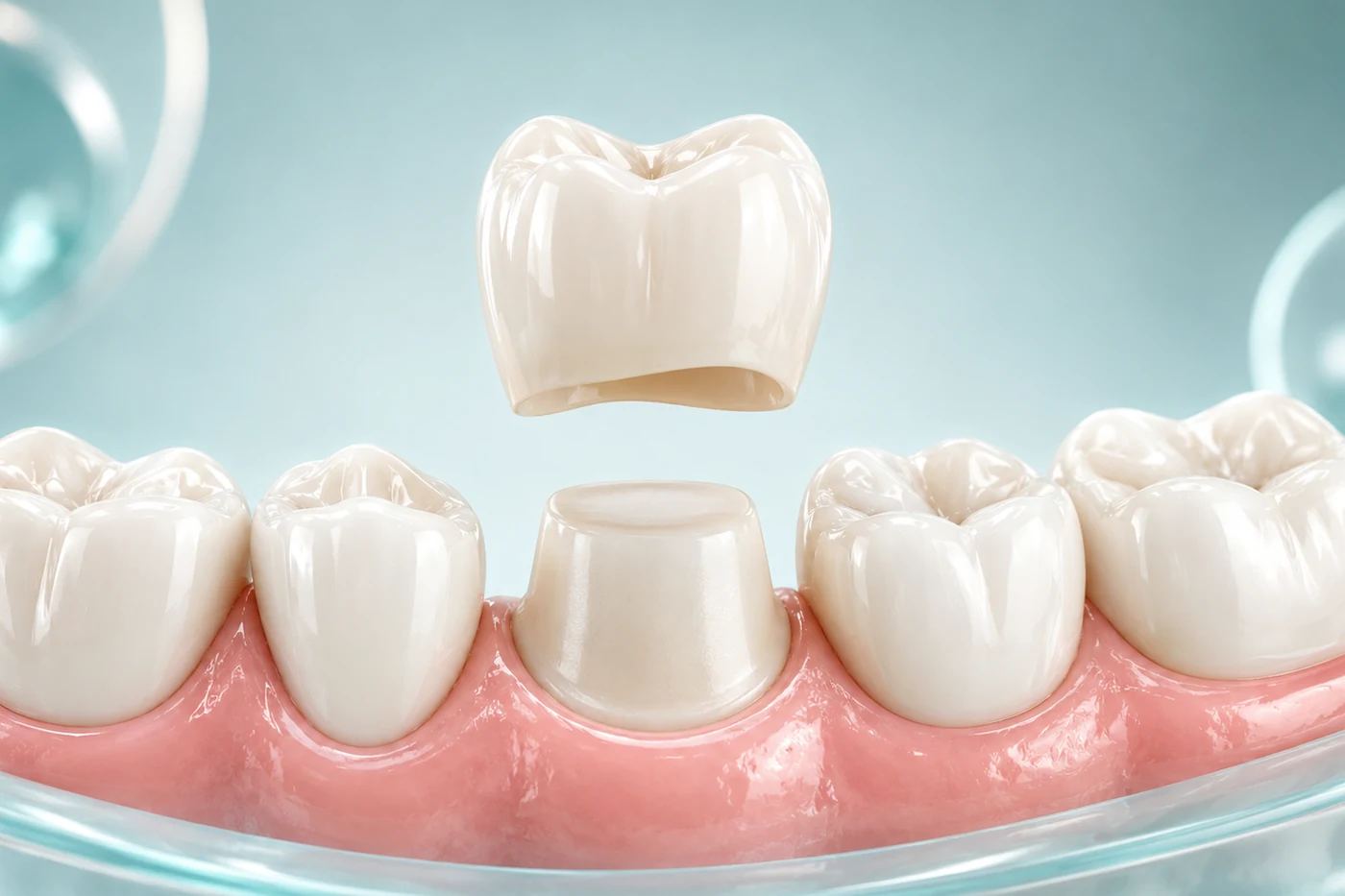
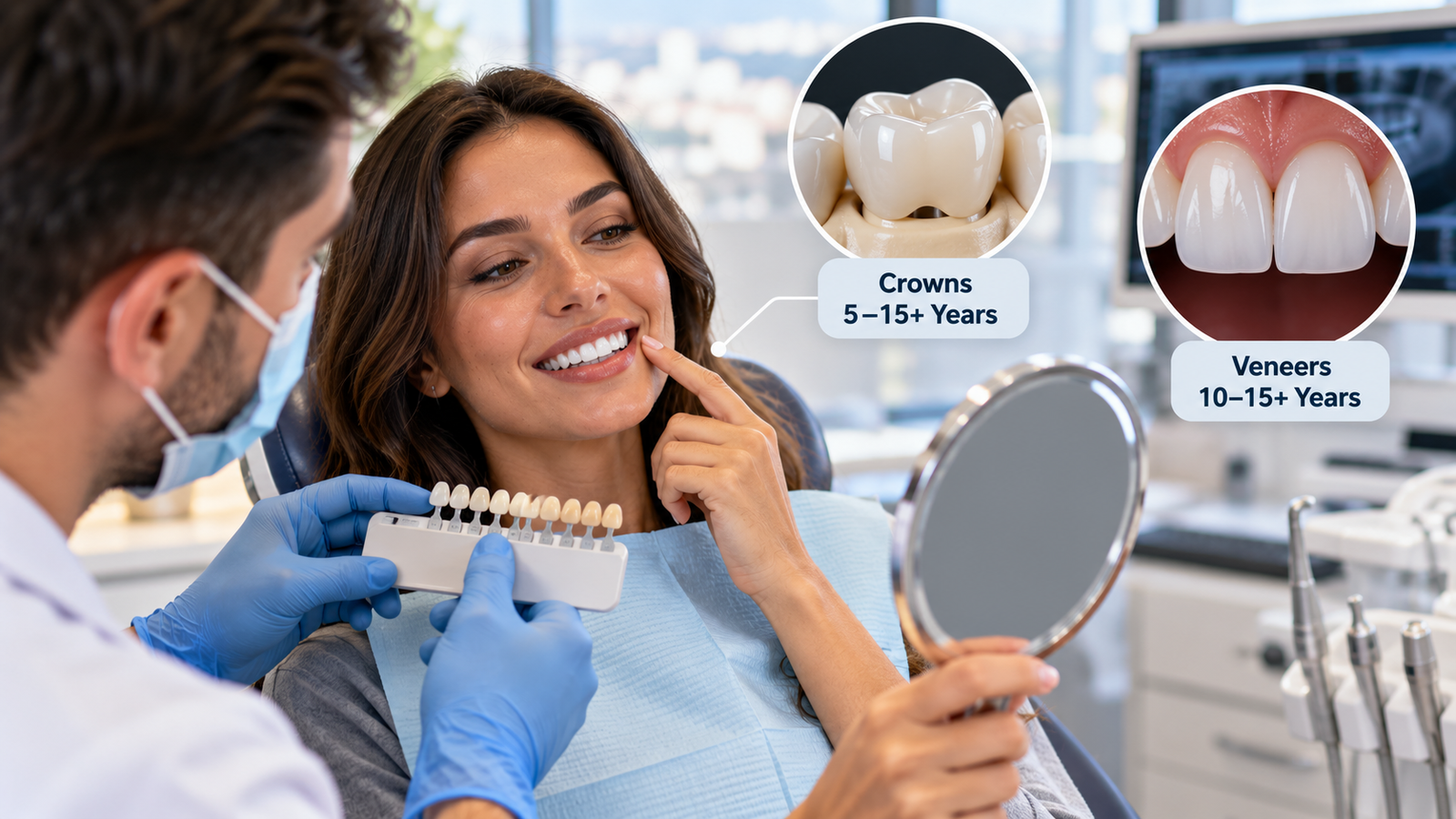
If you are asking how long do Turkey teeth last, the first thing to clarify is what “Turkey teeth” actually means in your treatment plan. It is not a clinical procedure or a material. The phrase is commonly used online for cosmetic dental work completed in Türkiye, but the restorations may be crowns, veneers or a mixture. Their longevity is not determined by the country where they were fitted. It depends on the restoration type, material, how much natural tooth remains, the quality of preparation and bonding or cementation, your bite, grinding habits, oral hygiene and follow-up. Start with our Dental Crowns page if crowns are being proposed, and confirm the exact restoration planned for every tooth.
How Long Do Turkey Teeth Last? There Is No Single Number
A useful answer needs to separate crowns from veneers. Modern tooth-supported crowns can have high medium-term survival, but results vary by ceramic system, tooth position and study design. A 2025 systematic review and meta-analysis of tooth-supported single crowns reported estimated five-year survival ranging from about 90% to 98.5% across different ceramic and metal-ceramic designs. That does not mean every crown lasts five years, or that it fails immediately afterwards. “Survival” means the restoration remained in service during the study period.
Veneers also show strong long-term survival in selected clinical studies. A 2021 systematic review of porcelain laminate veneers estimated cumulative survival at 95.5% at 10 years. Earlier reviews reported wider ranges because materials, preparation designs, bonding surfaces and definitions of failure differed between studies.
These figures should be treated as population evidence, not a warranty for an individual smile. A person with well-supported restorations, healthy gums, no destructive grinding and regular maintenance may have a different outcome from someone with heavily restored teeth, active decay, bruxism or limited follow-up.
Country Does Not Create A Different Dental Lifespan
A crown made and fitted in Türkiye is not biologically governed by a separate “Turkey teeth lifespan.” The clinically relevant questions are what restoration was used, what tooth it was placed on, how much sound tooth structure remained, how the bite was managed and how the restoration is maintained afterwards.
This matters because online marketing often reduces a complex treatment plan to the number of units and a package price. Two people can both say they received “Turkey teeth” while one has minimally prepared veneers on healthy front teeth and the other has full crowns on heavily restored teeth. Those are different starting conditions and should not be expected to follow the same maintenance or replacement timeline.
Ask for a written tooth-by-tooth record before treatment. It should identify which teeth receive crowns, which receive veneers, the material used and any teeth that already have fillings, root-canal treatment or other factors that may influence the prognosis. Our questions before booking guide can help organise these points before you travel.
What Makes A Dental Crown Last Longer Or Fail Earlier?
The crown is only one part of the system. The underlying tooth, the margin between tooth and restoration, the cement or bonding system and the way the crown meets the opposing teeth all matter. Research on tooth-supported crowns identifies technical and biological problems such as fracture, chipping, loss of retention, recurrent decay and endodontic complications as reasons restorations may need intervention.
Bruxism can also matter. Long-term clinical studies of ceramic restorations have found higher failure risk in patients with parafunctional habits such as grinding. That does not mean everyone who grinds will lose a crown. It means the clinician should recognise the risk, assess the bite and discuss whether protective strategies are appropriate.
A crown can also remain physically intact while the tooth underneath develops a problem. Decay at the margin, gum disease, fracture of the remaining tooth or a new root-canal problem may require treatment even if the ceramic itself has not broken. This is one reason a crown should not be thought of as a maintenance-free shell.
How Long Do Turkey Veneers Last?
Porcelain or ceramic veneers can remain in service for many years when they are properly selected, prepared, bonded and maintained. The 2021 systematic review mentioned above estimated 95.5% cumulative survival at 10 years across 6,500 porcelain laminate veneers. A separate long-term clinical study reported an estimated 10-year survival probability of 93.5% and found significantly higher failure risk with bruxism and non-vital teeth.
Survival does not mean every veneer remains completely unchanged. A veneer may stay in place but develop a chip, marginal change, surface wear or an aesthetic issue that needs polishing, repair or replacement. Studies also use different definitions of “success” and “survival,” so two papers can report different percentages without actually contradicting each other.
If your plan involves veneers rather than crowns, review the procedure separately on our Dental Veneers page. The amount of enamel available for bonding and the preparation design are clinically important and should be confirmed by the treating dentist.
Do Turkey Teeth Need Replacing?
Dental crowns and veneers are not lifetime body parts. They may eventually need repair, recementation or replacement, but there is no fixed year when every restoration must be changed. Replacement should be based on clinical findings, not on the age of the restoration alone.
A dentist may recommend intervention if a restoration fractures, repeatedly debonds, develops an unacceptable margin, has recurrent decay underneath, creates gum problems, no longer fits the bite or cannot be maintained satisfactorily. In some cases a small chip or surface problem can be repaired. In others, the restoration needs to be replaced. If the underlying tooth itself has failed, the treatment can become more extensive.
This is why “they last 10 years” is too simple. Ten-year survival data can be useful when discussing expectations, but they do not create an automatic ten-year replacement rule. A clinically sound restoration should not be removed simply because a calendar date has arrived, and a failing restoration should not be left in place because it is still “too new.”
Do Turkey Teeth Stain?
They can change in appearance, but the type of discoloration matters. Ceramic crowns and veneers generally have good colour stability, yet studies show that staining solutions, surface condition and long-term wear can produce measurable colour changes. Marginal discoloration has also been reported in clinical veneer studies.
A systematic review of ceramic veneers reported severe marginal discoloration in a small proportion of restorations, while another five-year review found marginal discoloration to be one of the more commonly recorded veneer complications. Long-term clinical research has also reported greater marginal discoloration among smokers. These findings do not mean a white ceramic crown will inevitably become visibly stained. They show that material, surface finish, margins and patient habits all matter.
The surrounding natural teeth can also change colour over time, which can make an unchanged restoration look different by comparison. Before whitening your natural teeth or using abrasive products, ask a dentist how the existing crowns or veneers are likely to respond. The goal is to protect the ceramic surface and avoid creating a new shade mismatch.
Coffee, Tea And Smoking Are Not The Whole Story
Dietary staining is only one part of the appearance of a restoration. Laboratory reviews of CAD/CAM ceramics show that coffee and other pigmented liquids can produce colour change under test conditions, while surface polishing or glazing affects how resistant the material is to staining. Laboratory exposure is not the same as years of normal drinking, so those tests should not be turned into a precise prediction for one patient.
More important clinically is the condition of the restoration surface and margin. A roughened or damaged surface can behave differently from a well-polished one. A visible dark line may also come from the margin, cement, underlying tooth or gum changes rather than from the ceramic itself.
If the appearance changes, have the restoration examined before assuming it needs replacement. Professional cleaning or polishing may help some surface stains, whereas a fractured, leaking or biologically compromised restoration needs a different plan.
Why Oral Hygiene Still Matters Around Crowns And Veneers
Neither a crown nor a veneer makes the tooth immune to decay or gum disease. Plaque can still collect around restoration margins, and the natural tooth remains biologically active. Good cleaning is therefore part of protecting the restoration and the supporting tissues.
Ask the treating dentist to show you how to clean around the margins and between restored teeth. If flossing technique, interdental brushes or another aid is recommended, make sure you can use it before you travel home. A restoration that looks excellent on the treatment day still depends on long-term maintenance.
Regular dental review is also important because early changes may be easier to manage than problems discovered after pain, fracture or visible movement develops. Your local dentist should know what restorations were placed and ideally have a copy of the treatment record and relevant images.
Bruxism Can Shorten The Useful Life Of Restorations
Grinding and clenching can place repeated heavy forces on ceramic restorations and the teeth supporting them. Long-term studies have linked bruxism with increased failure risk in ceramic restorations and porcelain veneers. The effect is not identical for every patient or material, but it is important enough to discuss before a large cosmetic treatment plan.
If you grind your teeth, tell the treating clinic before preparation begins. The dentist may want to assess wear patterns, jaw symptoms and bite contacts and discuss whether a protective appliance is appropriate after treatment. A night guard should be individually planned rather than copied from a generic online recommendation.
Do not assume that selecting the strongest-looking ceramic removes all mechanical risk. The restoration, tooth, cement, bite and opposing teeth function together. A material choice that is suitable for one person may not be the best option for another.
What To Get In Writing Before You Leave Türkiye
For international treatment, maintenance becomes easier when you return home with clear records. Ask for the name of the restoration on each tooth, the material or product family if available, which teeth had crowns versus veneers, whether any teeth had root-canal treatment, and any specific aftercare instructions.
You should also know who to contact if a crown comes loose, a veneer chips, your bite feels wrong or pain develops after you return home. Turkelite Medcare's patient services page explains how practical return-home handover can be coordinated around the treating provider's clinical plan.
Good records do not guarantee that a future dentist can repair every restoration, but they can make assessment easier and reduce uncertainty about what was originally placed.
Questions To Ask If Longevity Is Important To You
- Is each treated tooth receiving a crown, a veneer or another restoration?
- What material is planned, and why is it appropriate for this tooth and bite?
- How much natural tooth structure is expected to remain after preparation?
- Do I have signs of grinding or clenching that could affect the restorations?
- What maintenance and cleaning method is recommended around the margins?
- What problems can be repaired, and what problems would require replacement?
- Who reviews the restorations after I return home?
- What records will I receive for my local dentist?
These questions are more useful than asking only for a promised lifespan. A responsible treatment plan should explain the condition of the teeth, expected maintenance and the factors that could shorten or extend the useful life of the restorations.
How Turkelite Medcare Coordinates Long-Term Dental Planning
Turkelite Medcare is a patient coordination service, not the treating dental clinic. We do not promise how many years a crown or veneer will last, diagnose a failing restoration or decide whether a restoration should be replaced. Those decisions belong to the independent treating dentist after examination.
Our role is to help keep the practical journey connected to the confirmed clinical plan. That can include coordinating provider communication, helping organise questions about crown or veneer type, arranging travel around appointments and keeping the return-home handover clear. If a provider gives a longevity claim, ask what restoration, evidence and maintenance assumptions that claim is based on.
For the wider dental pathway, see our Dental treatment page. If you want help organising an independent provider review and travel around a clinician-confirmed plan, use the private enquiry page.
Frequently Asked Questions
What Is The Typical Lifespan Of “Turkey Teeth”?
There is no single lifespan for “Turkey teeth” because the term can refer to crowns, veneers or mixed restorations. Modern crown studies report high five-year survival, while porcelain veneer reviews report strong survival around 10 years in selected patients. Your own result depends on the tooth, restoration design, material, bite, grinding, hygiene and follow-up rather than the country alone.
How Long Do Turkey Veneers Last?
A 2021 systematic review estimated 95.5% cumulative survival for porcelain laminate veneers at 10 years. That is population-level evidence, not a guarantee for one person. Veneer preparation, the amount of enamel available for bonding, bruxism, tooth vitality and maintenance can all influence the outcome.
Do Turkey Teeth Need Replacing Every 10 Years?
No. Ten years is not an automatic replacement date. A crown or veneer may need intervention earlier if it fractures, debonds, develops decay or another clinical problem, while a healthy restoration may remain in service longer. Replacement should be based on examination and clinical need.
Do Turkey Teeth Stain From Coffee Or Tea?
Ceramic restorations can experience colour change, and laboratory studies show that coffee and other pigmented liquids can affect some materials. Clinical studies also report marginal discoloration in a proportion of veneers. Surface condition, material, margins, smoking and surrounding natural-tooth colour all influence how the smile looks over time.
Can A Stained Crown Or Veneer Be Whitened?
Do not assume that tooth-whitening products will change a crown or veneer in the same way as natural enamel. If the shade looks different, a dentist should first identify whether the issue is surface stain, the margin, the underlying tooth or a change in the surrounding natural teeth. The solution may be cleaning, polishing, repair or replacement depending on the cause.
What Happens If A Crown Or Veneer Breaks After I Return Home?
Contact the treating clinic and arrange a dental assessment. A minor chip may be repairable, while a larger fracture, repeated debonding, decay or a problem with the underlying tooth may require replacement or additional treatment. Keep your original treatment records so a local dentist can understand what was placed.
Think In Terms Of Maintenance, Not A Countdown
The better question is not simply how many years “Turkey teeth” last. It is what has been placed, why it was chosen, how the supporting teeth are expected to behave and how the restorations will be maintained after you return home. Longevity is a clinical outcome, not a package promise.
If you want help coordinating provider communication and travel around a clinician-confirmed dental plan, Start your private enquiry.
This content is for general information and does not replace individual medical advice, diagnosis or treatment. Discuss treatment suitability, risks and recovery with a qualified healthcare professional.