
Quick answer
Revision Rhinoplasty in Turkey: Secondary Nose Surgery Guide: the right answer depends on diagnosis, the actual treatment plan and individual risk factors. Use this article to prepare for consultation, then have the treating clinic confirm timing, medicines, suitability and travel planning for your case.
- Do not confirm treatment before adequate clinical assessment.
- Get scope, risks, aftercare and return-travel criteria in writing.
- For care in Turkey, verify the authorised facility and responsible clinician.
Revision rhinoplasty in Turkey means operating on a nose that has already undergone rhinoplasty. The goal may be cosmetic, functional or both, but revision is usually more technically demanding because the surgeon is working with scar tissue, altered cartilage, previous structural changes and sometimes reduced tissue quality. A 2026 evidence review describes revision rhinoplasty as one of the most challenging procedures in facial plastic surgery. Start with our Rhinoplasty page and make sure the consultation addresses both appearance and breathing.
Why Patients Consider Revision Rhinoplasty
Reasons can include persistent asymmetry, an over-reduced or under-corrected bridge, tip problems, contour irregularities, visible grafts, scar-related distortion, nasal obstruction or a result that changed during healing.
The first task is to separate a true structural problem from normal postoperative swelling or a result that has not finished maturing.
Why Revision Is More Difficult Than Primary Rhinoplasty
Previous surgery changes the normal tissue planes. Scar tissue can make dissection more difficult, cartilage may already have been removed or weakened, and the skin-soft-tissue envelope may have altered blood supply or reduced flexibility.
A 2026 review specifically highlights the importance of protecting compromised nasal skin and soft tissue in revision cases because prior surgery can leave reduced vascularity, scarring and poorer tissue quality.
Appearance And Breathing Must Be Assessed Together
Revision is not only about external shape. Previous rhinoplasty can leave or reveal problems involving the septum, internal or external nasal valves and structural support.
Professional plastic-surgery guidance notes that revision cases may need correction of septal deviation, valve collapse or deficient cartilage while also addressing appearance.
What Records Help Before A Revision Consultation?
- The date and details of previous rhinoplasty operations.
- Previous operative notes if available.
- Before-and-after photographs from earlier surgery.
- Details of any septal, ear or rib cartilage already used.
- Current breathing symptoms and when they began.
- Records of infection, trauma, steroid injections or other postoperative treatment.
How Long Should You Wait Before Revision Rhinoplasty?
There is no single timing rule for every case. The nose can continue to refine for many months after primary rhinoplasty, and professional recovery guidance notes that final contour may take up to a year or longer to settle.
Elective revision is therefore often delayed until swelling and scar behaviour are stable enough for meaningful assessment. Earlier intervention can sometimes be considered for specific functional or structural problems, so timing should come from the revision surgeon rather than a fixed internet rule.
Why Cartilage Grafts Are Common In Revision Surgery
Revision rhinoplasty often needs new structural support because cartilage was removed, weakened or reshaped during the first operation. The surgeon may use remaining septal cartilage, ear cartilage or rib cartilage depending on what is available and what must be reconstructed.
The American Society of Plastic Surgeons notes that septal cartilage may be insufficient in revision cases, which can make ear or rib cartilage necessary for selected reconstructions.
What Problems Can Grafts Address?
Cartilage grafts can be used to rebuild the bridge, support the tip, improve nasal valves, smooth contour problems or replace missing structural support.
The choice of graft source has its own trade-offs, including donor-site surgery, available quantity, shape and the type of support required.
Open Or Closed Revision Rhinoplasty?
Revision can be performed through an open or closed approach. The choice depends on the problem, scar tissue, need for exposure, grafting and the surgeon’s technique.
A more complex case does not automatically require one approach, and the incision choice should follow the reconstruction that is actually needed.
Can Revision Rhinoplasty Fix Everything From The First Surgery?
No surgeon can guarantee complete correction. Scar tissue can recur, skin may not contract or redrape as expected, cartilage availability can be limited and some changes may create new trade-offs.
Professional guidance specifically warns that revision rhinoplasty has limits and that patients should understand what can realistically be improved and what may remain.
What Are The Main Risks?
Revision rhinoplasty carries the general risks of rhinoplasty, including bleeding, infection, poor wound healing, changes in sensation, breathing difficulty, septal perforation, swelling, scarring, unsatisfactory appearance and the possibility of further revision.
Because revision anatomy is altered, the surgeon should also explain any additional risk related to scar tissue, graft harvesting and the condition of the skin-soft-tissue envelope.
Recovery After Revision Rhinoplasty
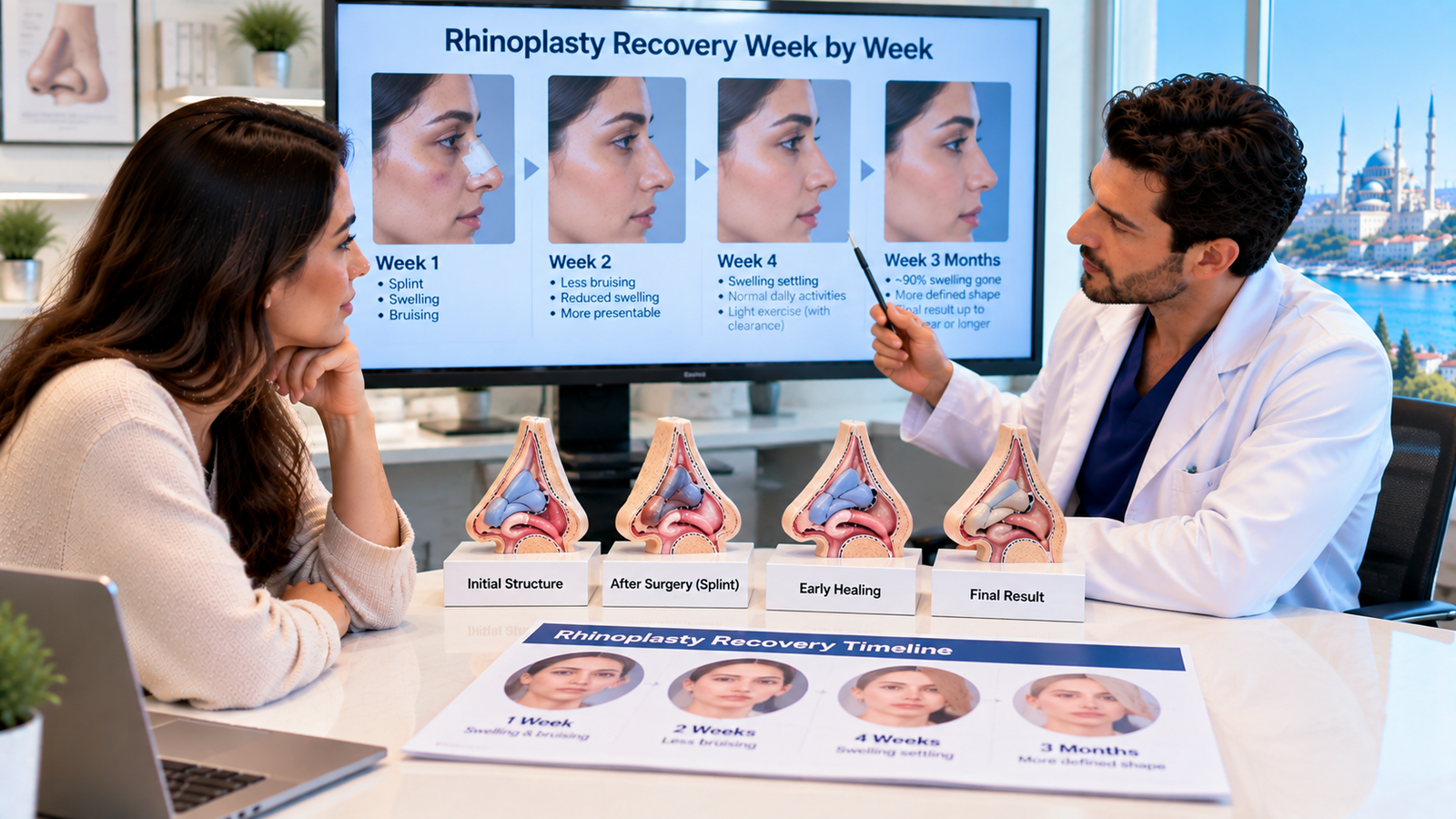
Early recovery can include swelling, bruising, congestion, splints or dressings and activity restrictions similar to primary rhinoplasty, but the exact course can be less predictable in a previously operated nose.
Do not judge the final result during the travel window. Swelling can continue to change for months, especially around the nasal tip.
Planning Revision Nose Surgery In Turkey
Revision nose surgery in Turkey should be planned around the surgeon and the reconstruction, not around a package. Ask how much of the surgeon’s work involves revision rhinoplasty, whether functional airway assessment is part of the consultation and what graft sources may be needed.
Also ask which facility will be used, who provides anaesthesia, how early postoperative reviews are organised and what must be checked before return travel.
Questions To Ask A Revision Rhinoplasty Surgeon
- What exact cosmetic and functional problems do you identify?
- Which findings are still likely to change with more healing time?
- What can realistically be improved and what may remain?
- Do I have enough septal cartilage, or might ear or rib cartilage be needed?
- How will you assess my nasal airway and valve function?
- Will the revision be open or closed, and why?
- What scars or tissue changes from my first surgery increase complexity?
- What are the important risks in my specific revision?
- When can the first meaningful result review take place?
- Who provides clinical follow-up after I return home?
How Turkelite Medcare Coordinates Revision Rhinoplasty
Turkelite Medcare is a patient coordination service, not the operating plastic surgeon. We do not decide whether revision is necessary, which graft should be used or what cosmetic change is achievable.
Our role is to organise previous records, provider questions, appointments, travel and the return-home follow-up handover around the surgical plan confirmed by the treating surgeon. See patient services.
Frequently Asked Questions
Is Revision Rhinoplasty Harder Than A First Rhinoplasty?
Usually it is more technically complex because of scar tissue, altered anatomy and possible loss of cartilage or tissue quality.
How Long After A First Rhinoplasty Can Revision Be Done?
There is no universal date. Many elective revisions are delayed until swelling and scar maturation allow reliable assessment, while specific functional problems may justify a different timeline.
Will Revision Rhinoplasty Need Rib Cartilage?
Not always. Septal or ear cartilage may be sufficient, but rib cartilage can be considered when larger or stronger structural grafts are needed and other donor cartilage is inadequate.
Can Revision Rhinoplasty Improve Breathing?
It can in selected patients when breathing difficulty is caused by a correctable structural problem such as septal deviation or nasal-valve collapse.
A Revision Plan Should Reconstruct What Is Missing, Not Simply Repeat The First Operation
The useful question is not whether a second rhinoplasty can “redo” the first result. It is what anatomy has changed, what tissue remains, what function must be protected and what improvement is realistic after previous surgery.
Sources and further reading
- NHS: Before you have a cosmetic procedure
- NHS: Choosing who will do your cosmetic procedure
- Republic of Türkiye Ministry of Health: International health tourism regulation
These sources support general patient information. Individual medical recommendations must come from the treating clinician.
View the related treatment area
This content is for general information and does not replace individual medical advice, diagnosis or treatment. Discuss treatment suitability, risks and recovery with a qualified healthcare professional.