Quick answer
Rhinoplasty Recovery Week by Week: Healing Timeline: the right answer depends on diagnosis, the actual treatment plan and individual risk factors. Use this article to prepare for consultation, then have the treating clinic confirm timing, medicines, suitability and travel planning for your case.
- Do not confirm treatment before adequate clinical assessment.
- Get scope, risks, aftercare and return-travel criteria in writing.
- For care in Turkey, verify the authorised facility and responsible clinician.
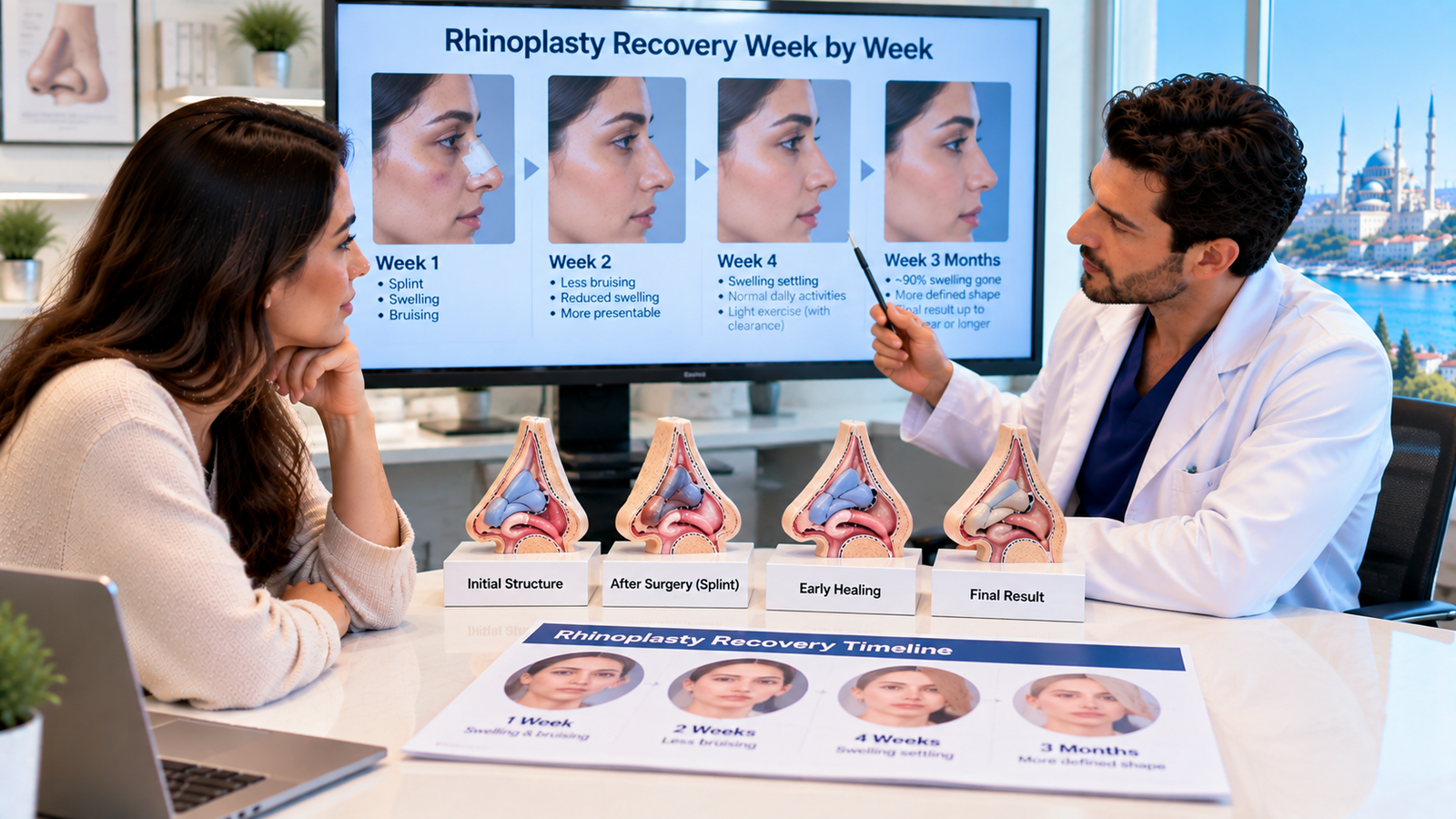
Rhinoplasty recovery week by week is easier to understand when early recovery and final healing are treated as different milestones. A splint may come off within the first one or two weeks, but swelling can continue for months and the final nasal contour may take about a year or longer to refine. Cleveland Clinic notes that around 90% of swelling may be gone by three months, while the American Society of Plastic Surgeons states that final contour can continue refining for up to a year. Start with our Rhinoplasty page and use the surgeon’s own instructions as the final authority for your recovery.
The First 24 To 48 Hours: Swelling, Congestion And Protection
During the first 24 to 48 hours, swelling, nasal congestion, pressure and small amounts of drainage can occur. If internal packing is used, Cleveland Clinic notes that it is commonly removed within 24 to 48 hours according to the surgeon’s instructions.
Keep the head elevated, protect the nose from pressure or impact and follow the prescribed wound and medication plan. Do not blow your nose unless the surgeon has specifically said it is safe.
Days 3 To 7: Bruising And Swelling Are Still Visible
During days 3 to 7, swelling and bruising around the nose and eyes may still be obvious but should gradually begin to improve. Light walking is generally encouraged, while strenuous activity is avoided because it can increase swelling or bleeding.
External sutures, when used, may be removed around the end of the first week. The exact timing depends on the surgical technique and the surgeon’s protocol.
End Of The First Week: Splint Removal May Happen
A nasal splint commonly remains in place for at least several days and may be worn for one to two weeks. Johns Hopkins notes that an external splint is often kept for at least 5 days, while Cleveland Clinic describes splint use for one or two weeks.
Many people can return to school or desk-based work around one to two weeks, but visible swelling, bruising and congestion can still be present.
Week 2: You May Look More Presentable Socially, But You Are Not Fully Healed
By the second week, bruising is often substantially improved and the face usually looks less swollen. Some patients feel ready for social activity or work, depending on the type of work and how visible the remaining swelling is.
The nose is still healing internally and externally. Avoid assuming that looking better means the bones, cartilage and soft tissues are ready for unrestricted exercise or impact.
Weeks 2 To 3: Nose Blowing May Still Be Restricted
Johns Hopkins advises avoiding nose blowing for two to three weeks after rhinoplasty. The surgeon may provide a different instruction based on the procedure, internal work and healing findings.
If congestion is uncomfortable, ask what saline or other nasal care is allowed instead of forcefully clearing the nose.
Weeks 3 To 4: Swelling Continues To Settle
During weeks 3 to 4, the nose usually looks more settled, but swelling remains normal. The tip can stay more swollen than the bridge, especially after more extensive tip work.
Daily activities may feel easier, but exercise restrictions still depend on the operation and surgeon. Do not use appearance alone to decide that the nose is ready for heavy exercise.
Weeks 4 To 6: Light Exercise May Resume With Clearance
Cleveland Clinic states that light exercise can often resume within four to six weeks and that heavy lifting should be avoided for four to six weeks. The exact timing should be confirmed by the treating surgeon.
Contact sports or activities with a meaningful risk of impact to the nose usually need a more cautious return because nasal bones and cartilage remain vulnerable while healing.
Around 3 Months: Most Swelling May Be Gone, But Refinement Continues
Cleveland Clinic reports that about 90% of swelling may be gone by three months. That still leaves residual swelling that can affect fine details, especially around the tip.
At this stage, photographs may look much closer to the expected result, but the result should still not be treated as completely final.
Months 6 To 12: The Nose Continues To Refine
Between six and 12 months, smaller changes continue as residual swelling settles and the skin and soft tissues adapt to the new framework. The tip is often among the last areas to refine.
The American Society of Plastic Surgeons notes that final nasal contour can take up to a year to fully refine, and swelling may fluctuate during that period.
12 Months And Beyond: Some Patients Continue To See Small Changes
Some patients continue to notice minor refinement after 12 months. An American Society of Plastic Surgeons recovery article notes that full healing can take one to two years in some cases.
This is one reason revision decisions should not be based only on early swelling or temporary asymmetry unless there is a specific functional or structural problem that needs earlier assessment.
Why The Nose Can Look Uneven During Healing
Swelling does not always disappear symmetrically. Cleveland Clinic notes that one side can swell differently from the other during the first weeks, which can temporarily make the nose appear crooked.
Persistent or worsening asymmetry still deserves review, but early uneven swelling alone does not prove that the final result is asymmetric.
Glasses, Pressure And Accidental Impact
Pressure on the nasal bridge can matter while the bones and cartilage are healing. Cleveland Clinic advises avoiding excessive pressure from eyeglasses or sunglasses during the early recovery period.
Ask the surgeon how glasses should be supported and when normal bridge pressure is safe again, especially if nasal bones were repositioned.
When Can You Fly During Rhinoplasty Recovery?
Fitness to fly is a separate decision from looking socially recovered. The treating surgeon should assess bleeding, swelling, pain control, wound status, congestion, mobility and any individual medical risks before return travel.
Do not assume that splint removal or return to desk work automatically means you are cleared for an international flight.
Warning Signs That Need Prompt Medical Review
Johns Hopkins advises contacting the surgical team for unexpected changes such as a fever above 101 degrees Fahrenheit, which is about 38.3 degrees Celsius, excessive bleeding, uncontrolled pain, a skin rash or visual disturbance.
Severe breathing difficulty, rapidly worsening swelling or another urgent symptom should be assessed promptly rather than waiting for a routine remote review.
Questions To Ask Before You Travel Home
- When will my splint and any external sutures be removed?
- When can I blow my nose safely?
- When can I wear glasses normally on the nasal bridge?
- When can I restart light exercise?
- When can I return to heavy exercise or contact activity?
- What level of swelling or asymmetry is still expected?
- Which symptoms require urgent review?
- When do you consider me fit for the return flight?
- When should I send photographs for follow-up?
- When can the result be judged meaningfully?
How Turkelite Medcare Coordinates Rhinoplasty Recovery
Turkelite Medcare is a patient coordination service, not the operating plastic surgeon. We do not decide when splints come off, when exercise can restart or when a patient is medically fit to fly.
Our role is to organise provider questions, appointments, travel, records and the return-home follow-up handover around the recovery plan confirmed by the treating surgeon. See patient services.
Frequently Asked Questions
What Is The First Week Of Rhinoplasty Recovery Like?
Swelling, bruising, congestion and a splint are common. Activity is limited, and the nose needs protection from pressure, impact and strenuous effort.
When Can I Return To Work After A Nose Job?
Many patients return to work or school in about one to two weeks, but the timing depends on the type of work, visible swelling and the surgeon’s advice.
How Much Swelling Is Left At 3 Months?
Cleveland Clinic reports that about 90% of swelling may be gone by three months, while fine swelling can remain and continue improving afterward.
When Is The Final Rhinoplasty Result Visible?
Final refinement often takes around a year, and some patients continue to heal for longer. Early appearance should not be treated as the final result.
Recovery Is Fastest At The Beginning, But Refinement Is Slow
The first few weeks bring the biggest practical changes: splint removal, less bruising, easier daily activity and gradual return to work. The final shape develops much more slowly, so week-by-week recovery should be judged by healing milestones rather than by expecting the nose to look final early.
Sources and further reading
- NHS: Before you have a cosmetic procedure
- NHS: Choosing who will do your cosmetic procedure
- Republic of Türkiye Ministry of Health: International health tourism regulation
These sources support general patient information. Individual medical recommendations must come from the treating clinician.
View the related treatment area
This content is for general information and does not replace individual medical advice, diagnosis or treatment. Discuss treatment suitability, risks and recovery with a qualified healthcare professional.